


Editorial & Legal Accuracy Notice (Louisiana)
This blog contains general legal and safety information and is not legal advice. Laws and deadlines can change, and outcomes depend on specific facts.
Last reviewed / updated: March, 2026
Reviewed, updated, and authored by: Stephen Babcock, Louisiana injury lawyer
This guide explains how traumatic brain injury claims are proven in Louisiana, with a focus on documentation and evidence that tends to matter when symptoms are disputed.
A concussion is a type of traumatic brain injury, and symptoms can involve sleep, focus, mood, or balance. The CDC’s overview of mild TBI and concussion explains that a concussion can happen from a hit to the body that makes the head and brain move quickly. That detail matters in claims because you may have real symptoms before you can describe them clearly.
When a claim turns into a proof fight, we start with a simple plan and build from the first clean record. We are not built for volume. We are built for leverage. Speed + evidence preservation + insurer-insider knowledge + trial-ready preparation = The Babcock Benefit. In traumatic brain injury claims, leverage comes from showing how symptoms changed real-world function over time.
If you are inside the first 72 hours, call (225) 500-5000 or use the free case review form before evidence changes.
Firm links: Client Reviews | Contact | Locations
If you want a print-friendly version, Download the printable toolkit (PDF). It compiles both infographics and the checklists from this page.
What Is a Traumatic Brain Injury (TBI) Claim in Louisiana?
A traumatic brain injury claim is a personal injury claim where you seek damages for brain-related symptoms after an incident caused by someone else’s fault. Strong claims connect the event to symptoms, the symptoms to daily limits, and the limits to real losses using consistent records.
- Event proof: how the crash or incident happened
- Injury proof: symptoms, diagnosis, and treatment records
- Causation proof: why the event explains the symptoms
- Damage proof: how the injury changed work, home, and life
The National Institute of Neurological Disorders and Stroke describes traumatic brain injury as a disruption in brain function caused by an external force. Even when the label is “mild,” insurers often argue the symptoms are vague or unrelated, so organization matters. If you want the practice-area overview, start with our Baton Rouge brain injury lawyer page and then use the checklists below to build your file.
Many TBI claims start after a vehicle collision, so it can help to understand the early steps that apply to most injury cases on our car accident page. That is especially true when property damage photos look “minor” but symptoms do not match the story the insurer wants to tell.
What Should You Do in the First 72 Hours After a Possible TBI?
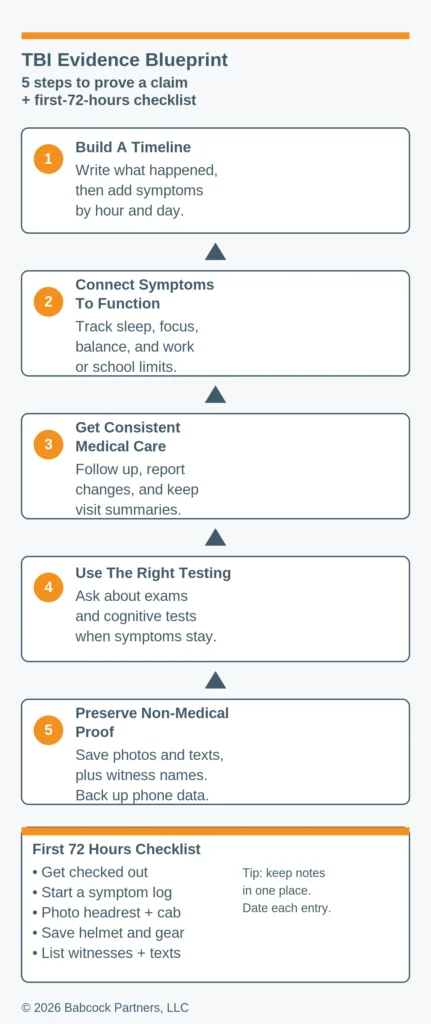
In the first 72 hours, prioritize safety, medical evaluation, and preserving proof before it disappears. A dated symptom log and scene documentation often matter more than a perfect explanation on day one.
- Get medical evaluation and follow discharge instructions.
- Write down symptoms and when they started.
- Photograph the scene, the vehicle, and safety features.
- Save names, numbers, and any video sources.
- Keep all papers, portal notes, and work or school messages.
The CDC’s mild TBI discharge instructions emphasize monitoring symptoms and following medical guidance after a concussion. This is why we treat the first 72 hours as evidence triage, because memory is fresh and physical proof is still available. If the insurer later questions timing, your early notes can anchor the timeline.
Medical Red Flags To Treat as Emergencies
Some head-injury symptoms need immediate care, even if the crash seemed minor. The CDC’s danger signs guidance is a useful baseline for when to call 911 or go to the ER.
- Worsening headache, repeated vomiting, or increasing confusion
- Weakness, numbness, slurred speech, or seizures
- Unequal pupils, loss of consciousness, or unusual behavior changes
- Severe neck pain with dizziness after a high-force impact
Non-Medical Evidence People Forget To Save
Non-medical evidence can disappear before your first follow-up visit. Saving it early helps connect the event to the injury when the defense tries to reduce the crash to a “bump.”
- Photos of the headrest, airbags, seat belt marks, and interior contact points
- Dashcam footage, nearby business video, and 911 call details
- Vehicle repair estimates, tow invoices, and rental paperwork
- Texts with witnesses and your immediate post-crash messages
How Do You Build a Timeline That Holds Up in a TBI Claim?
A timeline holds up when it is simple, dated, and tied to records an adjuster can verify. You are not trying to write a novel; you are trying to show a clean sequence of changes from “before” to “after.”
| Time | What Happened | Symptoms / Limits | Record That Supports It |
|---|---|---|---|
| Day 0 | Crash details | Headache, dizziness | Photos, report number |
| Day 1-3 | First evaluation | Sleep, light sensitivity | Visit summary |
| Week 1-4 | Follow-up care | Work restrictions | Work note, portal messages |
Timeline Builder tip: Put each symptom next to a date, a real-life example, and one supporting record. If you cannot point to a record, write down what you can request next.
- Use plain words you would say to a friend, then repeat the same words to providers.
- Save appointment summaries and after-visit notes in one folder.
- Ask your employer or school for written accommodations when you need them.
What Tests and Records Matter When Imaging Is Normal?
Normal CT or MRI imaging does not automatically end a TBI claim, because providers use symptoms and exams to evaluate concussion. The goal is to collect the records that show what your clinician observed and what you reported over time.
- Emergency or urgent care notes and neuro exam findings
- Follow-up visit summaries that track symptom changes
- Cognitive screening or neuropsychological testing when recommended
- Vestibular, vision, or balance evaluations when dizziness persists
- Therapy plans and progress notes tied to functional limits
MedlinePlus concussion testing guidance explains that imaging tests cannot show a concussion, even though providers may use CT or MRI to look for more serious injuries. Cleveland Clinic’s concussion overview also notes that imaging cannot diagnose a concussion, which is why the visit notes and exam findings matter.
The Eunice Kennedy Shriver National Institute of Child Health and Human Development describes diagnostic tools that can include exam findings and neuropsychological evaluation when appropriate. Mayo Clinic’s concussion overview describes symptoms that can affect thinking, sleep, and mood, which is why follow-up records can be as important as the first visit.
How Do Symptoms Translate Into Real-World Losses?
Insurers pay attention when symptoms are tied to concrete limitations like missed work, reduced driving, or trouble with screens. A short, consistent record usually beats a long story that changes each time.
- Work limits: missed shifts, reduced hours, or written accommodations
- Home limits: childcare, errands, and household tasks you cannot do
- Driving and screen tolerance: triggers that worsen symptoms
- Sleep and mood changes: fatigue, irritability, and concentration issues
The Johns Hopkins Medicine concussion overview describes a wide range of concussion symptoms, including cognitive and emotional changes. The CDC’s symptom guidance also lists symptoms that affect daily function, which helps explain why work notes and family observations can matter in a claim.
Keep documentation honest and specific. For example, write “I left work early because noise triggered a headache” and save the message, timecard, or calendar entry that matches it.
What Defense Arguments Do Insurers Use in TBI Cases?
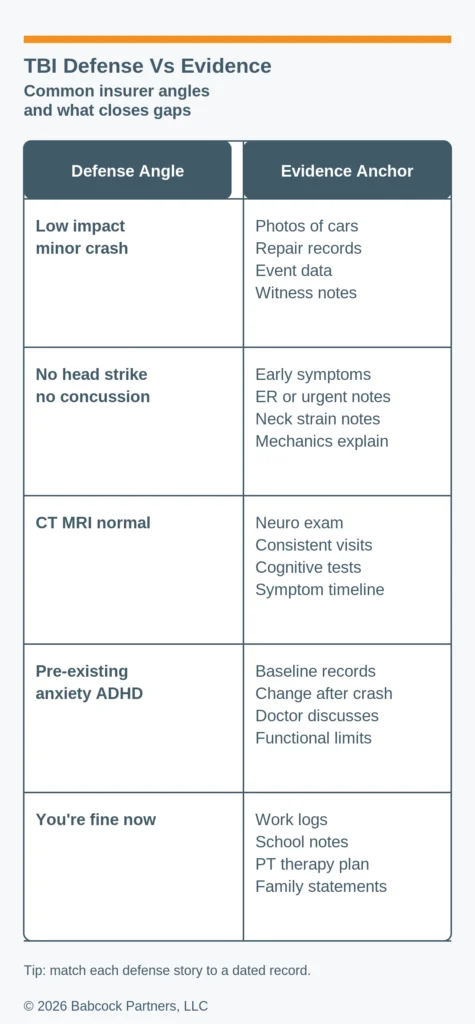
Insurance defenses in TBI cases usually attack causation and credibility, not just the diagnosis. You can reduce that pressure by matching each defense story to a dated record.
| Common Defense Angle | Evidence Anchor That Helps |
|---|---|
| “Low impact, so no TBI.” | Photos, repair estimates, witness statements, and early symptom notes |
| “No head strike.” | Mechanism explanation, neck symptoms, and consistent clinician notes |
| “Imaging was normal.” | Neuro exams, follow-up notes, and appropriate testing when needed |
| “It’s pre-existing.” | Baseline records and a before/after function timeline |
| “You’re fine now.” | Work and school records, therapy notes, and ongoing symptom logs |
Defense Audit tip: The Louisiana Department of Insurance consumer guide explains that an adjuster will examine damage and talk with you after a claim. That is what we mean by leverage against insurer tactics, because the first conversation often shapes how the adjuster frames causation.
- Do not guess about speed, distance, or what “must have happened.”
- Answer what you know, and keep the rest for your timeline and records.
- Save every message about work limits, appointments, and symptom changes.
What we see in practice
We see many TBI files where the first medical record is thin, then symptoms get described later, and the insurer calls the story “inconsistent.” We also see good cases weakened when people stop follow-up care after a brief improvement, then return weeks later with a flare that looks unexplained.
- Gaps in care often become “gaps in proof.”
- Unmatched dates make it easy to challenge causation.
- Short, steady documentation usually outperforms long, changing narratives.
When we review a timeline early, we can often spot the missing records and fix the proof gaps before they harden into defense talking points. We also see that simple, dated notes from family or coworkers can help explain day-to-day changes when symptoms are not visible in a photo.
When Should You Talk to a Lawyer About a TBI Claim?
You should talk to a lawyer when evidence is at risk, symptoms are evolving, or an insurer starts pushing for a quick closure. The earlier you set a plan for records and deadlines, the easier it is to avoid proof gaps later.
- You have worsening symptoms, missed work, or new restrictions
- The insurer questions causation, demands “proof,” or minimizes the crash
- You are unsure what records to request or how to organize them
- The crash involved a commercial vehicle with additional evidence issues
If a commercial vehicle is involved, our truck accident page explains why company logs, maintenance records, and electronic data can become important quickly. For practice-level TBI guidance, you can read our brain injury case page and then use the timeline and defense audit tools above.
If you want a print-friendly version, Download the printable toolkit (PDF). It includes the evidence blueprint and defense-audit table so you can keep your documentation consistent.
Louisiana Law Snapshot (Updated 2026)
Louisiana uses a two-year prescriptive period for many injury claims, and missing that deadline can end the case before the facts are heard. Louisiana also applies comparative fault rules that can reduce recovery and, in some cases, bar it.
| Rule | What It Means for a TBI Claim |
|---|---|
| Two-year delictual prescription | Louisiana Civil Code article 3493.1 states that delictual actions are subject to a liberative prescription of two years, running from the day injury or damage is sustained. |
| Comparative fault + 51% bar (effective Jan. 1, 2026) | Louisiana Civil Code article 2323 provides that damages are reduced by your percentage of fault and bars recovery if your fault is 51% or more. |
Talk to a lawyer quickly if fault is disputed, if there is video that may be overwritten, or if symptoms are changing week to week. Those are the situations where early documentation can make or break causation.
Free Case Review: TBI Claim Leverage Starts With Evidence
We are not built for volume. We are built for leverage. We use the Babcock Benefit approach to organize evidence fast, spot proof gaps early, and prepare each case as if it may have to be tried.
Call (225) 500-5000 and use the free case review form to get an evidence-first plan. In traumatic brain injury claims, urgency comes from video overwrite risk, record confusion, and hard deadlines.
You can also review our brain injury team for a clear overview of how we approach brain injury claims in Louisiana. Outcomes depend on the facts, but preparation is something you can control.
These items are helpful to have with you when you call, but do not delay calling because you do not have them. If you have them handy, keep them nearby for the call.
- Where you were evaluated and the dates of visits
- Your top 5 symptoms and when each started
- Photos, dashcam links, and witness names
- Work or school notes showing changes
- Any letters, emails, or texts from insurers
Call Today If…
- Your symptoms are worsening, changing, or returning after a brief improvement
- The insurer says the crash was “too minor” or your imaging was “normal”
- You are being pushed toward a quick settlement before follow-up care
- You missed work, need restrictions, or cannot drive like you used to
What Happens Next
- We triage evidence: timeline, medical records, non-medical proof, and missing items.
- We spot deadlines and fault issues early and plan around the defenses we expect.
- We handle insurer contact strategy so your documentation stays consistent.