

A dog bite can leave two urgent problems at once: a wound that needs attention and a set of facts that may soon be difficult to reconstruct. The safest first move is to get away from the dog, address bleeding, wash the wound with soap and running water, and seek appropriate medical care. Deep punctures, bites to the face or hands, uncontrolled bleeding, infection signs, or uncertainty about rabies vaccination call for prompt professional evaluation.
The legal questions come next. Louisiana has a specific rule for injuries caused by dogs, but ownership, preventability, provocation, shared fault, and the incident date can all affect the analysis. This guide explains those issues without assuming that every bite leads to the same result.
Louisiana’s rule for dog owners
Louisiana Civil Code article 2321(B) states that a dog owner is strictly liable for injuries to people or property caused by the dog when the owner could have prevented the injury and the injury did not result from the injured person’s provocation of the dog. That dog-specific provision differs from the article’s general rule for other animals, which includes a knowledge element.
A prior bite is therefore not an automatic prerequisite to a claim against a dog owner. The file still needs proof of ownership, causation, preventability, injury, and the absence of provocation. A statement that the dog had always been friendly may be relevant background, but it does not replace the statutory analysis.
Responsibility can become more complicated when someone other than the owner held the leash, opened a gate, or supervised the dog. A handler, property manager, business, or another person may be relevant under general fault principles if that person’s own conduct contributed to the injury. Those claims require proof tied to the particular duty and conduct at issue. They should not be treated as automatic extensions of the owner’s strict liability.
Provocation and comparative fault are related but distinct
Provocation is written into the dog-owner rule itself. The question is what happened immediately before the contact, not whether someone later attached the word “provocation” to it. Video, neutral witnesses, the positions of the people and dog, any warnings, and the reason the injured person was present can be more useful than competing recollections.
Comparative fault is a separate issue. The current text of Louisiana Civil Code article 2323 applies a modified comparative fault rule. For incidents governed by the version effective January 1, 2026, an injured person’s recovery is barred at 51 percent or more fault. A lower percentage reduces damages proportionally. Earlier incidents require analysis under the law in effect when the claim arose, so the accident date should be checked before anyone applies the current threshold.
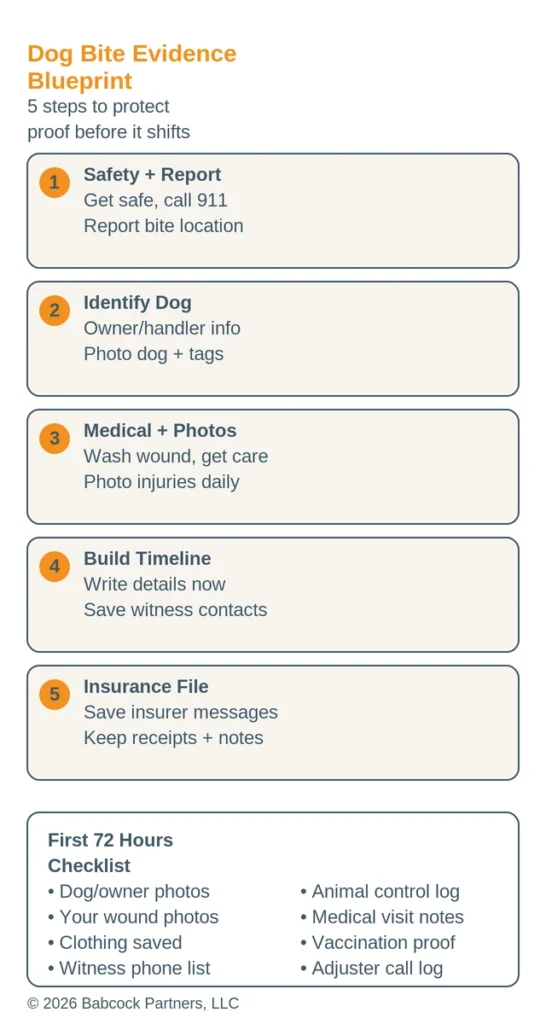
What to do after a dog bite
- Get to safety. Move away from the dog without creating another confrontation. Call emergency services if the injuries or continuing danger require it.
- Address the wound. Control bleeding with clean pressure, wash the area, and obtain medical guidance. Ask about infection risk, tetanus status, and rabies precautions based on the dog and exposure.
- Identify the dog and owner. Record the owner’s name and contact information, the address where the dog lives, and any license, tag, veterinary, or vaccination information that can be obtained safely.
- Report the incident. A report to the appropriate animal-control or law-enforcement agency can create an independent record and help address vaccination or observation questions.
- Photograph what matters. Take clear wound photographs before treatment when possible, then document changes over time. Photograph the dog, leash, gate, fence, warning signs, and the area where the contact occurred if it is safe to do so.
- Preserve names and recordings. Save witness contact information, doorbell or surveillance video, messages, social posts, and any statements made at the scene. Digital recordings can be overwritten quickly.
Do not delay needed care to build a perfect evidence file. Medical safety comes first. The first treatment record can also help establish the timing, location, and nature of the wound, provided the history is described accurately.
Evidence that answers the real disputes
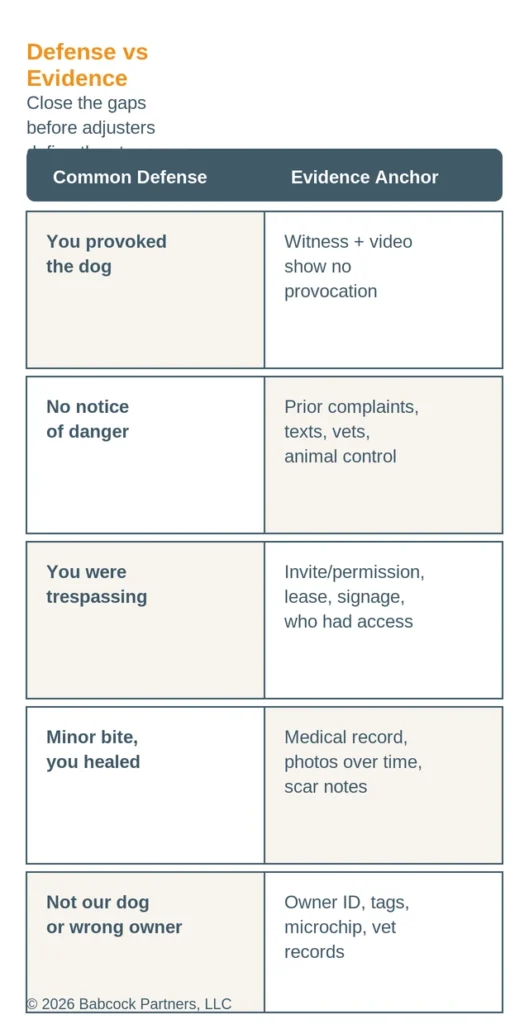
A strong file connects each item of proof to a disputed question. A collar tag or veterinary record can help identify the owner. A broken latch may bear on preventability. Doorbell footage may show whether the dog escaped, was restrained, or was approached. Witnesses may clarify whether any warning was given and what occurred immediately before the bite.
Scroll horizontally to see all columns. Use the arrow keys when the table is focused.
| Question | Useful records |
|---|---|
| Who owned or controlled the dog? | License and vaccination records, messages, photographs, veterinary information, lease records, and witness accounts. |
| Could the injury have been prevented? | Leash, gate, fence, door, or enclosure photographs; prior complaints; repair records; video; and statements about how the dog got access. |
| Was there provocation or shared fault? | Full-length video, neutral witnesses, scene layout, warnings, lawful reason for being present, and contemporaneous notes. |
| What harm did the bite cause? | Medical records, dated wound and scar photographs, prescriptions, wage records, activity restrictions, and follow-up recommendations. |
Our article on proving fault in a Louisiana dog bite case takes a closer look at evidence for negligence theories. When the dog belongs to someone nearby, the guide to a neighbor’s dog bite discusses the practical ownership and insurance questions that can arise.
Medical progress and scarring should be documented over time
The first photograph does not always show the full injury. Infection, nerve symptoms, limited hand movement, and scarring can develop after the initial visit. Follow medical instructions, attend recommended appointments, and take dated photographs under similar lighting as the wound changes. Keep records of medication, travel for care, missed work, and ordinary activities that the injury prevents.
Children can have additional treatment, school, and emotional effects. A parent should preserve the same ownership and scene proof while also keeping pediatric records, school absence information, counseling recommendations, and dated scar photographs. No special result should be assumed merely because the injured person is a child. The medical and legal analysis still depends on the evidence.
Insurance may depend on where and how the bite happened
Homeowners, renters, commercial liability, or other coverage may respond, depending on the insured, location, exclusions, and policy terms. The dog’s owner may not know which policy matters, and the first insurer contacted may not be the only one that requires notice. A bite at an apartment complex, business, or property controlled by someone other than the owner can raise separate questions about who controlled the area or condition.
Coverage is not the same as liability. An insurer can investigate ownership, provocation, preventability, medical causation, and damages even when a policy potentially applies. Avoid giving an inaccurate recorded history or signing a broad release before the injuries and responsible parties are understood.
Check the filing period using the incident date
Louisiana Civil Code article 3493.1, effective July 1, 2024, provides a two-year prescriptive period for delictual actions beginning on the day the injury or damage is sustained. Claims arising before that change may be governed by the earlier one-year rule or another provision. Minors, public defendants, criminal conduct, and other circumstances can also raise distinct timing questions.
Medical treatment, an animal-control investigation, or negotiations with an insurer should not be assumed to stop the filing clock. The safest approach is to identify the incident date and responsible parties early, then evaluate the applicable deadline rather than relying on a general online calculation.
A focused review starts with the first records
The Baton Rouge dog bite practice page explains how our firm reviews ownership, control, provocation, medical proof, and insurance. The first conversation should sort what is known, what evidence may disappear, which legal rule fits the incident date, and what remains too uncertain to answer responsibly.