

A dog bite case can become a dispute about a few minutes that nobody thought to record. Who owned the dog? Where was it before the injury? Could the owner have prevented what happened? A clear answer usually comes from photographs, witnesses, messages, and medical records gathered soon after the event.
Start with Louisiana’s dog-specific rule
Louisiana Civil Code article 2321(B) says a dog owner is strictly liable for injury to a person or property caused by the dog when the owner could have prevented the injury and it did not result from the injured person’s provocation. This is the dog provision. It should not be replaced with the article’s general reasonable-care rule for other animals. A prior bite is not stated as a required element.
Strict liability does not mean that every injury involving a dog produces a recovery. The owner’s identity, what the dog caused, preventability, provocation, injury, and available defenses still matter. A loose dog that knocks someone down can raise the rule even without a bite. A bite while the dog was leashed still requires a factual look at what the owner could have prevented.
If someone other than the owner may have contributed, that person’s conduct requires a separate analysis under applicable law, including Civil Code article 2315 and article 2316. Do not assume that a walker, property manager, or business is liable merely because of a connection to the dog. The firm’s Baton Rouge dog bite practice page explains how these questions are investigated.
Identify the dog, owner, and incident
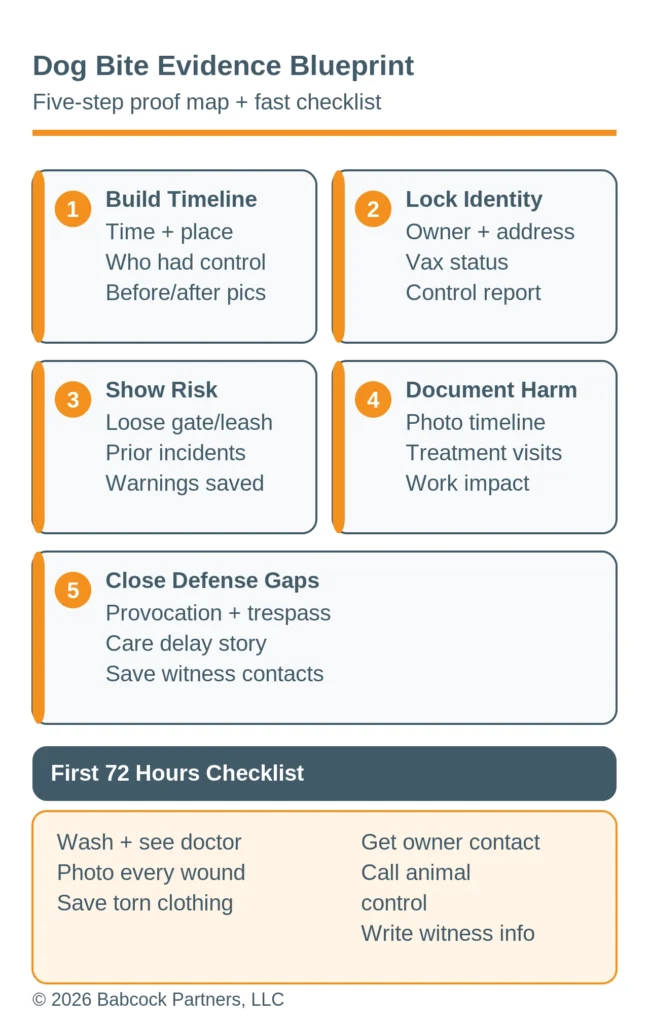
Record the address, the dog’s appearance, collar or tag details, and the name of the person handling it. If safe, photograph the gate, fence, leash, sidewalk, entrance, or dog-park boundary as it existed at the time. A repaired latch photographed a week later may not show what a witness saw on the day of the incident. Save original camera files and ask nearby homes or businesses to preserve relevant footage before it is overwritten.
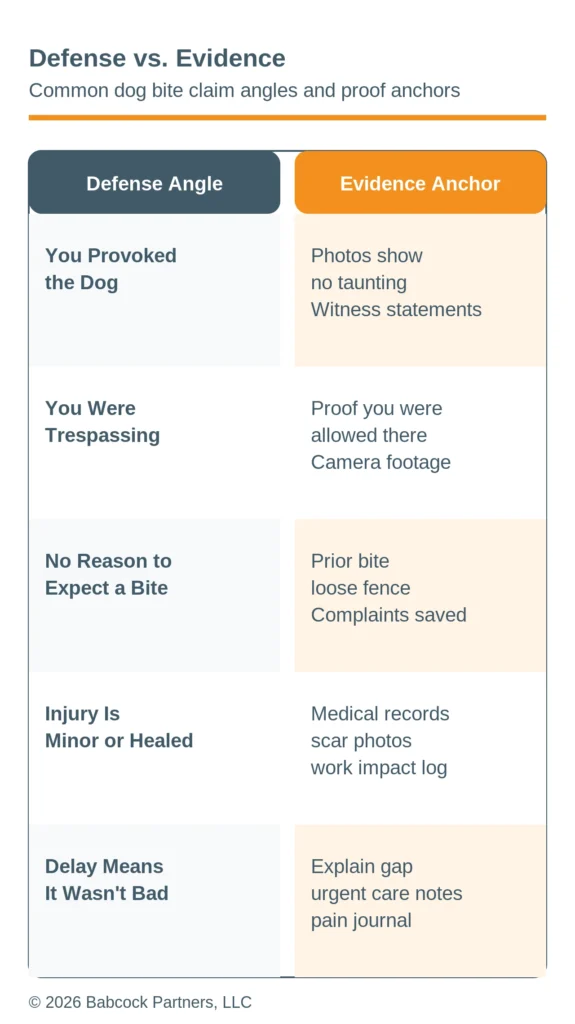
Ask witnesses what they personally saw, including the dog’s movement before contact and any interaction with the injured person. Write down statements accurately, without turning an uncertain recollection into a quotation. Invitations, delivery logs, text messages, or entry video can clarify why someone was on the property if access is disputed. An Animal Control report can help identify the dog and owner, but its conclusions should be compared with the other evidence.
What evidence addresses preventability and provocation?
A broken gate, an open door, a dropped leash, or a dog moving without a handler may help explain how an owner could have prevented an injury. Earlier complaints may give context, but they do not replace proof of this incident. A leash violation can be relevant without automatically deciding a civil case. If the event occurred in East Baton Rouge Parish, the City-Parish’s dog regulations describe confinement and six-foot leash rules.
Provocation is stated in article 2321(B), so preserve evidence of what happened immediately before the injury. Video, neutral witnesses, and consistent early descriptions are more useful than labels such as “provoked” or “unprovoked” without supporting facts. The dog may have been frightened or startled, but an insurer’s characterization should be tested against the actual sequence.
For a neighbor incident, our separate article on bites involving a neighbor’s dog discusses how to preserve the relationship and location facts. Our Louisiana dog bite claim guide follows the medical, reporting, insurance, and filing steps.
Make the injury record as reliable as the scene record
Seek medical advice promptly for a bite, particularly if it is deep, involves a hand or face, shows signs of infection, or raises a rabies concern. The CDC advises immediate wound washing and professional assessment after a possible rabies exposure. A clinician or public health professional should decide what treatment is needed. Do not wait for an insurer or lawyer before seeking care.
Keep visit summaries, prescriptions, dated photographs, follow-up instructions, missed-work records, and receipts. A photo on the first day cannot show later infection, scarring, or function limits. Describe symptoms and recovery accurately at follow-up visits. Future care and work loss should be supported by evidence rather than assumed from the first wound photograph.
Check the law against the date of injury
Comparative fault may be raised even when article 2321(B) applies. Under the current Civil Code article 2323, a person who is 51 percent or more at fault cannot recover, and a smaller fault share reduces otherwise recoverable damages. Act 15 of 2025 made this rule effective January 1, 2026. A claim arising before then generally remains under the former pure comparative fault rule; the later filing date alone does not change the governing law.
For many ordinary injury claims arising after July 1, 2024, Civil Code article 3493.1 provides two years to file, beginning when injury or damage is sustained. Act 423 of 2024 applies prospectively. Older incidents and special claims need their own deadline analysis. Reporting a bite or negotiating with an insurer does not itself guarantee more time to sue.
A prompt review can identify the owner, preserve footage and incident records, examine preventability and provocation, and calculate the filing deadline. If you want the firm to evaluate a particular event, contact Babcock Injury Lawyers. The outcome depends on the facts, governing law, and available proof.