Editorial & Legal Accuracy Notice (Louisiana)
This blog contains general legal and safety information and is not legal advice. Laws and deadlines can change, and outcomes depend on specific facts.
Last reviewed / updated: March, 2026
Reviewed, updated, and authored by: Stephen Babcock, Louisiana injury lawyer
This guide explains how to prove negligence in a Louisiana dog bite case using practical evidence steps. It also flags common insurance defenses and the documentation that helps address them.
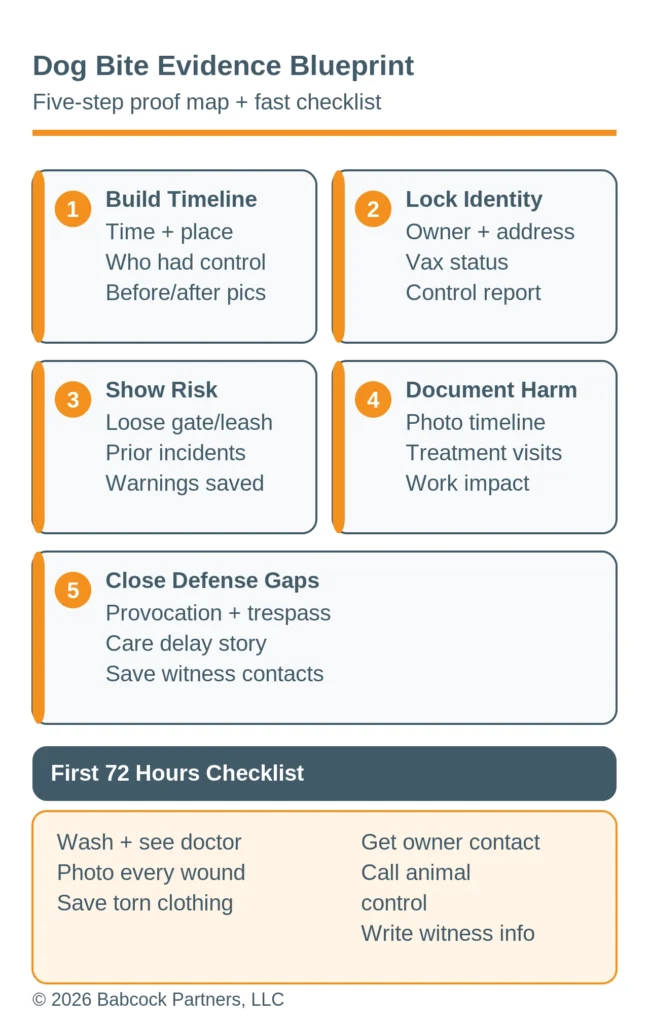
A dog bite claim often turns on what you can prove, not what you can remember. That means your first job is building a clear record that shows who controlled the dog, what precautions were missing, and how the bite changed your life.
We build cases around fast, simple proof steps that hold up when stories conflict. We are not built for volume. We are built for leverage. Speed + evidence preservation + insurer-insider knowledge + trial-ready preparation = The Babcock Benefit. In a Louisiana dog bite negligence claim, leverage usually comes from early documentation that closes the “provocation” and “avoidable” gaps.
If you are inside the first 72 hours, call (225) 500-5000 or use the free case review form before evidence changes.
Firm links: Client Reviews | Contact | Locations
Download the printable toolkit (PDF)
How Do You Prove Negligence in a Louisiana Dog Bite Case?
To prove negligence in a Louisiana dog bite case, you show a safety failure and a direct link to your injuries. Louisiana Civil Code article 2315 is the general fault rule, and Louisiana Civil Code article 2321 explains how preventability and provocation shape dog-bite responsibility.
- Control: Who owned or controlled the dog at the time.
- Preventability: What reasonable step would have avoided the bite.
- Causation: How that failure led to the bite and your injuries.
- Damages: Medical costs, lost time, and day-to-day impact backed by records.
Many people start by reading our Baton Rouge dog bite practice page to see how we frame evidence and early insurer pressure in these cases. If the bite happened at a business or apartment complex, the overlap with premises liability can matter, but your proof plan should still begin with control, preventability, and documentation.
What Does Louisiana Law Require After a Dog Bite?
Louisiana’s main dog-bite rule focuses on whether the injury was preventable and whether provocation is in play. In Louisiana Civil Code article 2321, the legislature says a dog owner is strictly liable for injuries the owner could have prevented when the injury did not result from the injured person’s provocation.
- Preventable: What was the missing safety step, like a leash, gate, or supervision.
- Provocation: What the defense may claim you did to trigger the bite.
- Evidence: Records and witnesses that make the story reliable.
Even when strict liability applies, insurers often try to shift blame to you, and Louisiana Civil Code article 2323 requires the factfinder to assign fault percentages. This is why we treat every Louisiana dog bite negligence case like a documentation project from day one, even when the law sounds straightforward.
What Are the Elements You Usually Need to Prove?
Most dog bite cases rise or fall on a few repeat proof questions: who controlled the dog, what risk was foreseeable, and what reasonable step would have prevented the injury. The negligence principle in Louisiana Civil Code article 2316 helps organize those questions into a clear “what should have been done” story.
| Proof Question | Examples of Helpful Evidence |
|---|---|
| Who controlled the dog? | Owner or keeper identity, address, witness statements, photos of collars or tags. |
| Could it have been prevented? | Gate and latch photos, leash setup, prior complaints, video showing missing supervision. |
| Was provocation involved? | Video, neutral witnesses, your clothing condition, contemporaneous texts, injury pattern photos. |
| What are the real damages? | Medical records, photo timeline, work notes, receipts, and a short daily impact log. |
If a child was bitten, the same proof steps apply, but the documentation tends to be more time-sensitive. Our child injury resources explain how we think about record-building when a minor’s medical care and school impact are part of the file.
Timeline Builder: First 72 Hours to 30 Days
The first month is where many dog bite claims are won or lost because evidence disappears and stories harden. MedlinePlus guidance on animal bites stresses prompt medical attention for certain bite locations, and that medical record often becomes the first time-stamped proof document in your case.
| When | What to Do |
|---|---|
| Hours 0–24 | Photograph the scene and injuries, get the owner or keeper information, and write down witness names while memories are fresh. |
| Hours 24–72 | Request camera footage in writing, report to animal control if needed, and start a simple daily impact log. |
| Week 1 | Collect medical records, receipts, and work notes, and keep a photo timeline as bruising and swelling change. |
| Weeks 2–4 | Organize documents into a single folder, confirm follow-up care, and avoid broad releases until you understand what is requested. |
This is why we ask people to treat the first 72 hours like an evidence sprint: video can be overwritten, fences get repaired, and witnesses become hard to reach. That is what we mean by leverage when we build a record that is stronger than a late, disputed narrative.

What Evidence Matters Most (and How to Preserve It)?
The best evidence is usually simple: clear photos, neutral witnesses, and reliable records that show the dog was not controlled the way it should have been. The preventability focus in Louisiana Civil Code article 2321 makes these “what could have been done differently” details central.
- Scene proof: gate latches, broken fences, leash setup, warning signs, and the dog’s location relative to sidewalks or entrances.
- People proof: owner or keeper identity, who was present, and who admits what right after the event.
- Video proof: doorbell cameras, business cameras, neighbor cameras, and any dashcam footage.
- Consistency proof: short notes you make immediately, plus a photo timeline of the injuries.
When insurers argue “reasonable care,” they usually mean what a careful dog owner should have done to prevent a bite, and Louisiana Civil Code article 2321 ties liability to preventability. If you want help organizing that proof early, start with our dog bite case help page and the checklist in the PDF toolkit.
Medical Records and Damages Documentation
Medical documentation is not just about treatment; it is also how you prove the injury happened, how it progressed, and how it affected your daily function. Mayo Clinic’s animal bite first-aid guidance lists infection warning signs, and that kind of timing detail often shows up in clinical notes.
- Care timeline: visit dates, diagnoses, medications, wound care instructions, and follow-ups.
- Photo timeline: day-of photos, plus weekly photos that show swelling, bruising, or scarring changes.
- Work and routine impact: missed work notes, duty restrictions, and a short log of limitations.
- Out-of-pocket costs: receipts for prescriptions, supplies, and travel for appointments.
If rabies exposure is a concern, Louisiana Department of Health rabies guidance explains when post-exposure vaccination and immune globulin are considered. CDC rabies information outlines what post-exposure prophylaxis includes, and you should follow your clinician’s instructions and local public health guidance.
Common Insurance Defenses and How to Answer Them
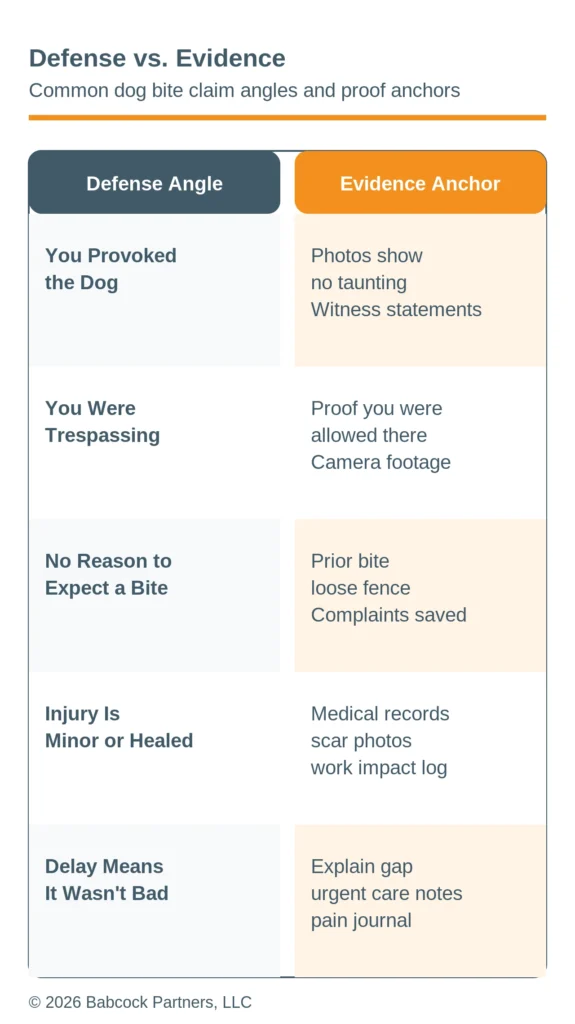
Insurance companies tend to repeat the same themes in dog bite cases: provocation, trespass, minor injury, and “you are fine now.” Louisiana Civil Code article 2321 explicitly mentions provocation, so you should assume the defense will test that issue early.
| Defense Theme | Records That Help Answer It |
|---|---|
| “You provoked the dog.” | Video, neutral witnesses, scene photos, and consistent early descriptions in texts or reports. |
| “You were trespassing.” | Invite texts, delivery logs, business entry video, and witness confirmation of permission. |
| “The bite was minor.” | Medical records, photo timeline, scar progression, and work or activity limits. |
| “The owner could not prevent it.” | Gate and leash evidence, prior incidents, and proof of a missing safety step. |
| “You share most of the fault.” | A clean timeline and records that limit speculation under Louisiana Civil Code article 2323. |
This is why we build a defense-first checklist: we want each expected argument to have an evidence answer. That is what we mean by leverage when we keep the claim focused on records instead of blame-shifting.

What we see in practice
Dog bite claims often start with a “quick settlement” conversation that feels helpful until the paperwork shows up. We see adjusters ask for broad medical authorizations and recorded statements early, long before scarring and follow-up treatment are clear.
We also see the provocation story grow over time when there is no neutral record. When video is missing, the file becomes a credibility contest, and small inconsistencies can be amplified into “comparative fault” arguments under Louisiana Civil Code article 2323.
This is why we push for early, simple proof: photos, timestamps, and third-party witnesses. It is not complicated, but it takes urgency, and that urgency is about evidence loss, not hype.
Talk to a Lawyer Quickly If…
Some dog bite situations have faster evidence loss or higher risk of blame-shifting, so waiting can make the claim harder. The comparative fault rules in Louisiana Civil Code article 2323 make early documentation especially important when the defense is expected to argue you caused the incident.
- The dog is unidentified or the owner is denying control.
- There is camera footage that could be overwritten within days.
- The bite happened at an apartment, store, or other property with multiple responsible parties.
- You are being pushed to sign releases or “close the claim” quickly.
- A child was bitten or the injury involves the face, hands, or infection concerns.
Mistakes That Can Hurt a Dog Bite Claim
Most harmful mistakes are paperwork mistakes because they change what can be proven later. The provocation language in Louisiana Civil Code article 2321 makes it risky to create gaps the defense can fill with speculation.
- Giving a detailed recorded statement while you are still in shock and missing key facts.
- Posting about the bite or your activities before your medical picture is stable.
- Failing to request video quickly, then relying on memory when stories diverge.
- Signing broad authorizations that pull in unrelated history and invite misdirection.
- Not keeping a simple photo timeline, which is often the best “before and after” proof.
Download the printable toolkit (PDF)
Louisiana Law Snapshot (Updated 2026)
Most Louisiana personal injury claims have a two-year prescriptive period, and Louisiana Civil Code article 3493.1 is the statute people commonly look to for that deadline. Talk to a lawyer quickly if time is unclear, because missing prescription can end a claim.
Comparative fault can reduce or bar recovery, and Louisiana Civil Code article 2323 sets a 51% bar for claims governed by the amended language effective January 1, 2026. Under that rule, fault below 51% reduces damages, while fault at 51% or more prevents recovery.
Free Case Review: Build Leverage Before the Record Sets
We are not built for volume. We are built for leverage.
When we talk about leverage, we mean fast evidence capture, smart documentation, and a claim file that is ready if it has to be tried. If you want help with a Louisiana dog bite negligence case, call (225) 500-5000 and use the free case review form so we can triage the timeline and the missing records.
These items are helpful to have with you when you call, but do not delay calling because you do not have them. If you have them handy, keep them nearby for the call.
- Photos of the injuries and the scene
- Owner or keeper name and address
- Any animal control or incident number
- Names of witnesses
- Medical provider names and visit dates
Call Today If…
- The owner is denying the dog was theirs or was under their control
- There is video that could be overwritten soon
- You are being pushed to sign releases or settle fast
- Your injury is getting worse or infection is a concern
- A child was bitten or scarring is likely
What Happens Next
- We triage evidence and send fast requests for video, reports, and identity documentation.
- We spot deadlines and fault issues early so the claim is built around records, not assumptions.
- We manage insurer communications and organize the proof file to reduce narrative drift.
For a deeper overview of how we approach these cases, you can review our dog bite claim guidance and the broader Baton Rouge hub. If you are not sure what practice area fits yet, start with the hub and work outward from the facts.