Editorial & Legal Accuracy Notice (Louisiana)
This blog contains general legal and safety information and is not legal advice. Laws and deadlines can change, and outcomes depend on specific facts.
Last reviewed / updated: March, 2026
Reviewed, updated, and authored by: Stephen Babcock, Louisiana injury lawyer
This guide explains how to file a Louisiana dog bite injury claim and what proof usually matters. It also provides a simple 72-hour checklist to help you protect the record early.
When we evaluate a dog bite injury claim, we start with the record: who controlled the dog, what happened, and what proof exists today. We are not built for volume. We are built for leverage. Speed + evidence preservation + insurer-insider knowledge + trial-ready preparation = The Babcock Benefit. In dog bite cases, leverage often means identifying coverage fast and closing provocation and trespass gaps before an adjuster writes the story.
If you are inside the first 72 hours, call (225) 500-5000 or use the free case review form before evidence changes.
Firm links: Client Reviews | Contact | Locations
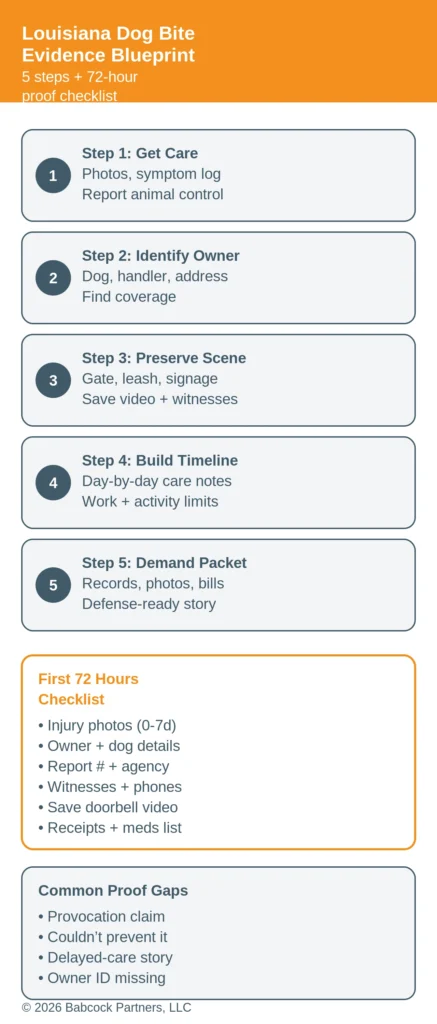
Prefer a print-friendly checklist? Download the printable toolkit (PDF). It includes both infographics and a first-72-hours evidence checklist.
How Do You File a Dog Bite Injury Claim in Louisiana?
To file a Louisiana dog bite injury claim, start by getting medical care, reporting the bite, identifying the owner or keeper, and saving photos, video, and witness info. Then gather records and send a clear demand to the correct insurance policy; our Baton Rouge dog bite practice page shows how we structure that proof.
- Get medical care and start a simple symptom and treatment log.
- Report the bite to local animal control and keep the report number.
- Identify the dog’s owner or keeper and confirm where the bite happened.
- Preserve evidence: photos, video, witness contacts, and scene details.
- Track work limits, missed time, and out-of-pocket costs.
- Submit a demand package and avoid signing releases too early.
Most claims run through homeowner’s insurance, renter’s insurance, a commercial policy, or an umbrella policy, so identifying coverage is not busywork. If the bite happened in Baton Rouge, our Baton Rouge hub shows where we help across the city. Either way, the goal is the same: lock in the facts while they are still easy to verify.
What a “Clean” Claim Process Looks Like
A clean process keeps the story consistent from day one through the demand package. You document the bite, the injuries, the treatment, and the practical limits it causes, and you keep copies of every communication. This reduces room for an insurer to argue that the incident was minor, unreported, or unrelated to your later care.
This is why we start with evidence triage instead of arguments. Once surveillance footage overwrites or witnesses scatter, you cannot “lawyer” your way back to proof.
What Should You Do in the First 72 Hours After a Dog Bite?
In the first 72 hours, focus on safety, medical documentation, and preserving the scene facts that will not exist later. Your job is not to build a case file; it is to prevent gaps that insurers use to deny or discount the claim.
- Get evaluated, then save discharge papers, prescriptions, and follow-up instructions.
- Photograph injuries the same day and again as bruising and swelling change.
- Report the bite and write down the report number and responding agency.
- Write down owner/keeper identity details and where the dog was kept or controlled.
- Save video sources and witness contact info before they disappear.
American Red Cross animal bite first aid explains basic steps like cleaning the wound and seeking medical care based on severity and infection risk. For rabies-risk situations, North Carolina’s rabies control guidance emphasizes immediate wound washing and rapid medical follow-up after an exposure.
If an adjuster calls early, you can take the contact information and tell them you will respond after you have stabilized and organized records. You do not need to guess answers on the spot. Keep your focus on the record you can prove.
What Do You Have to Prove for Dog Bite Liability in Louisiana?
Louisiana dog bite liability usually turns on whether the owner could have prevented the harm and failed to do so, along with whether the victim contributed to the incident. Louisiana Civil Code article 2321 is the core statute, and insurers often fight over “preventability” and “fault” rather than the fact of the bite.
| Issue | What It Means | Proof Examples |
|---|---|---|
| Control / ownership | Who kept or controlled the dog at the time. | Photos of the property, witness statements, ID of the handler, vet or tag details. |
| Preventability | Whether reasonable steps could have prevented the bite. | Fence or gate condition, leash use, prior incidents, warnings, supervision facts. |
| Comparative fault | Your actions can reduce recovery if they helped cause the bite. | Video, witness accounts, your written timeline, messages showing permission to be there. |
Insurers regularly try to reframe a dog bite into a “provocation” story, a “trespass” story, or a “you should have known better” story. When comparative fault matters, Louisiana Civil Code article 2323 is the statute they point to when they argue that fault should be allocated between the parties.
What Evidence Usually Matters Most in a Dog Bite Claim?
The strongest dog bite claims read like a timeline, not a debate: what happened, what changed physically, and what documentation supports each step. Focus on evidence that is time-stamped, third-party, and hard to reinterpret later.
- Animal control report number, agency contact, and any follow-up notes.
- Injury photos over time and scene photos showing gates, leashes, and warnings.
- Video sources and witness contact details, saved quickly.
- Medical records that connect symptoms to function and work limits.
- Proof of permission to be there, if the location becomes an issue.

That is what we mean by leverage when we talk about evidence preservation. The earlier you preserve video, identify the handler, and document the scene, the fewer “maybe” arguments an insurer can sell later.
If you want to see how we connect proof to coverage, our dog-bite case page explains the documentation we typically request and why timing matters. We also focus on keeping your communications clean so the claim stays about facts instead of emotion.
How Do You Build a Timeline for a Dog Bite Claim?
A simple timeline helps you keep dates, symptoms, and follow-up care consistent across medical records and claim paperwork. It also makes it easier to spot gaps before an insurer uses them against you.
| Date / Time | Event | Who Was There | Document to Save |
|---|---|---|---|
| Day 0 | Bite occurs; photos taken | Owner/keeper, witnesses | Photos, video source, witness names |
| Day 0–1 | Medical visit | Clinic / ER staff | Discharge papers, prescriptions |
| Day 1–3 | Animal control report | Responding agency | Report number, officer contact |
| Week 1 | Follow-up care and work limits | Employer, provider | Work notes, visit summaries |
This is why we ask clients to track “function” in plain language, not just pain scores. Notes like “could not grip a steering wheel” or “missed a shift” often match what insurers actually dispute.
How Do Insurers Defend Dog Bite Claims?
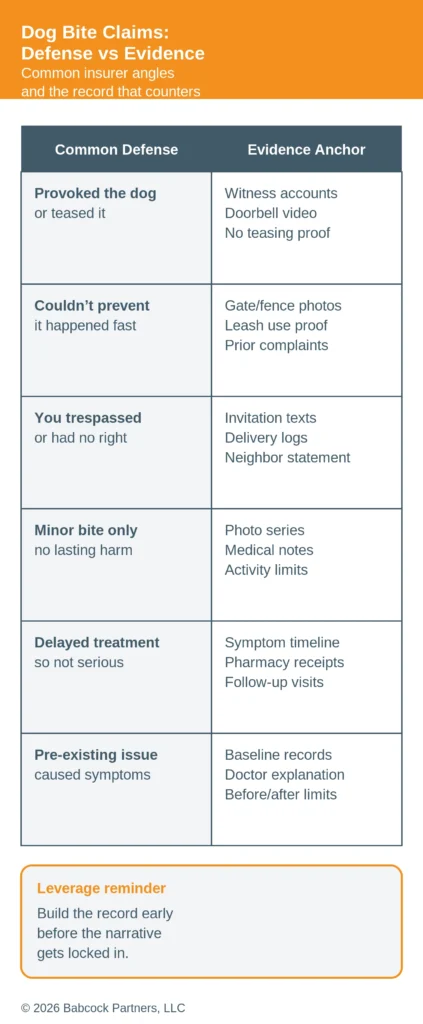
Most dog bite defenses are predictable: provocation, trespass, lack of preventability, minor injury, delayed treatment, or a pre-existing condition. If you prepare for those angles early, you can keep the claim focused on evidence rather than arguments.
| Defense Theme | Evidence That Counters It |
|---|---|
| “You provoked the dog.” | Witness accounts, video, and a consistent timeline of what you were doing right before the bite. |
| “The owner couldn’t prevent it.” | Photos of gates/fences, leash-control facts, and any history that shows the risk was known. |
| “You had no right to be there.” | Texts or invitations, delivery logs, and any proof of permission or lawful presence. |
| “It was a minor bite.” | Photo progression, medical notes, and work or activity restrictions that show real impact. |
| “You delayed treatment.” | Documentation of access issues, symptom changes, and follow-up records that show continuity. |

This is why we treat insurer communication as part of evidence preservation. A recorded statement or a premature release can lock in wording that is hard to unwind later.
What Damages Can a Louisiana Dog Bite Claim Include?
Damages in a Louisiana dog bite claim are usually tied to what you can document: treatment, limits, and the ripple effects on daily life. You do not need to put a dollar value on everything early, but you do need to preserve proof that the loss happened.
- Medical expenses and follow-up care, including prescriptions and wound care.
- Lost wages or missed earning opportunities supported by employer records.
- Pain, inconvenience, and loss of normal activities supported by consistent notes.
- Scarring or disfigurement documented with photo progression and medical observations.
- Future care needs when providers document them as likely and related.
A clean damages story matches the timeline: bite, treatment, recovery, and residual limits. When those pieces do not match, insurers often argue that something else caused the problem. Building the record early keeps the claim anchored to facts.
What we see in practice
We often see dog bite cases get harder when people wait to report the incident or when the owner’s identity stays unclear for weeks. We also see insurers lean heavily on “provocation” or “trespass” even when the bite itself is not disputed.
- Early photos and video usually matter more than later recollections.
- “Minor bite” arguments grow when there is no follow-up documentation.
- Coverage issues appear when the dog is tied to a renter, a business, or a third-party handler.
- Delay creates gaps, and gaps create defense narratives.
Talk to a Lawyer Quickly If…
Some dog bite situations have a shorter “evidence clock” because proof disappears or the consequences escalate quickly. When any of the triggers below are present, move faster than you feel comfortable.
- A child is bitten, especially on the face, neck, or hands, and you need a tight medical and photo record.
- The bite causes significant scarring, nerve issues, or functional limits, including hand injuries.
- The dog or handler is unknown, uninsured, or trying to avoid identification.
- An insurer asks for a recorded statement, broad medical authorization, or a quick settlement release.
- The incident involves a workplace, a delivery, or a business property with possible multiple policies.
If your child was hurt, our Baton Rouge child injury page explains how we approach documentation without turning your life upside down. If a dog attack leads to a fatality, our wrongful death page covers the different claim structure for families.
Need the checklists on paper? Download the printable toolkit (PDF). The PDF bundles the evidence blueprint and the defense-audit table.
Louisiana Law Snapshot (Updated 2026)
Most Louisiana injury claims have a two-year deadline, and the clock can run faster than people expect once medical care stabilizes and life gets busy. Comparative fault can also reduce recovery, and after Jan. 1, 2026, being 51% or more at fault can bar recovery under the state’s comparative fault rule.
| Rule | Where to Read It | Why It Matters |
|---|---|---|
| Two-year delictual prescription | Louisiana Civil Code article 3493.1 | If you miss the deadline, the claim can be dismissed even if liability is clear. |
| Comparative fault and the 51% bar | Louisiana Civil Code article 2323 | Fault allocation can reduce recovery, and high fault can defeat the claim after 2026. |
Deadlines and fault analysis depend on facts, so treat this as a starting point, not a substitute for legal advice. A quick review is often enough to spot missing evidence and calendar issues.
Final Checklist and Free Case Review
If you want the fastest path to a clean claim record, focus on evidence and consistency before you focus on negotiation. We are not built for volume. We are built for leverage.
The Babcock Benefit is our approach to moving quickly on proof, spotting claim traps, and preparing the file like it may be tested later. Call (225) 500-5000 and use the free case review form so we can triage evidence, coverage, and deadlines with you.
For a snapshot of the practice area this guide supports, review our Baton Rouge dog bite lawyer page. Common urgency reasons include overwritten video, shifting witness stories, and early insurer pressure to sign paperwork before the record is complete.
These items are helpful to have with you when you call, but do not delay calling because you do not have them. If you have them handy, keep them nearby for the call.
- Animal control report number and the responding agency name.
- Photos of injuries and the bite location.
- Owner/keeper name and contact information.
- Witness names and phone numbers.
- Medical visit summaries and prescription receipts.
Call Today If…
- The dog or handler identity is unclear or disputed.
- You are being asked for a recorded statement or broad release.
- Your injuries involve the face, hands, nerve symptoms, or infection concerns.
- The bite happened on business property or during work duties.
- You have gaps in care and want to avoid a “delay” narrative.
What Happens Next
- We triage evidence sources fast and map out what can be preserved immediately.
- We spot deadlines and fault issues early, then build a timeline that matches records.
- We set an insurer contact strategy designed to avoid premature statements and releases