Bike Safety Tips From Cars in Louisiana


Editorial & Legal Accuracy Notice (Louisiana)

This blog contains general legal and safety information and is not legal advice. Laws and deadlines can change, and outcomes depend on specific facts.

Last reviewed / updated: March, 2026

Reviewed, updated, and authored by: Stephen Babcock, Louisiana injury lawyer

This guide focuses on bike riding safety tips for reducing dangerous interactions with cars in Louisiana, plus a practical plan for what to save if a crash happens.

If you ride near traffic, the goal is simple: be seen, be predictable, and leave yourself an “out” when a driver makes a mistake. This post is written for everyday riders, not racing theory. It also assumes you may need to explain what happened to an insurance company later. That is why we pair safety habits with documentation habits.

If you ride in Baton Rouge or anywhere in Louisiana, the safest approach is a mix of smart positioning and a plan for what to do if a car gets too close. We are not built for volume. We are built for leverage. Speed + evidence preservation + insurer-insider knowledge + trial-ready preparation = The Babcock Benefit. For bike-and-car incidents, leverage means preserving the facts that prove visibility, lane position, and driver choices before they get rewritten.

If you are inside the first 72 hours, call (225) 500-5000 or use the free case review form before evidence changes.

Firm links: Client Reviews | Contact | Locations

Download the printable toolkit (PDF) if you want the checklists in a clean, print-friendly format. Keep it on your phone so you can use it even at the scene.

How Can I Ride a Bike Safely Around Cars in Louisiana?

The safest bike riding safety tips are the ones you can repeat every ride: ride predictably, claim safe space on the road, and plan for the driver who does not see you. NHTSA’s bicycle safety guidance emphasizes visibility and awareness, and those themes also matter when a crash becomes an insurance claim.

  • Be visible: lights, reflectors, and bright contrast help drivers process you faster.
  • Be predictable: signal early, hold a line, and avoid sudden swerves.
  • Control the “door zone”: give parked cars room to open a door.
  • Own the decision points: intersections, driveways, and merges deserve extra caution.
  • Think like a recorder: know what you would photograph if something went wrong.

If a car does hit you, your next steps can shape fault, coverage decisions, and what gets paid later. That is why we pair these tips with a plan for the first 72 hours. If you are hurt, you can also read how we approach cyclist cases on our Baton Rouge bicycle accidents practice page.

Which Louisiana Bike Laws Matter Most for Safety and Fault?

Louisiana bike laws matter because insurers often argue “the cyclist broke a rule,” even when the driver caused the danger. The fastest way to respond is to know a few core rules and document how the roadway actually looked at the moment of conflict.

Rule That Often Comes Up Why It Matters in the Real World
The general rule in La. R.S. 32:194 applies basic traffic duties to people riding bicycles. Drivers and cyclists both get judged against “rules of the road,” so clarity helps when stories conflict.
The safe passing space rule in La. R.S. 32:76.1 addresses how a motorist should pass a bicycle. Photos of lane width and where you were riding can matter when a driver says “I had no room.”
Bike lane use and related duties in La. R.S. 32:203 can affect lane-position arguments. If a crash happens near a bike lane, the markings and curb layout become evidence, not just background.
Dooring risk is addressed by the vehicle-door rule in La. R.S. 32:283. Door-zone photos and parked-car context help explain why “riding wide” was a safety choice.
Night visibility equipment is covered by La. R.S. 32:329.1 for bicycle lamps and reflectors. After a dark crash, insurers often attack visibility, so gear photos and receipts can matter.
Louisiana’s youth helmet rule in La. R.S. 32:199 is sometimes raised in family cases. Even when helmets are not the legal issue, insurers may argue “avoidable injury,” so documentation matters.
Harassment protections appear in La. R.S. 32:201. If a driver buzzed, threatened, or intentionally squeezed you, a quick timeline and witnesses are critical.

These links are not here to turn your ride into a law exam. They are here because fault gets argued later, and a clear record today is easier than a reconstruction months from now.

Where Do Bike-Car Crashes Happen Most Often?

Bike-car crashes often happen where driver attention is split: intersections, driveways, and turns across your path. CDC’s bicycle safety overview highlights visibility and sharing the road, which becomes most important at these conflict points.

  • Left turns and right hooks: the driver turns across your line because they misjudge speed or fail to check.
  • Driveways and parking lot exits: “rolling stops” are common when drivers hunt for gaps.
  • Dooring zones: a parked-car door opens into your space, especially on narrow streets.
  • Merges and lane changes: drivers drift while looking over a shoulder or at a phone.
  • Night or rain: visibility and stopping distance become the whole story.

If your ride includes these zones, plan for them like you would plan for bad weather. That is what keeps bike riding safety tips practical instead of theoretical.

What Safety Habits Reduce Bike-Car Collisions?

The best bike riding safety tips are habits you can do without thinking: visibility, predictable lines, and early communication. NHTSA’s bike safety guidance supports the core idea that being seen and being expected reduces conflict.

  1. Use lights early: do not wait for full darkness if traffic is fast or the sky is fading.
  2. Signal like you mean it: point, look, and hold the line so drivers can predict your next move.
  3. Leave the door zone: assume a door can open quickly and without warning.
  4. Take the space you need: narrow lanes sometimes require you to be centered for safety.
  5. Choose lower-stress routes: fewer high-speed crossings beats the shortest line on a map.
  6. Expect distraction: if you see a phone glow, treat it as a hazard and increase your buffer.

We see many cases where the rider did “everything right,” but the driver was still distracted or rushed. If you want more context on that risk, our Baton Rouge page on distracted driving explains why small attention lapses can create big consequences.

What Should I Do in the First 72 Hours After a Bike-Car Crash?

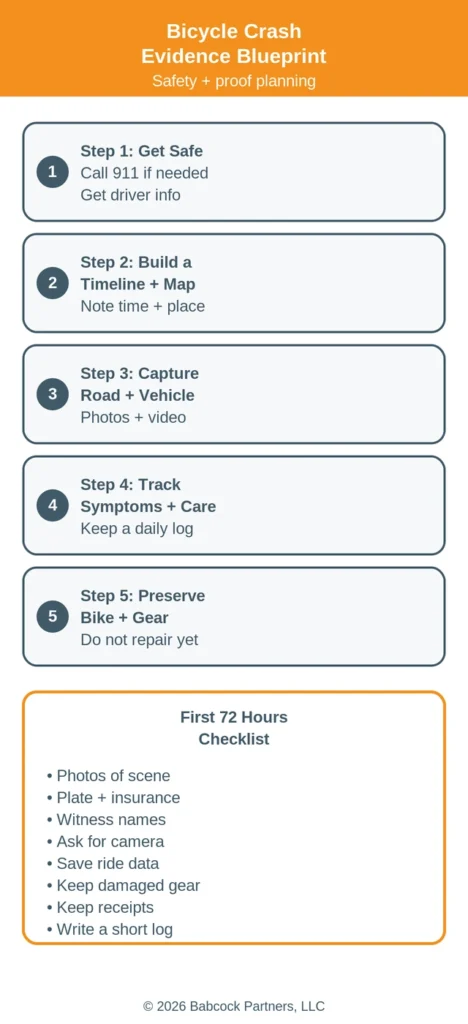
In the first 72 hours, focus on two things: your health and your proof. This is why we treat those first few days as an evidence clock, because video gets overwritten, bikes get repaired, and memories get “polished.”

  • Call 911 if anyone may be hurt and ask how to get the report number once it exists.
  • Photograph the scene including lane markings, signage, lighting, and debris patterns.
  • Identify witnesses and save their names and numbers before they leave.
  • Request nearby video from businesses or homes as soon as possible.
  • Preserve the bike and gear in the same condition until photos and notes are complete.
  • Start a short daily log of symptoms, sleep, work impact, and activity limits.
Quick reference: the 5-step bicycle crash evidence blueprint + first-72-hours checklist. (Download the printable PDF below.)

That is what we mean by leverage when the other side tries to reduce your crash to a few lines in a report. The stronger your first-72-hours record is, the harder it is for an insurer to “simplify” the facts against you.

Timeline Builder: How Do I Write a Clean Crash Story?

A clean timeline makes your claim easier to understand and harder to distort. The goal is not to argue online, but to capture facts while they are fresh and while the roadway still looks the same.

15-minute timeline outline:

  1. Start point: where you began, the route, and why you chose it.
  2. Traffic setting: speed of cars, lane width, bike lane markings, and weather/light.
  3. Conflict moment: what the car did first, what you did next, and where you were positioned.
  4. Impact details: contact points, where you landed, and what was damaged.
  5. Immediate symptoms: what you felt and what you could not do right after.
  6. Witnesses and video: who saw it and where cameras may exist.

Medical and Documentation Basics

Do not try to “tough it out” just to avoid paperwork, but also do not panic if you did not have every detail on day one. Keep your care consistent, keep your notes simple, and be honest about limits. If symptoms change, write the change down with the date and what activity triggered it.

This is why we push for early documentation even when you are unsure how serious the injury is. Proof gaps tend to get filled by assumptions, and assumptions rarely favor the cyclist.

Defense Audit: How Do Insurers Try to Shift Blame to Cyclists?

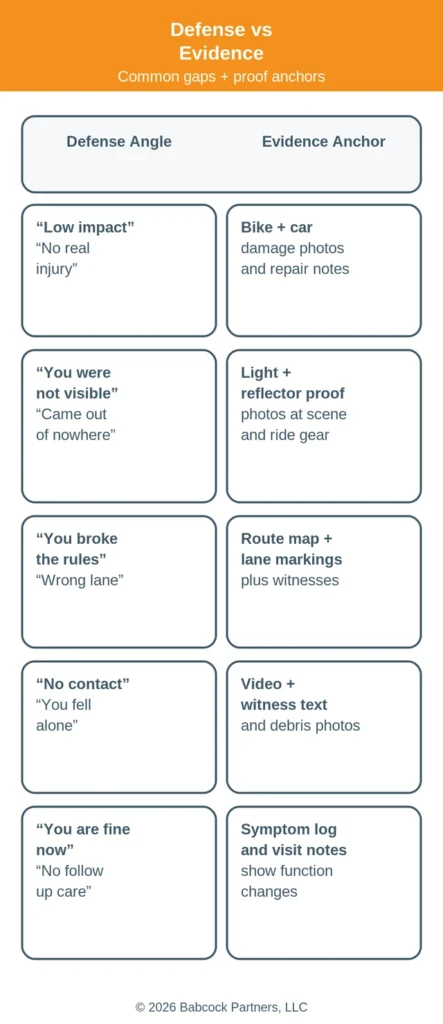
Insurance adjusters often focus on a short list of arguments: visibility, lane position, and “you caused it.” The fastest way to respond is to build a record that answers those points with objective proof instead of opinions.

Common Defense Narrative Evidence Anchors That Help
“You were riding where you shouldn’t.”
  • Photos of lane markings and any bike lane at the scene.
  • Route map and time stamps showing where you were before the conflict.
  • Relevant roadway duties tied to La. R.S. 32:194 and bike-lane context in La. R.S. 32:203.
“The driver gave you room.”
  • Lane-width photos and a clear map of where the pass occurred.
  • Any video showing distance, speed, and squeeze points.
  • The safe passing framework in La. R.S. 32:76.1 when the dispute is “how close was close.”
“You were invisible.”
  • Gear photos, light photos, and receipts when you have them.
  • Night equipment context tied to La. R.S. 32:329.1.
  • A scene photo that shows lighting, contrast, and sight lines.
“You fell on your own; no contact.”
  • Witness names and quick written statements while memory is fresh.
  • Debris and tire-mark photos that match your described path.
  • Any nearby camera footage requests made early.
“Minor damage means minor injury.”
  • Bike-shop estimates and close-up damage photos.
  • A simple daily function log and consistent medical documentation.
  • A clear timeline that ties symptoms to activities you could not do.
Common bicycle crash defense narratives—and the evidence anchors that close the gaps.

If you are dealing with a bike-and-car collision, you do not have to guess how insurers will frame it. That is what we mean by leverage: we prepare for the predictable arguments and answer them with a record that is hard to ignore.

If you want a deeper look at how we approach these cases, start with our cyclist collision case page and then focus on preserving proof before the bike is repaired or the scene changes.

What we see in practice

In bicycle crash claims, the fight often turns on small details that do not show up in a quick summary: lane markings, lighting, and what the rider did seconds before impact. We also see insurers push comparative fault early, especially when the cyclist cannot point to objective proof.

  • Video disappears fast: many systems overwrite within days, and sometimes sooner.
  • Scene photos beat arguments: a clear photo of the lane and signage prevents “creative” descriptions later.
  • Dooring and merges get minimized: photos and witnesses stop the story from becoming “they just fell.”
  • Medical gaps get exploited: if care is inconsistent, insurers tend to argue the injury was minor or unrelated.
  • Bike repairs erase proof: once parts are replaced, it is harder to show what failed or what was hit.

When Should I Call a Lawyer After a Bicycle Crash?

You should talk to a lawyer quickly when the crash involves serious injury, unclear fault, missing video, or an insurer pushing you to “wrap it up.” Even when you are not sure you will hire anyone, a short call can help you spot deadlines and preserve proof you only get one chance to save.

  • You were hit at an intersection, during a turn, or during a close pass with disputed distance.
  • You suspect the driver was distracted, impaired, or intentionally aggressive.
  • There is a dooring scenario or a squeeze that forced you off the road.
  • You have fractures, head symptoms, or any injury that changes work or daily function.
  • An insurer requests a recorded statement before you have gathered your own photos and witnesses.

For Louisiana riders, a common starting point is understanding what evidence and claim steps tend to matter in bike cases. You can review that approach on our bike-and-car crash help page, then decide what fits your situation.

Download the printable toolkit (PDF) if you want a quick checklist for photos, witnesses, and a clean timeline. It is built to be useful even if you are still deciding what to do next.

Louisiana Law Snapshot (Updated 2026)

Louisiana deadlines and fault rules can decide whether a strong set of facts becomes a strong case. The point of this snapshot is not to replace legal advice, but to help you understand why “waiting to see” can cost evidence and options.

Rule Practical Meaning
The two-year delictual prescription in La. Civ. Code art. 3493.1. Many injury claims must be filed within two years, so you should spot the deadline early and preserve proof while it is still available.
Comparative fault rules in La. Civ. Code art. 2323, including the post–Jan. 1, 2026 51% bar described in that article. Fault can be divided, and the details you document about lane position and visibility can affect how blame is assigned.

This is why we treat deadlines and fault arguments as an evidence strategy, not paperwork. If you are unsure how the snapshot applies to your crash, get a quick legal review of your facts.

Free Case Review: Protect the Claim Before Proof Disappears

We are not built for volume. We are built for leverage.

The Babcock Benefit is a plain idea: move fast, preserve evidence, and prepare the case like it may need to be proved in court. Call (225) 500-5000 and use the free case review form so we can triage evidence and deadlines while the record is still recoverable. Waiting can mean lost video, repaired bikes, and avoidable fault arguments.

These items are helpful to have with you when you call, but do not delay calling because you do not have them. If you have them handy, keep them nearby for the call.

  • Photos or video of the scene, the vehicles, and your bike and gear
  • The driver’s name, plate, and insurance information
  • Witness names and contact information
  • The crash report number or the agency that responded
  • A short note of symptoms and work or activity limits

Call today if:

  • You think camera footage exists and may overwrite soon
  • The driver disputes what happened or blames you
  • You have head symptoms, fractures, or limits that affect work
  • An insurer is pressuring you for a statement or quick settlement

What happens next:

  • Evidence triage: we identify video sources, witnesses, and vehicle/bike proof to preserve.
  • Deadline spotting: we map key dates and claim steps so you do not lose options.
  • Insurer contact strategy: we plan communications to reduce misstatements and fault traps.
×