

The easiest time to avoid a distraction is before the car moves. Set the route, choose the music, silence notifications and put the phone somewhere you will not reach for it. If a message needs an answer, stop somewhere safe before answering.
A phone is only one source of distraction. Eating, reaching behind a seat or getting drawn into an argument can also take attention away from traffic. The CDC describes three kinds of distraction: looking away from the road, taking a hand off the wheel and taking your mind off driving. A hands-free call can still occupy your attention.
Make fewer decisions behind the wheel
Small preparations help because they remove reasons to look down or reach across the car. Enter the destination before leaving. Secure loose items. Ask a passenger to handle directions or messages. If children or pets need attention, find a safe place to stop instead of turning around while driving.
Leave room for the vehicle ahead to slow down. Extra space does not make it safe to check a screen, but it gives an attentive driver more time to react. Louisiana’s following-distance rule, R.S. 32:81, requires a reasonable and prudent distance for the speed, traffic and road conditions.
Driver alerts can help, but they do not relieve the driver of watching the road. Our article on driver monitoring systems discusses the role of in-car cameras and warnings. Treat those features as backup, not permission to divide your attention.
What Louisiana’s phone law covers
R.S. 32:59 prohibits specified wireless-device use while operating a motor vehicle on public roads unless the vehicle is lawfully stationary. The statute defines that term and contains exceptions, including certain hands-free and emergency uses. It is broader than texting alone.
The rules for a traffic citation and the evidence needed for an injury claim are different questions. The statute restricts device searches based solely on a secondary-offense violation. A crash report therefore may not contain phone records or resolve whether the driver was distracted. Records sought later in a civil case must be obtained through proper legal procedures.
For the phone-specific issues, see our discussion of texting and driving accidents. A lawful way to use a device is not necessarily a sensible choice in heavy traffic.
After a crash, record what you actually observed
Get to safety and obtain emergency help first. Photographs and witness information can wait if collecting them would expose you to traffic or delay medical care.
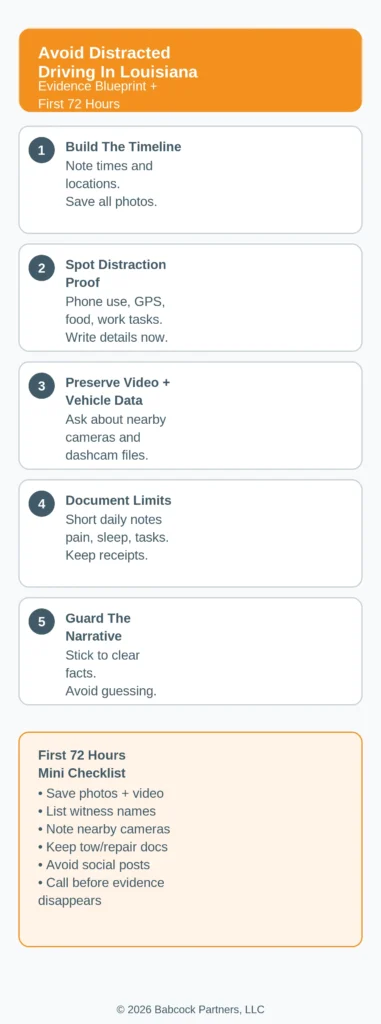
When it is safe, photograph vehicle positions, damage, lane markings and signals. Get witnesses’ names and contact information. Note nearby cameras, including the business or address where each camera is located. Save original dashcam files rather than relying only on a short clip shared by text.
Be precise about what you saw. Seeing a driver holding a phone is different from seeing the driver type. A driver looking down may suggest distraction, but it does not establish what the driver was doing. Tell the investigating officer what you observed, and distinguish those observations from your conclusions.
Write down the sequence while it is fresh. If you later remember something else, add a dated note rather than rewriting the original account. Keep the report number, tow records, photographs and witness details together. Prompt requests matter because camera systems can overwrite footage; there is no single retention period that applies to every system.
How the evidence fits together
A distracted-driving claim usually depends on several pieces of evidence. A witness may describe the driver’s conduct, video may show the car leaving its lane, and vehicle data may help establish braking or speed. Phone records can be relevant, but the available records and what they establish will depend on the circumstances.
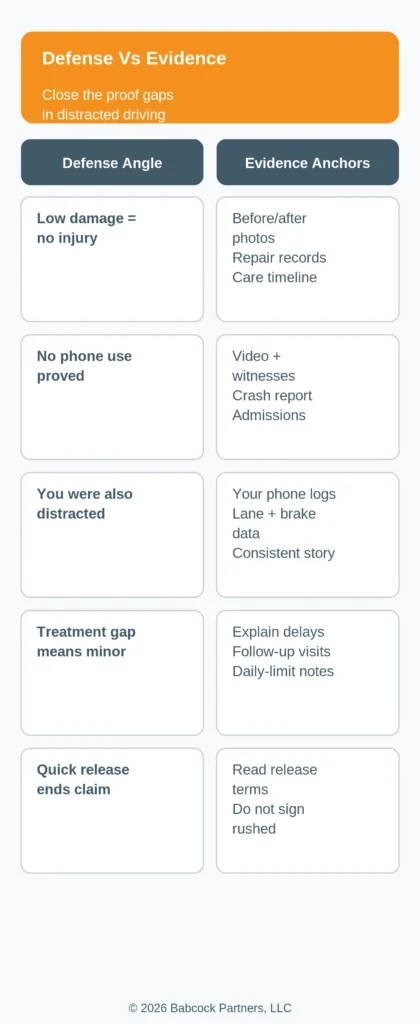
The evidence should explain how the driving caused the collision. It should also be checked against other possibilities and the conduct of everyone involved. Proof of a phone in the driver’s hand does not, by itself, answer every question about fault or injury.
The same care applies to the injury records. Vehicle photographs, medical evaluations, treatment records and information about missed work answer different questions. If treatment was delayed, document the actual reason. Do not let a short description of vehicle damage stand in for a medical assessment.
Keep insurance communications accurate
Before a detailed interview, gather the facts you know and identify what you still need to check. Do not guess about speed, distance or the other driver’s phone use. Ask which insurer is requesting a statement and what the request concerns. Your own policy may impose cooperation duties, so get advice about those duties rather than simply ignoring a request.
Read a settlement release carefully before signing. A payment described as small or preliminary may come with language ending the claim. The scope of the release matters as much as the amount offered.
Fault and filing deadlines still matter
Civil Code article 3493.1 provides a two-year prescriptive period for delictual actions and took effect July 1, 2024. The accident date and the type of claim matter when determining which deadline applies. Do not assume that every claim has two years or that discussions with an insurer preserve the right to sue.
The version of Civil Code article 2323 effective January 1, 2026 bars recovery when the injured person’s negligence is 51 percent or more and reduces recovery proportionately below that threshold. The applicable version must be determined for the claim. Evidence about following distance, lane position and each driver’s attention can matter even when distraction is suspected.
If you were injured and need help evaluating the evidence, our Baton Rouge distracted-driving lawyers can review what happened and identify records worth requesting. You can contact Babcock Injury Lawyers with the information you have; a complete set of records is not required to ask for help.