


Editorial & Legal Accuracy Notice (Louisiana)
This blog contains general legal and safety information and is not legal advice. Laws and deadlines can change, and outcomes depend on specific facts.
Last reviewed / updated: March, 2026
Reviewed, updated, and authored by: Stephen Babcock, Louisiana injury lawyer
This guide explains what half-body paralysis after a car accident can mean in Louisiana. It also lays out a practical plan to document symptoms, testing, and proof gaps before the record changes.
In Cleveland Clinic’s hemiplegia overview, hemiplegia means paralysis on one side of the body, and that is often the label people hear when half-body paralysis after a car accident is documented. When symptoms start suddenly, CDC’s stroke symptom guide urges people to call 9-1-1 right away. Once emergency care is underway, the next priority is building a clean record that shows when weakness started, how it affected daily function, and what testing found.
Even if you already saw an ER doctor, you can still take steps today to protect your care plan and your claim. The goal is not to self-diagnose; it is to make sure your symptom timeline, your testing, and your crash evidence all point to the same story.
Our approach is simple: stabilize the medical story and preserve the evidence before it gets edited by time and paperwork. We are not built for volume. We are built for leverage. Speed + evidence preservation + insurer-insider knowledge + trial-ready preparation = The Babcock Benefit. In a half-body paralysis case, leverage usually comes from tight timelines, consistent symptoms, and records that explain why this changed your life.
Firm links: Client Reviews | Contact | Locations
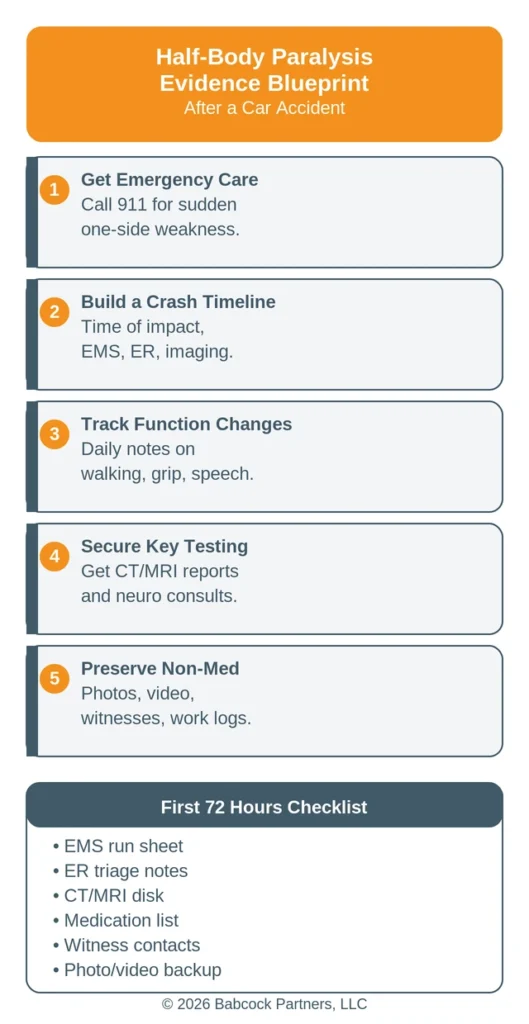
Printable toolkit: Download the printable toolkit (PDF) to keep the checklists and both infographics in one place. This is designed to print cleanly and travel with you to appointments.
If you are inside the first 72 hours, call (225) 500-5000 or use the free case review form before evidence changes.
Can a Car Accident Cause Half-Body Paralysis?
Yes, a car accident can cause half-body paralysis when trauma interrupts how the brain or spinal cord controls movement; in Cleveland Clinic’s hemiplegia overview, hemiplegia describes paralysis on one side of the body. Because sudden one-side weakness can also be a stroke warning sign, CDC’s stroke signs and symptoms page says to call 9-1-1 immediately.
- In NINDS’s spinal cord injury overview, the institute explains that cord damage can affect strength and sensation.
- Mayo Clinic’s spinal cord injury page lists weakness, numbness, and loss of movement as possible effects.
- CDC’s traumatic brain injury overview describes TBI as an injury that affects how the brain works.
- When weakness is “partial” instead of complete paralysis, Cleveland Clinic’s hemiparesis explanation ties one-side weakness to disruptions in the brain, spinal cord, or related nerves.
If your doctors are evaluating spinal cord involvement, start with our Baton Rouge spinal cord injury page to see how these cases are usually documented and proven. We also see overlap with serious crash trauma that belongs on a catastrophic injury track, because paralysis claims often turn on long-term function limits. That is what we mean by leverage when we insist on clean early records that match what you were experiencing, not just what someone typed later.
What Should You Do in the First 72 Hours?
In the first 72 hours, your priority is emergency evaluation, stabilization, and follow-up planning, which Mayo Clinic’s spinal cord injury diagnosis and treatment guide describes as the immediate focus when serious neurologic symptoms appear. At the same time, you should preserve early records and crash proof so your medical story and your evidence story stay aligned.
- Get evaluated urgently and follow discharge instructions.
- Write down the first moment you noticed one-side weakness and how it changed.
- Ask for copies of EMS and ER records while they are easy to request.
- Save the imaging disk and the written radiology report, not just a summary.
- Back up photos, videos, and witness details from the crash scene.
If weakness is sudden, severe, or paired with trouble speaking, facial droop, or confusion, treat it as an emergency even if the crash seemed “minor.” CDC’s stroke guidance highlights that fast action can be critical.
This is why we push evidence preservation early: the first EMS run sheet, the first ER triage note, and the first imaging order often become the “timestamp” everyone argues about later. Insurers also look hard for gaps, inconsistencies, and missing objective anchors, especially when the injury is neurologic and life-changing. You do not need perfect paperwork on day one, but you do need a plan that keeps the record honest and complete.
Timeline Builder: What Should You Write Down Each Day?
Your timeline should show what changed and when, using short daily notes that connect symptoms to real-life function. This is especially important when half-body paralysis after a car accident fluctuates from hour to hour or improves in one task but not another.
| Daily Entry | Why It Matters |
|---|---|
| Time you woke up and first symptoms | Shows whether weakness is constant, worse in mornings, or triggered by activity. |
| Walking, balance, and falls | Turns “I feel weak” into specific functional limits an adjuster or jury can understand. |
| Hand grip, writing, and fine motor tasks | Helps prove one-side loss of control and how it affects work and self-care. |
| Speech, vision, and cognition notes | Supports evaluation of brain involvement, which NINDS describes in its TBI overview as a condition that can change thinking and function. |
| Medication changes and side effects | Explains fatigue, dizziness, and why some days look different than others. |
Daily Function Log Template
A good log is short, consistent, and written like a nurse’s note rather than a diary. If you can, take one photo of the log each week and store it in a cloud folder so it does not disappear with a lost phone.
- One sentence on what you tried to do that day.
- One sentence on what failed or took longer because of weakness.
- One sentence on what helped: rest, therapy, medication timing, or assist devices.
What Medical Testing and Records Matter Most?
The most helpful medical proof usually combines a neurologic exam, imaging, and a treatment plan that makes sense for the symptoms you reported. In suspected spinal cord injury, Johns Hopkins Medicine’s acute spinal cord injury overview highlights the role of prompt evaluation and care planning.
- EMS and ER records: They capture your first complaints before anyone has a reason to “frame” the story.
- Radiology report plus images: Mayo Clinic’s diagnosis and treatment discussion explains that imaging is part of how clinicians evaluate spinal cord injury.
- Neurology consult notes: These notes often document strength testing, reflexes, and sensation changes.
- Therapy evaluations: PT/OT tests turn symptoms into measurable limits you can track over time.
- Brain injury screening: When the crash may involve head trauma, CDC’s TBI overview explains that TBI affects how the brain works and may require follow-up care.
Do not panic if the first scan report sounds reassuring. In Johns Hopkins Medicine’s acute spinal cord injury overview, the focus is on ongoing neurologic evaluation and care planning, which is why follow-up exams still matter even when early imaging is limited. Your job is to keep symptoms and function documented so the medical team can decide whether additional testing is needed.
If providers mention brain involvement, our Baton Rouge brain injury page covers proof issues like symptom consistency and testing. If the main concern is spinal cord damage, our spinal cord injury claim guidance explains how lawyers and doctors typically build the record together. For crash mechanics, you can also review the basics on our Baton Rouge car accident page, because liability proof still matters even when the injury is medical.
Defense Audit: How Do Insurers Dispute One-Side Paralysis?
Insurers often dispute half-body paralysis after a car accident by arguing the crash did not cause it, the testing is “normal,” or the symptoms do not match the paperwork. The best response is a record that ties timing, symptoms, and functional loss together so the file answers the questions an adjuster is trained to ask.
| Common Pushback | Evidence That Helps |
|---|---|
| “The crash was low impact.” | Scene photos, vehicle repair records, and EMS notes that document immediate neurologic complaints. |
| “Imaging is normal.” | Radiology reports, follow-up testing plans, and therapy evaluations showing real limits in daily function. |
| “This is pre-existing.” | Baseline records that show your prior level of function and a clear change after the crash. |
| “You got better, so it wasn’t serious.” | Consistent follow-up notes and a timeline showing what remains hard even on “good” days. |
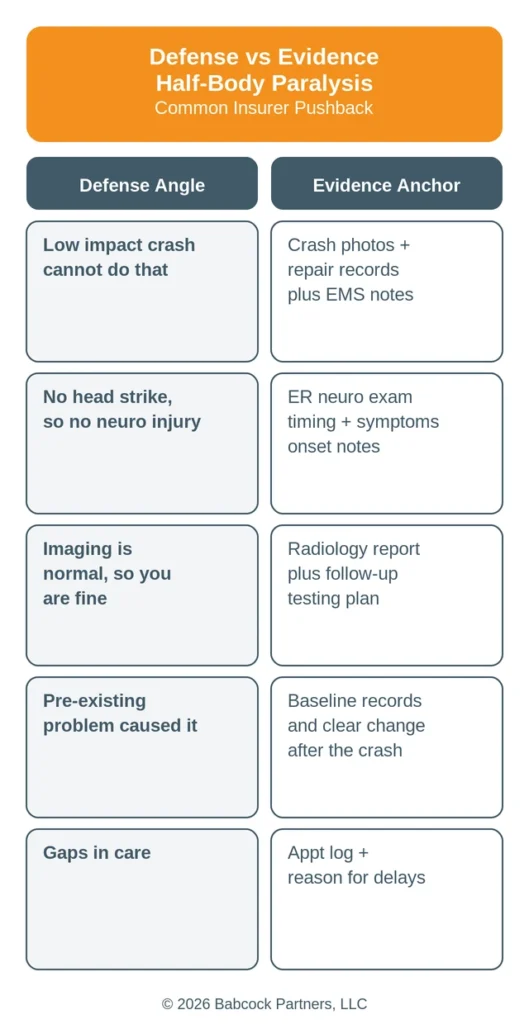
This is why we build a “defense-first” file: we assume the carrier will focus on gaps, not on your day-to-day reality. That is what we mean by leverage when we organize evidence around the exact denial themes we expect. When you are in Baton Rouge or nearby, we also use local resources and scene context from the Baton Rouge hub to keep the investigation practical.
What we see in practice
We see that paralysis and one-side weakness cases rise or fall on consistency and timing, not on dramatic language. We also see that the strongest files connect medical findings to real function limits in work, self-care, and mobility.
- Early records matter more than later summaries.
- Gaps in care become “gaps in credibility” unless you document why they happened.
- Therapy notes often explain function better than a single imaging report.
- Non-medical proof like photos, witness accounts, and work logs can support the timing of decline.
When Should You Talk to a Lawyer Quickly?
You should talk to a lawyer quickly when half-body paralysis after a car accident creates an evidence problem or a deadline problem. Under La. Civ. Code art. 3493.1, many Louisiana personal injury claims are subject to a two-year prescriptive period, but waiting is still risky because records and witnesses change.
- You have new weakness, numbness, or loss of coordination and cannot work or drive.
- The crash involved multiple vehicles, a commercial driver, or unclear fault.
- You were transferred between facilities and records are scattered across systems.
- An insurer is pushing for a quick statement or quick release before your diagnosis stabilizes.
- You need help preserving video, vehicle data, or witness contact details.
Printable toolkit: Download the printable toolkit (PDF) if you want the evidence checklist and the defense-vs-evidence table in a handout. It is useful for organizing questions for doctors and keeping your notes consistent.
Louisiana Law Snapshot (Updated 2026)
Louisiana generally uses a two-year delictual prescription for many injury claims, and La. Civ. Code art. 3493.1 is where that deadline is commonly discussed. Louisiana also applies comparative fault, and La. Civ. Code art. 2323 addresses how fault can reduce recovery and reflects the post–Jan. 1, 2026 51% bar.
- Mark the crash date and do not assume you can “wait and see,” because art. 3493.1 is unforgiving when the clock runs out.
- Expect fault arguments, and remember art. 2323 can reduce what you recover if a factfinder assigns you a share of fault.
- Even when the injury is medical, negligence principles still matter, and La. Civ. Code art. 2315 is a core starting point for fault-based injury claims.
Free Case Review Next Steps
We are not built for volume. We are built for leverage. If a crash left you with one-side weakness, we use the Babcock Benefit mindset to lock down the timeline, preserve proof, and prepare the claim like it may be tried. Call (225) 500-5000 and use the free case review form so we can help you triage records, deadlines, and insurer strategy while care is underway. Do it quickly because crash video can disappear, notes can drift from what you felt, and deadlines keep moving while you recover.
These items are helpful to have with you when you call, but do not delay calling because you do not have them. If you have them handy, keep them nearby for the call.
- Crash location, date, and the investigating agency name
- Any EMS or ER paperwork you were given
- Names of hospitals, clinics, and therapists you have seen
- A short list of your biggest day-to-day limits
- Photos of the vehicles and any visible injuries
Call Today If…
- Your symptoms changed quickly in the first days after the crash
- An insurer is pushing for a recorded statement or a release
- You suspect missing records or you cannot get the imaging disk
- You have new weakness and your work status is uncertain
If spinal cord damage is part of the picture, we can also point you to help with a spinal cord injury case so you understand the proof path without guessing. Evidence can fade fast, and neurologic symptoms can evolve, so urgency is about preserving what is real today. If you are dealing with severe symptoms, emergency care comes first, and the paperwork can be organized after you are safe.
What Happens Next
- We triage evidence: medical records, imaging, therapy notes, and crash proof.
- We spot deadlines and the right claim lanes based on the facts and parties involved.
- We set an insurer contact plan that protects your timeline and your treatment focus.