


Editorial & Legal Accuracy Notice (Louisiana)
This blog contains general legal and safety information and is not legal advice. Laws and deadlines can change, and outcomes depend on specific facts.
Last reviewed / updated: March, 2026
Reviewed, updated, and authored by: Stephen Babcock, Louisiana injury lawyer
This guide explains when Louisiana drivers should notify police after a crash, how to keep the report accurate, and what to preserve for insurance and injury claims.
In many Louisiana claims, the police report becomes the first document an adjuster reads, so small errors can create big proof problems later. Even when an officer does not respond, you can still create a clear record with photos, witness contacts, and a same-day timeline. Below, we walk through when to report, what to say, and how to get the crash report without turning a stressful moment into a paperwork trap.
We focus on building the record early, because the best leverage is proof you can still collect. We are not built for volume. We are built for leverage. Speed + evidence preservation + insurer-insider knowledge + trial-ready preparation = The Babcock Benefit. In a police-report case, leverage means your timeline and documentation stay consistent when the insurer starts testing your story.
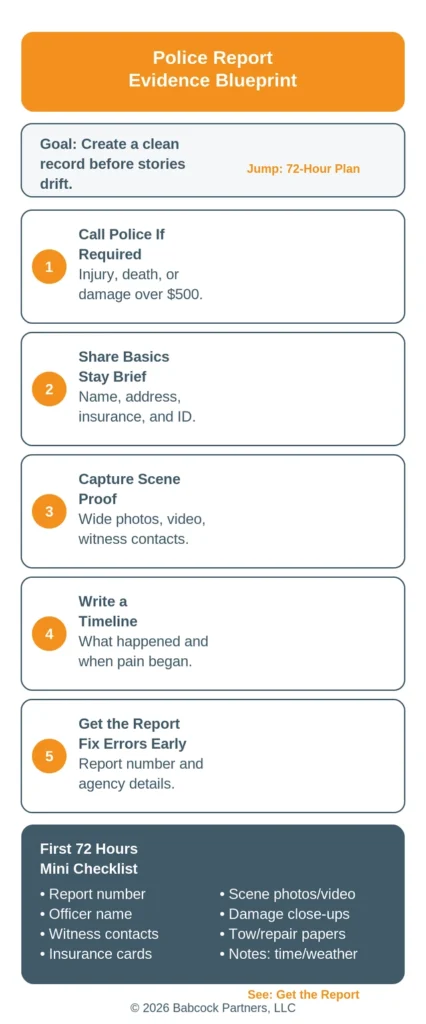
Download the printable toolkit (PDF) to keep the first-72-hours checklist and both infographics in one place.
If you are inside the first 72 hours, call (225) 500-5000 or use the free case review form before evidence changes.
Firm links: Client Reviews | Contact | Locations
Do You Have to Report a Car Accident to the Police in Louisiana?
Yes—La. R.S. 32:398 says drivers must report crashes that involve injury or death, or when property damage appears to exceed $500, and the notice generally must be made immediately to the proper law enforcement agency. The same statute also explains that if evacuation orders or a declared emergency prevents immediate notice, the report must be made within 72 hours when conditions allow.
- If anyone may be hurt, call 911 and request an officer.
- If damage looks more than minor, call and ask for an incident or report number even if an officer is delayed.
- If the other driver is uninsured, intoxicated, or leaves the scene, call law enforcement and avoid chasing them.
- If you are unsure, call and let the dispatcher advise you on the right next step.
If you were hit in Baton Rouge and your claim is already turning into a dispute, we focus on the facts you can prove and the evidence you can still collect. Our Baton Rouge car accident practice page explains how we build that record.
What Information Should You Give Police After a Crash?
La. R.S. 32:398 describes the core information drivers should provide, including identification details and proof of insurance, so the report has usable basics. Keep your description factual and short so you do not accidentally lock in a guess that becomes a “statement against interest” later.
| Good Information to Provide | Better Framing for Gray Areas |
|---|---|
| Driver name, address, and license details | If you are unsure about something, say you do not know and that you can follow up after you review photos. |
| Vehicle info and insurance card details | Ask the officer how to add a supplement if you later find a witness or video. |
| Where each vehicle ended up and what you saw | Describe what happened in sequence instead of giving legal conclusions like “it was their fault.” |
Accuracy matters, because La. R.S. 32:1023 addresses penalties tied to knowingly giving false information in a crash report context. If you do not know a detail, it is usually better to say “I’m not sure” than to guess.
What If Police Do Not Respond or Ask You to Self-Handle?
If police do not come, you can still document the crash in a way that protects you in an insurance dispute. The goal is to preserve neutral proof, so the claim does not become a credibility contest weeks later.
- Get to a safe location, then exchange driver and insurance information.
- Take wide photos first, then close-ups, then a short video sweep of the entire scene.
- Ask witnesses for contact details and a one-line description of what they saw.
- Write a same-day timeline while details are fresh, including time, weather, and road conditions.
- If property damage is the main issue, keep every estimate and receipt; our property damage claim page explains the documentation that tends to matter in valuation disputes.
How Do You Get a Copy of the Crash Report in Louisiana?
Louisiana State Police’s Traffic Records Unit explains how crash reports are requested and why timing matters, because reports are not always available immediately. If the report was handled by LSP, the official Louisiana crash report portal is a common starting point for obtaining a copy.
| Where to Start | What You Need | Practical Tip |
|---|---|---|
| Responding agency records unit | Date, location, drivers, and the report or incident number | Ask whether a supplement can be added if you later locate a witness or video. |
| Louisiana State Police portal (LSP reports) | Crash details used for lookup and identity verification | Search as soon as you can, because early review lets you flag errors quickly. |
Timeline Builder: The First 72 Hours After a Crash
The first 72 hours is your best window to preserve evidence that disappears and to keep your story consistent. Use this timeline to build a clean, date-stamped record that matches what will later be written in reports and adjuster notes.
| Time Window | Best Actions |
|---|---|
| 0–2 hoursScene and safety | Call law enforcement if required, take wide photos, capture traffic controls, and get witness contacts. |
| Same dayLock details | Write your timeline, save texts and call logs, and back up photos to a second location. |
| 24–72 hoursFill gaps | Request the report number if you do not have it, identify nearby cameras, and preserve tow and repair records. |
This is why we treat the first 72 hours as an evidence window: we want dispatch records and nearby video before routine overwrites wipe them out. If you want the checklist in one place, use the PDF toolkit link near the top.
Quick reference: the police-report evidence blueprint and first-72-hours checklist. (Download the printable PDF below.)
Evidence Checklist: What to Save Before the Story Changes
When there is no clear police report, adjusters often argue about what happened based on small gaps in the record. Your goal is to save neutral proof that does not depend on memory.
- Report number or incident number, the officer’s name, and the agency that handled the call.
- Photos of vehicle positions, damage, skid marks, debris, and traffic signals from multiple angles.
- Witness contacts plus a one-sentence note of what each witness said they saw.
- Tow slip, repair estimate, and any communication about storage or total-loss decisions.
- If distraction may be an issue, preserve what you can and avoid speculation; our distracted driving page explains why documentation matters more than accusations.
That is what we mean by leverage in documentation: your photos and notes make the insurer argue with the record, not your recollection. This is also why we encourage prompt review of the report once it becomes available.
What we see in practice
In real claims, the “police report” issue is rarely just about one document—it is about what the insurer can point to when negotiating. When the report is thin, missing, or wrong, adjusters often treat that gap as permission to push fault or minimize injuries.
- Officers may not respond to minor crashes, which creates a proof gap that the insurer later calls “no objective record.”
- Small report errors, like the wrong lane or time, can become the anchor for a denial unless corrected quickly.
- Insurers may request recorded statements early, before you have seen the report, photos, or repair estimate.
- Video from nearby businesses can be decisive, but many systems overwrite quickly if no one asks fast.
Defense Audit: How Insurers Use a Missing Police Report
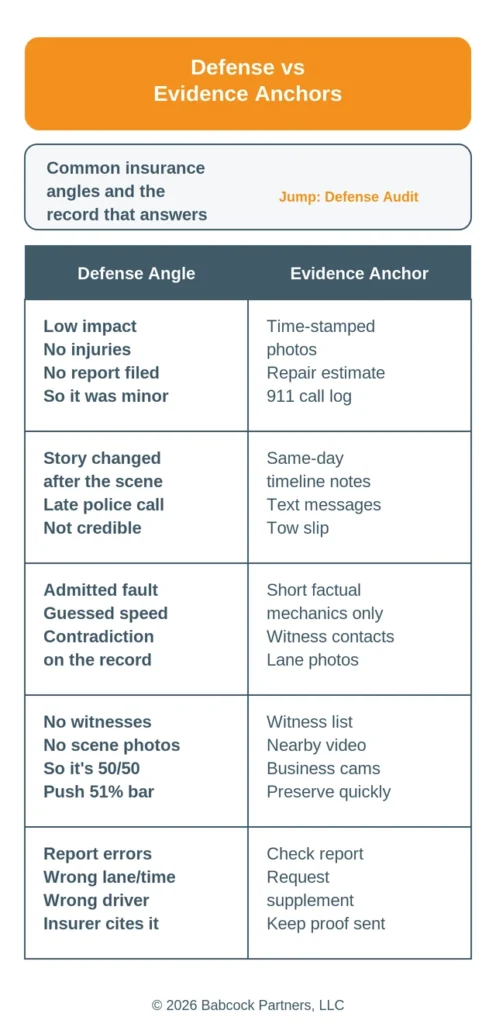
When there is no clear report, insurers often test your claim with predictable “proof gap” arguments. The best response is not a louder story—it is a cleaner record that answers each angle with documents.
| Common Defense Angle | Evidence Anchor That Helps |
|---|---|
| “Low impact, so no injury.” Adjusters point to minimal damage or no officer response. | Time-stamped photos, repair estimates, tow records, and a same-day symptom/timeline note. |
| “You waited, so your story changed.” They frame delays as credibility problems. | Call logs, texts, dispatch details, and a written timeline created the day of the crash. |
| “You admitted fault.” A polite apology gets treated as an admission. | Stick to mechanics, preserve lane and signal photos, and gather witness contacts. |
| “No witnesses, so it’s 50/50.” They push comparative fault to reduce recovery. | Witness list, nearby video requests, and any business camera preservation steps. |
| “The report is wrong, but it’s the only record.” Errors become the default narrative. | Prompt review, requests for supplements, and written corrections with proof of submission. |
This is why we map defense angles early: insurers use gaps to push fault and shrink value, and we want the counterproof ready. For how we build an auto claim around evidence, see our car wreck case page.
Download the printable toolkit (PDF) if you want the defense-audit table and both infographics in a print-friendly format.
Louisiana Law Snapshot (Updated 2026)
La. Civ. Code art. 3493.1 sets a two-year delictual prescription period for many Louisiana injury claims, which means you often have two years to file suit from the date of injury. La. Civ. Code art. 2323 explains comparative fault, and it also adds that for causes of action arising on or after January 1, 2026, a plaintiff found 51% or more at fault cannot recover.
- Deadline risk: Waiting for a “final” crash report can burn time, so track the prescription date early.
- Fault risk: Report gaps and missing witnesses can make it easier for insurers to argue you share most of the blame.
Free Case Review and How We Build Leverage Early
We are not built for volume. We are built for leverage. When the police report is missing or wrong, we build leverage by preserving evidence early and closing proof gaps, which is the plain-English idea behind the Babcock Benefit.
Call (225) 500-5000 and use the free case review form to start the evidence triage, because video overwrites, vehicles get repaired, and report errors harden into “facts” quickly. For more on our approach to auto claims, you can also review our car accident team page and then bring your questions to the call.
These items are helpful to have with you when you call, but do not delay calling because you do not have them. If you have them handy, keep them nearby for the call.
- Report or incident number, plus the agency name
- Photos/video and witness contacts
- Tow and repair paperwork
- Insurance policy and claim numbers (if opened)
- Your same-day timeline notes
Call Today If…
- The other driver left the scene or you suspect impairment
- You were told “no officer will respond” and you need a plan to document the crash
- The report has errors that could change fault
- A commercial vehicle, rideshare, or company truck was involved
- You are being pushed to give a recorded statement or sign a release quickly
What Happens Next
- We triage evidence fast: report numbers, witness list, photos, video sources, and missing records.
- We spot deadlines and pressure points, then plan communications so your statement matches provable facts.
- We build a trial-ready file early, so the insurer negotiates against documentation instead of assumptions.