Editorial & Legal Accuracy Notice (Louisiana)
This blog contains general legal and safety information and is not legal advice. Laws and deadlines can change, and outcomes depend on specific facts.
Last reviewed / updated: March, 2026
Reviewed, updated, and authored by: Stephen Babcock, Louisiana injury lawyer
This guide explains why traumatic brain injury (TBI) cases get challenged and how to build a cleaner proof record in Louisiana.
Proving a traumatic brain injury (TBI) can feel backwards: you feel different, but the claim file wants tidy “objective” proof. In CDC’s concussion basics, the agency explains that concussion is a type of TBI caused by a bump, blow, or jolt. If you need help preserving proof early, start with our Baton Rouge brain injury practice page and then use the checklists below.
At Babcock Injury Lawyers, we start TBI cases by treating the first week like an evidence emergency, not a paperwork chore. We are not built for volume. We are built for leverage. Speed + evidence preservation + insurer-insider knowledge + trial-ready preparation = The Babcock Benefit. That is what we mean by leverage in TBI litigation: a clean timeline and function-based proof that makes “you seem fine” hard to sell.
On Johns Hopkins Medicine’s concussion overview, clinicians note that symptoms can appear right away or come on slowly and that force transmitted from the body can cause concussion. That is why the record you build after the crash often matters as much as the scan.
If you are inside the first 72 hours, call (225) 500-5000 or use the free case review form before evidence changes.
Firm links: Client Reviews | Contact | Locations
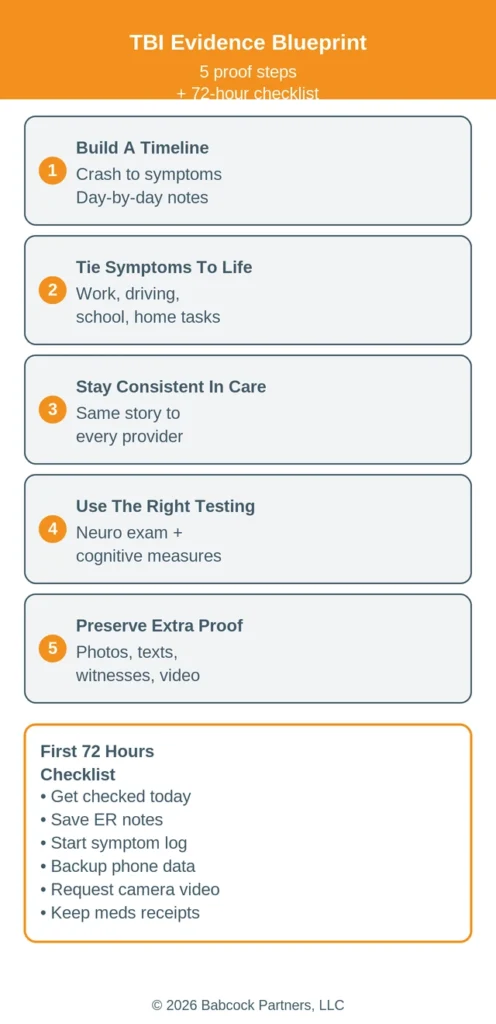
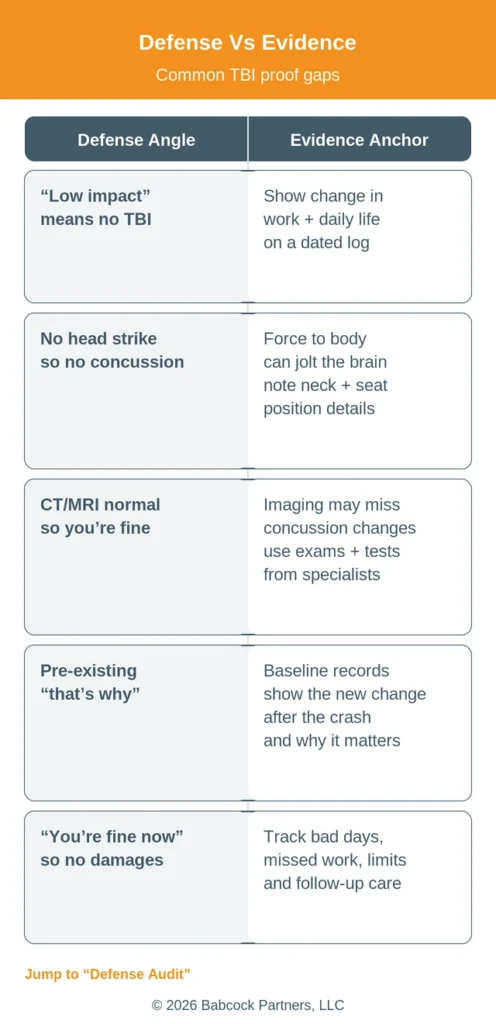
Download the printable toolkit (PDF) for both infographics and the appointment-ready checklists.
How Do You Prove a Traumatic Brain Injury (TBI) in Louisiana Court?
You prove a TBI by showing a real before-and-after change and connecting it to the crash with consistent medical documentation and credible daily-life impacts. Because Cleveland Clinic’s concussion diagnostics overview explains that conventional imaging like CT and MRI does not detect concussions, strong cases often rely on timelines, clinical exams, symptom-to-function proof, and preserved non-medical evidence.
- Build a dated timeline: crash details, first symptoms, and what changed day by day.
- Confirm the diagnosis path: exams, referrals, and why imaging was ordered or not ordered.
- Translate symptoms into function: work limits, driving issues, and daily tasks you can’t do the same way.
- Preserve non-medical proof: video, witness notes, texts, calendars, and device data before it disappears.
- Anticipate defense themes: “low impact,” “normal scan,” “pre-existing,” and “you’re fine now.”
In NINDS’s TBI overview, the NIH explains that TBI results from an outside force and that concussion is a type of mild TBI. This is why we build the “proof spine” early: dated facts first, opinions second, and no gaps for an adjuster to fill with a story that minimizes the injury.
What Makes TBI Hard to Prove (and How Insurers Push Back)?
TBI is hard to prove because the injury often looks “normal” on basic scans and the most important impacts show up in attention, mood, sleep, and work stamina. When CDC’s concussion basics describes concussion as a brain injury that affects how the brain works, it also signals why claims get challenged: the effect is real, but the proof is easy to under-document.
- Invisible symptoms: brain fog, headaches, sleep disruption, and irritability don’t photograph well.
- Delayed onset: symptoms can show up later, so the first record may not capture the full picture.
- “Normal imaging” messaging: insurers lean on CT/MRI results to imply nothing happened.
- Pre-existing allegations: they blame stress, migraines, anxiety, or prior injuries.
- Function gaps: if you can’t show what changed at work or home, they call it “subjective.”
That is what we mean by leverage when the claim feels like an argument about “how you look” instead of “how you function.” A structured record shifts the conversation from vibes to verifiable facts.
First 72 Hours: Evidence That Disappears Fast
The first 72 hours are about stopping evidence loss and locking in a clean “first narrative” while details are fresh. Because Johns Hopkins Medicine notes that concussion symptoms may come on slowly over time, you want an early record of the crash and your first changes even if symptoms evolve.
- Video: request nearby camera footage quickly because systems overwrite.
- Witnesses: capture names, numbers, and a short “what you saw” note.
- Medical entry point: ER or urgent care documentation anchors timing and initial complaints.
- Symptom log: short daily entries show progression and consistency.
- Vehicle and interior photos: document headrest position, seatbelt marks, and cabin contact points.
Talk to a lawyer quickly if a business has video, a vehicle may be repaired or totaled, you were in a rideshare or commercial vehicle, or an insurer is pushing for a recorded statement before you have follow-up care.
Timeline Builder: Turning Symptoms Into a Dated Record
A timeline turns “I don’t feel right” into a dated record that a jury can follow and an insurer can’t easily dismiss. When CDC’s Acute Concussion Evaluation (ACE) tool describes concussion as typically having normal structural imaging, it highlights why timing, symptoms, and functional change matter as much as pictures.
| Date / Time | What Changed | Where It Shows Up |
|---|---|---|
| Day of crash | Headache, dizziness, nausea, confusion, or “not myself” | ER/urgent care note, texts to family, photo timestamps |
| Days 1–3 | Sleep disruption, light/noise sensitivity, irritability | Symptom log, missed shifts, school absence records |
| Week 1 | Brain fog, memory issues, reduced stamina | Supervisor emails, calendar changes, follow-up appointments |
| Weeks 2–6 | Persistent symptoms or slow improvement with flare-ups | Therapy notes, specialist referrals, accommodation requests |
This is why we push the timeline early: it preserves reality before memory softens and before the claim file gets labeled “minor.” If your crash involved a vehicle collision, our Baton Rouge car accident page explains how we typically approach early evidence preservation across injury types, including TBI.

Connect Symptoms to Function (Work, School, Driving, Parenting)
Function proof is how you translate symptoms into real-life limits without exaggeration. When CDC explains that concussion affects how the brain works, it helps frame why concentration, reaction time, and sleep can matter even when you “look okay.”
- Work: errors, reduced pace, missed shifts, or needing extra breaks.
- Driving: avoidance, slower reactions, or difficulty with busy intersections.
- Home tasks: cooking mistakes, forgetting steps, irritability with noise.
- School: headache with screens, reduced reading endurance, attention drift.
- Relationships: mood swings, patience changes, social withdrawal.
A simple rule helps: pick three daily tasks you used to do easily, then write how each one changed and when. If you can say it plainly, you can usually support it with a record.
Testing and Diagnosis: What Actually Helps in a Mild TBI Case
In many mild TBI cases, the best proof comes from a careful clinical evaluation and consistent follow-up, not a single “magic” test. As Cleveland Clinic’s concussion overview explains, imaging tests can’t diagnose a concussion, but providers may use CT or MRI to look for serious complications like bleeding.
- Emergency documentation: initial symptoms, neuro checks, discharge instructions, and referrals.
- Clinical exam: balance, vision, vestibular screening, and neurologic findings.
- Cognitive measures: screening or formal testing when deficits are persistent or unclear.
- Consistency: repeating the same accurate history across providers avoids “changing story” arguments.
- Imaging context: Mayo Clinic’s concussion diagnosis guidance describes CT as a common early test after injury, but imaging alone does not answer how you functioned after the crash.
One common proof gap is a gap in care rather than a lack of symptoms. If you had reasons for delayed care, write them down and save the messages or calendar entries that show what was happening.
Defense Audit: Five Common Narratives and the Evidence That Counters Them
Insurers tend to recycle a few familiar narratives in TBI cases, and each one has a predictable proof “counter.” Because Cleveland Clinic’s Concussion Center states that conventional imaging does not detect concussions, “normal imaging” arguments often fall apart when the clinical record and function proof are consistent.
| Defense Angle | Evidence Anchor That Helps |
|---|---|
| “Low impact” | Timeline + symptom-to-function proof: missed work, reduced stamina, and consistent follow-ups. |
| No head strike | Crash mechanics and body-force explanation: Johns Hopkins Medicine notes a concussion can result from a jolt and from force transmitted to the head. |
| Normal CT/MRI | Context: CDC’s ACE tool describes concussion as typically associated with normal structural imaging, so clinical findings and function proof matter. |
| Pre-existing | Baseline records and the “new change”: show what was stable before and what shifted after the crash. |
| “You’re fine now” | Document flare-ups, missed time, restrictions, and follow-up care, not just the “good day” snapshot. |
That is what we mean by leverage when an adjuster tries to turn a complex recovery into a simple soundbite. We prefer to answer narratives with dated records that make the “easy” story harder to maintain.

Social Media, Wearables, and Daily Logs: Non-Medical Proof
Non-medical proof helps a jury understand the “lived impact” of a TBI without relying on labels or jargon. When NINDS explains TBI as injury caused by an outside force, it reinforces that you can prove a change even when the most obvious evidence is behavioral or functional.
- Texts and emails: “I can’t focus,” “I forgot,” “I’m dizzy,” and scheduling changes.
- Calendar evidence: missed events, cancellations, shorter shifts, extra rest breaks.
- Wearables: sleep disruptions or activity drops, saved as screenshots with dates.
- Social media: do not delete; save copies and avoid “I’m fine” posts in early days.
- Witness notes: short observations from a spouse, coworker, or friend with dates.
This is why we treat non-medical proof as part of the evidence plan, not as an afterthought. It can fill the gaps that imaging and brief office visits naturally leave behind.
What we see in practice
We often see insurers minimize TBIs by treating the case like it is only about property damage and “impact.” That approach ignores how concussion symptoms can build over days and how function loss shows up at work and home, not on a photograph.
We also see “record problems” create more harm than the injury itself: missed appointments, inconsistent histories, and long gaps without documentation. When the record is thin, the insurer does not just ask questions; it supplies answers that favor the cheapest interpretation.
We aim to make the record easier to understand than the defense narrative. When you have a clear timeline, consistent care, and function-based proof, it is harder to dismiss the injury as “subjective,” and it is easier to explain the case to a jury if litigation becomes necessary.
Common Mistakes That Shrink a TBI Claim
Most TBI cases don’t fail because the symptoms are fake; they fail because the proof record is incomplete or inconsistent. Since Cleveland Clinic notes that imaging does not diagnose concussion, you cannot rely on a scan alone to carry the claim.
- Waiting to document: no symptom log, no work impact notes, and no dated narrative.
- Inconsistent history: different versions of symptoms or timing across providers.
- Gap in care: long stretches with no follow-up and no written reason for the gap.
- Over-sharing with insurers: casual statements that get used as “you were fine.”
- Deleting posts: removal looks worse than context; preserve and explain instead.
If you want a simple organizer for appointments and insurer calls, Download the printable toolkit (PDF) and keep it with your discharge papers and notes.
Louisiana Law Snapshot (Updated 2026)
Two deadlines can quietly shape a TBI claim in Louisiana: the time to file and the effect of your own fault percentage. In La. Civ. Code art. 3493.1, the Legislature sets a two-year prescription period for delictual actions, and in La. Civ. Code art. 2323 the comparative fault rules now include a 51% bar effective January 1, 2026.
- Two-year prescription: the clock generally starts when injury or damage is sustained, so early deadline spotting matters.
- Comparative fault: your recovery can be reduced by your fault percentage, and if you are 51% or more at fault, you may recover nothing under the current statute.
- Practical takeaway: preserve evidence early because liability disputes can decide the case before damages are even discussed.
Free Case Review: Evidence-First Next Steps
We are not built for volume. We are built for leverage. We use the Babcock Benefit mindset to protect time-sensitive evidence, build a clean symptom-to-function story, and plan around the insurer’s favorite narratives.
If your TBI symptoms are affecting work, driving, or daily life, call (225) 500-5000 and use the free case review form below so we can triage the evidence while it is still available. For more on how we approach these claims, review our traumatic brain injury (TBI) case page and then come back to the checklist.
Urgency is not about hype; it is about disappearing proof, shifting stories, and hard deadlines. Video overwrites, witness memories fade, and early insurer calls can lock in an inaccurate narrative if you are not ready.
These items are helpful to have with you when you call, but do not delay calling because you do not have them. If you have them handy, keep them nearby for the call.
- Crash report number (if you have it) and the date/time/location
- Your first medical visit notes and any referrals
- A short symptom timeline (even 5 bullet points)
- Work or school absences and any restrictions
- Names of witnesses or businesses that may have video
Call Today If…
- A business, apartment complex, or truck stop may have video
- Your vehicle may be repaired, totaled, or released from storage
- An insurer wants a recorded statement right away
- You are missing work or can’t drive safely
- You had prior migraines, anxiety, or a previous head injury and expect “pre-existing” arguments
What Happens Next
- Evidence triage: we identify what can disappear and send targeted preservation requests.
- Deadline spotting: we map prescription timing and comparative fault issues early.
- Insurer contact strategy: we control communications so the record stays accurate and consistent.