

A driver who keeps missing exits, drifting toward the shoulder, or struggling to remember the last few miles needs to stop driving. Opening a window, turning up music, or changing the seat position will not replace sleep. Fatigue can affect a commuter on I-10 just as easily as a truck driver finishing a long run.
If a tired driver caused a crash, the question is also how to prove it. The driver may deny being sleepy, and a police report may never use the word “fatigue.” Timing, witness accounts, electronic records, and the circumstances of the collision can tell a more useful story.
What are the warning signs of drowsy driving?
Repeated yawning, heavy eyelids, trouble concentrating, missing a turn, difficulty recalling the last stretch of road, and drifting out of a lane are reasons to pull over. Striking a rumble strip is a warning that the driver may already have lost attention. A person can briefly fall asleep without realizing it.
The National Highway Traffic Safety Administration identifies midnight to 6 a.m. and the late afternoon as common periods for drowsy-driving crashes. A crash can happen at any hour, especially after inadequate sleep, a long shift, or a medication that causes drowsiness. Do not wait for several signs to appear together. One episode of lane drift is enough to change plans.
What should you do if you get sleepy behind the wheel?
Find a safe place to leave traffic. A designated, well-lit rest stop or other safe parking area is better than stopping on the shoulder unless an emergency makes that unavoidable. If you are too tired to continue, sleep, switch to a rested driver, arrange another ride, or stop for the night.
NHTSA says a short nap of about 20 minutes, sometimes combined with caffeine, may improve alertness for a limited time. It is a short-term measure, not a way to turn an exhausted person into a safe long-distance driver. Coffee by itself can leave a driver feeling more alert while brief episodes of sleep still occur. If you remain sleepy after a break, do not resume the trip.
For a planned drive, get adequate sleep beforehand, allow time for stops, and avoid scheduling the hardest part during the hours when you are normally asleep. Check prescription and over-the-counter medication warnings. Alcohol can worsen sleepiness and impairment. Passengers should speak up when they see a driver nodding, drifting, or struggling to stay engaged.
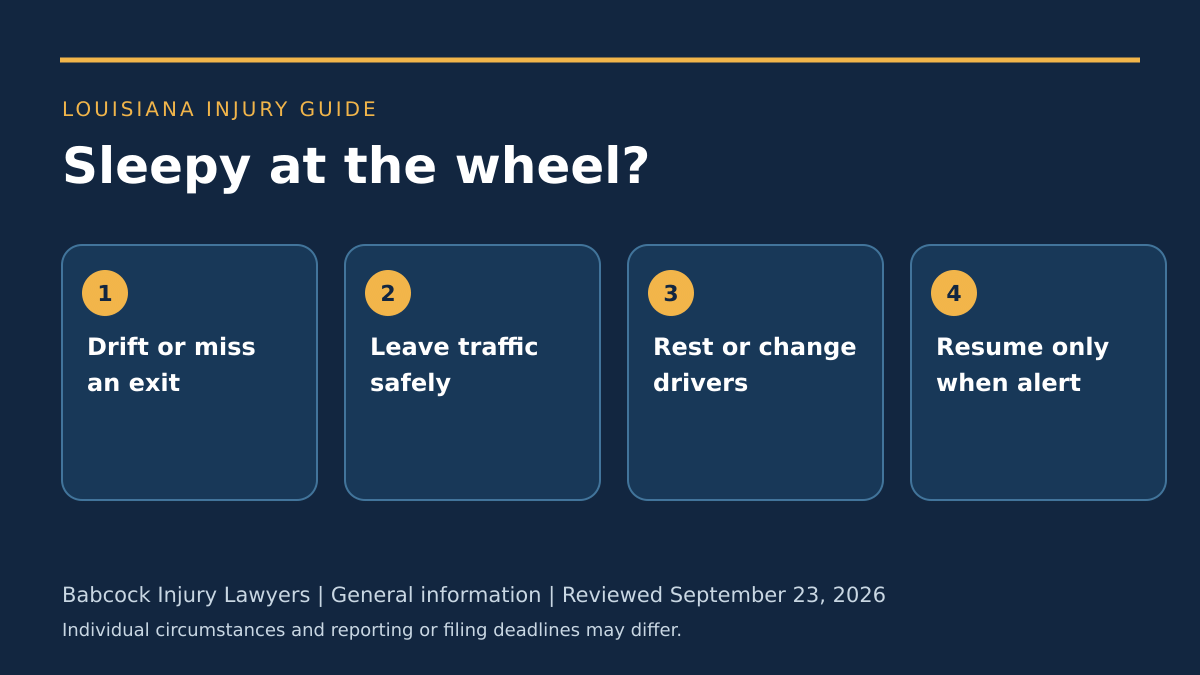
Cold air, loud music and snacks may briefly change how awake you feel. They do not replace sleep. If you are relying on them to keep your eyes open, stop driving. A work deadline does not make it safe to continue; tell the dispatcher or supervisor why you need to stop and keep the exchange if it later becomes relevant.
What rules apply to a fatigued commercial truck driver?
For many property-carrying commercial drivers covered by federal hours-of-service rules, the FMCSA summary describes an 11-hour driving limit after 10 consecutive hours off duty, a 14-hour driving window, and a 30-minute interruption after eight cumulative hours of driving without one. Weekly limits also apply. There are exceptions and different rules for some operations, including certain short-haul and passenger trips. A log alone does not establish that every rule applied to a particular vehicle or trip.
The hours shown on a log do not necessarily show how much a driver slept. Conversely, an hours-of-service violation does not by itself establish that fatigue caused a specific crash. The route, dispatch schedule, records, physical evidence, and witness testimony must be examined together. Our discussion of electronic logging device evidence in truck fatigue cases explains how logs can be compared with other records.
When a tractor-trailer is involved, our Baton Rouge truck accident page explains how the investigation can extend beyond the driver to the carrier and others who controlled the trip.
A traffic citation is not required for a civil claim and does not conclusively prove one. The evidence must connect a breach of duty to the injury. Where a company is involved, its responsibility depends on the driver’s work, the legal relationship and what the company controlled. Dispatch demands and company knowledge may matter; a logo on the truck does not resolve employment or insurance questions.
How can fatigue be investigated after a Louisiana crash?
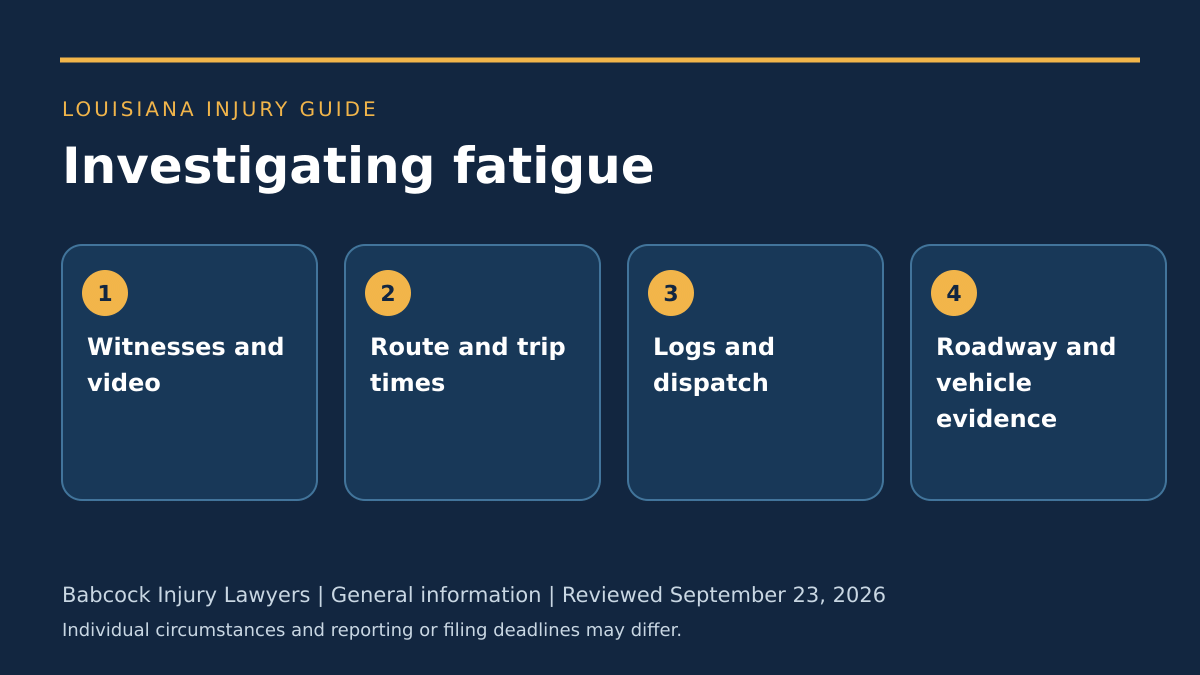
A driver can deny being tired, and there may be no test that settles the question. An investigation may compare the crash time and location with the driver’s work and travel history, then look for independent support:
- Statements about yawning, drifting, delayed braking, or an unresponsive driver;
- Dashcam, traffic, business, or nearby vehicle video;
- 911 calls, officer notes, roadway marks, and vehicle damage;
- Phone activity, navigation history, fuel and toll receipts, and trip records when legally obtainable;
- For covered commercial trips, electronic logs, supporting documents, dispatch messages, and company schedules.
None of these items proves fatigue by itself. A driver may drift for another reason, and an absence of braking can have several explanations. The value comes from matching records to a reliable timeline and testing other causes. The same approach applies to other evidence used in Louisiana car accident claims. Some footage is automatically overwritten, while vehicles can be repaired or disposed of. Identifying the holder of each record early matters.
Record what you observed, without diagnosing the driver
Get emergency help if anyone may have a serious injury. Follow medical advice, and explain what happened and what symptoms you are actually experiencing. Report the crash, obtain the report or incident number, and photograph the vehicles, roadway, lane markings, weather, and visible injuries when it is safe to do so. Save the original photos and videos rather than editing them.
Write down witness names and contact details, the other driver’s identifying information, and anything you observed about their behavior. Note your observations as observations. You do not need to diagnose the driver as sleep-deprived at the scene. Keep tow-yard records, repair notices, medical paperwork, missed-work records, and correspondence from insurers in one place.
Consider a prompt request to preserve video or electronic records when the crash involved a commercial vehicle or a business camera. A lawyer can help identify the correct companies and records without assuming every truck has the same electronic equipment. Our truck evidence preservation guide explains the practical problem of records disappearing on ordinary retention schedules.
If an insurer requests a recorded statement, ask which policy it represents and whether the statement is required. Your own policy may require cooperation. Do not guess at details, and understand the scope of any release or medical authorization before signing it.
Does Louisiana’s 51% fault rule affect a fatigue crash?
Fault can be disputed even where fatigue is suspected. An insurer may say the injured driver was speeding, failed to yield, or could have avoided the collision. Those claims should be tested against the scene and the available records.
For a cause of action arising on or after January 1, 2026, Louisiana Civil Code article 2323 generally bars recovery if the injured person is 51% or more at fault. Below that threshold, damages are reduced by the assigned percentage. Act 15 of 2025 made the amendment effective January 1, 2026. An older crash generally remains subject to the prior comparative-fault law; filing suit later does not by itself change the rule for that incident.
How long do you have to bring a Louisiana injury claim?
For many delictual injury claims arising after July 1, 2024, Civil Code article 3493.1 provides a two-year prescriptive period starting when injury or damage is sustained. Act 423 of 2024 applies prospectively. Older events and special claims can have different deadlines, so the filing date should be calculated from the actual facts rather than assumed from a headline rule. An insurer’s investigation does not automatically extend prescription.
When the crash record does not explain why the driver drifted
Our Baton Rouge car accident lawyers can examine the timing, available records, companies and policies involved. Bring the records you have; you do not need to wait for a complete police or medical file before asking about evidence that may disappear.
You can request a free case review or call (225) 500-5000. The firm must review the facts and conflicts before accepting representation, and no result is guaranteed.
Editorial & Legal Accuracy Notice (Louisiana)
This article provides general safety and legal information, not advice for a particular crash. Facts, policy terms, and filing deadlines matter. Reading it does not create an attorney-client relationship.