


car-accident-injury-claim-toolkit
Editorial & Legal Accuracy Notice (Louisiana)
This blog contains general legal and safety information and is not legal advice. Laws and deadlines can change, and outcomes depend on specific facts.
Last reviewed / updated: March, 2026
Reviewed, updated, and authored by: Stephen Babcock, Louisiana injury lawyer
This guide explains how to start a Louisiana car accident injury claim, what evidence matters most, and how to avoid common insurance proof traps.
Our approach is simple: move quickly on evidence, then speak from the record. We are not built for volume. We are built for leverage. Speed + evidence preservation + insurer-insider knowledge + trial-ready preparation = The Babcock Benefit. For a car accident injury claim, leverage usually comes from what you can prove in the first days.
If you are inside the first 72 hours, call (225) 500-5000 or use the free case review form before evidence changes.
Firm links: Client Reviews | Contact | Locations
Need a print-friendly checklist? Download the printable toolkit (PDF).
How Do I File a Car Accident Injury Claim in Louisiana?
To file a Louisiana car accident injury claim, open the insurance claim, document injuries and losses, and build a clear evidence packet before you discuss settlement. If you want help organizing the record, start with our Baton Rouge car accident practice page and focus on what you can prove in writing.
- Get the basics: names, policies, vehicles, and the report or incident number.
- Notify the right insurers: your own carrier and any at-fault driver’s carrier.
- Collect scene evidence: photos, video, and witness contact info.
- Get medical documentation: visits, follow-ups, restrictions, and work notes.
- Track losses: bills, receipts, mileage, and missed work records.
- Build a timeline: a dated, consistent story that matches documents.
- Do not settle too early: avoid releases until your treatment picture is clear.
Two Claims Can Run at the Same Time
Property damage and injury claims often move on different timelines, even when they come from the same crash. Settling vehicle damage does not always settle injury claims, but releases can. This is why we separate “what is fixed” from “what is still evolving” before anyone signs paperwork.
What Is the Difference Between an Insurance Claim and a Lawsuit?
An insurance claim is a negotiation with a carrier, while a lawsuit is a formal court case that uses court rules to gather evidence and resolve disputes. Louisiana’s basic fault concept comes from the Legislature’s text of La. Civ. Code art. 2315, but the path you take depends on facts, coverage, and how the insurer responds.
| Option | What It Usually Involves | Where People Get Tripped Up |
|---|---|---|
| Insurance claim | Adjuster communication, documentation, and settlement talks. | Recorded statements, missing records, and signing a release too soon. |
| Lawsuit | Formal filing, discovery, subpoenas, and court deadlines. | Waiting too long, losing evidence, or assuming the insurer will “be fair.” |
| Hybrid approach | Build a trial-ready file while still trying to resolve the claim. | Not matching the story to documents, which creates credibility gaps. |
What Evidence Should I Gather for a Car Accident Injury Claim?
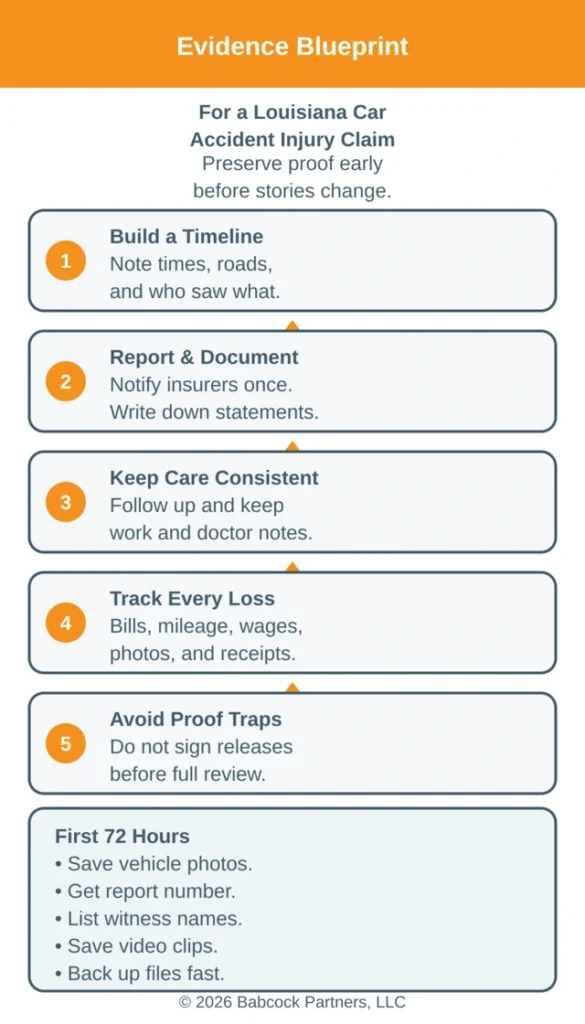
The best evidence is simple: items that lock in the timeline, show fault, and show how the injury changed your daily function. That is what we mean by leverage when we build a claim file that an adjuster cannot safely ignore.
- Scene proof: wide and close photos, video, and a sketch of positions.
- People proof: witness names, numbers, and what they saw.
- Vehicle proof: repair estimates, tow/storage paperwork, and total-loss documents.
- Medical proof: visit notes, imaging reports, restrictions, and follow-up plans.
- Work proof: missed time, job restrictions, and employer confirmation.
- Life proof: a dated symptom/activity log that stays consistent over time.
A Quick Evidence Preservation Note
Dash-cam files, business surveillance, and vehicle data can disappear quickly. If you see a nearby camera, write down the address and ask for preservation in writing. This is why we treat the first days like an evidence triage window instead of a waiting period.
What Should I Do in the First 72 Hours After a Crash?
In the first 72 hours, focus on safety, documentation, and preventing key proof from being overwritten or lost. When you later file a car accident injury claim, these early notes often matter more than a detailed memory.
- Back up media: save photos/video to two places the same day.
- Identify witnesses: get contact info and a short written note if possible.
- Start a timeline: time, location, symptoms, and who you spoke with.
- Log work impact: missed shifts, restrictions, and supervisor messages.
- Request the report: note the agency and report/incident number.
For crashes investigated by State Police, the Louisiana State Police crash report portal explains how to request reports and notes that availability can take time after a crash. If another agency investigated, ask that agency directly and keep the report number in your file.
Timeline Builder: What Should Happen in the First 2 Weeks and First 60 Days?
A clean timeline turns a stressful event into a record you can prove, which is what insurers respond to. Use a simple schedule and keep everything dated so your story never outruns your documents.
| Time Window | What to Do | What to Save |
|---|---|---|
| Days 1–3 | Back up photos/video, identify witnesses, and capture symptoms and work impact. | Scene photos, witness list, report number, first symptom notes. |
| Days 4–14 | Confirm claim numbers, follow up on care, and organize all bills and job notes. | Adjuster emails, visit notes, restrictions, employer confirmation. |
| Days 15–60 | Update the timeline weekly and document any new limitations or treatment changes. | Symptom log, mileage, receipts, therapy schedule, imaging reports. |
Defense Audit: How Do Insurers Try to Reduce a Car Accident Injury Claim?
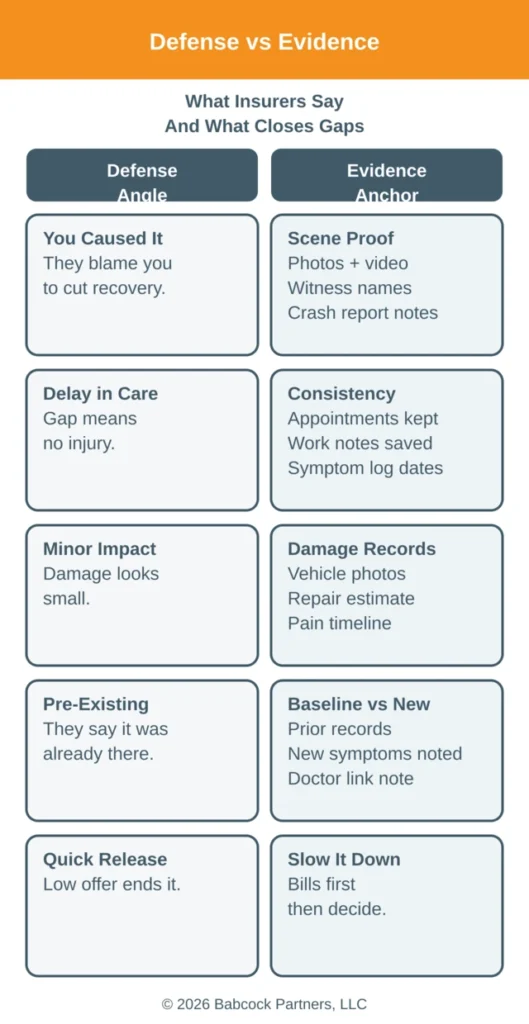
Insurers often focus on proof gaps because gaps make it easier to argue that the crash did not cause the injury or that your losses are smaller than claimed. This is why we build the file around the specific arguments we expect, not around what feels fair.
| Common Defense Angle | Evidence That Helps Close the Gap |
|---|---|
| “You were mostly at fault.” | Scene photos, witness info, consistent timeline, and crash report details. |
| “You waited too long to treat.” | Dated symptom log, appointment history, work notes, and follow-up plans. |
| “The impact was minor.” | Vehicle photos, repair estimates, tow/storage records, and early complaints. |
| “This was pre-existing.” | Prior baseline records, new symptoms, and provider notes linking changes. |
| “Sign a release and be done.” | Wait for a stable treatment picture and review the release language carefully. |
How Do I Document Bills and Wage Loss Without Overstating?
Documenting losses is about accuracy and consistency, not exaggeration, because overstatements can weaken a claim. Focus on dated records that match each other, and keep your file organized so you can answer questions with documents.
- Medical bills: save itemized statements, EOBs, and payment receipts.
- Mileage: track trips to care and pharmacy visits in a simple log.
- Wage loss: keep pay stubs, schedules, and a letter or email from payroll.
- Out-of-pocket costs: save receipts for braces, supplies, and co-pays.
- Property damage: keep estimates and valuations, and see our property damage claim page for repair and total-loss disputes.
What we see in practice
We see good people lose leverage when the early record is thin and the insurer becomes the “historian” of the crash. We also see claims improve when the timeline, medical notes, and work records tell the same story without drama.
- Adjusters often ask for broad records and then cherry-pick what seems inconsistent.
- Gaps in treatment or communication get framed as “you were fine,” even when you were not.
- Property damage gets used as a shortcut argument about injury, which is not a medical analysis.
- Small errors early can become big credibility fights later, even in clear-liability crashes.
Should I Give a Recorded Statement or Sign a Release?
You can usually provide basic facts without guessing, but recorded statements and releases can create lasting problems if you speak beyond what you know. If an adjuster pushes for a recording or a “routine” release, slow the process down and ask what the document covers.
- Do: confirm contact info, vehicles, policy numbers, and where the crash happened.
- Do not: guess about speed, distance, timing, or what another driver “must have” done.
- Do not: sign a blanket medical release without understanding the scope.
- Do: ask for the release in writing and read every page before you sign.
When Should I Talk to a Lawyer About a Louisiana Car Accident Claim?
Talk to a lawyer quickly when facts are disputed, injuries are evolving, or an insurer is pushing you toward a fast resolution. If you want help with Baton Rouge car wreck claims, start with help with Baton Rouge car wreck claims and focus on preserving evidence first.
- Call quickly if: you were hit by a commercial vehicle, rideshare, or uninsured driver.
- Call quickly if: you have a head injury concern, surgery talk, or lasting limitations.
- Call quickly if: the insurer disputes fault or says you were “mostly” to blame.
- Call quickly if: you need help coordinating multiple policies or claim numbers.
Want the timeline and checklists in one place? Download the printable toolkit (PDF).
Louisiana Law Snapshot (Updated 2026)
Two rules shape most car accident injury claims: the filing deadline and comparative fault. The deadline can be unforgiving, and fault allocation can reduce or even bar recovery.
| Rule | What It Means in Plain English |
|---|---|
| Two-year delictual prescription | The Louisiana Legislature’s text of La. Civ. Code art. 3493.1 generally gives two years to file suit for injury claims, so waiting can erase leverage even if the insurer is “still talking.” |
| Comparative fault and the 51% bar | The current wording of La. Civ. Code art. 2323 states that if your fault is 51% or more, you cannot recover damages, and any lesser fault percentage reduces recovery. |
Free Case Review: Protect the Record Before It Changes
We are not built for volume. We are built for leverage. If you need a plan to file a car accident injury claim without walking into proof traps, call (225) 500-5000 and use the free case review form so you do not have to guess on the record.
- Evidence can disappear or get overwritten.
- Deadlines can shrink your options fast.
- Insurers may push for statements or releases.
That plain-English approach is what we mean by the Babcock Benefit. If you want to see how we build a trial-ready claim file, review how our firm handles car accident cases before you talk settlement terms.
Most urgency is not about rushing a settlement. It is about preventing evidence loss, spotting deadline issues, and controlling what goes into the record first.
These items are helpful to have with you when you call, but do not delay calling because you do not have them. If you have them handy, keep them nearby for the call.
- Crash report or incident number and the responding agency
- Photos or video of the scene and vehicles
- Names of witnesses and adjusters
- A short list of your current symptoms and work limits
- Any letters or emails from insurance companies
Call Today If…
- You are within the first 72 hours and video or witness info may disappear
- An adjuster is pushing for a recorded statement or a fast release
- You missed work or you cannot do normal daily tasks
- You are being blamed for the crash or threatened with a 51% fault argument
What Happens Next
- We triage the evidence and build a timeline that matches documents.
- We spot deadline and coverage issues early so you do not get boxed in later.
- We plan insurer communication so you do not have to guess on the record.