

This material is general legal information, not legal advice for a particular claim. Deadlines, coverage terms, policy layers, parties, assignments, liens, and procedural posture can change the analysis.
This article distinguishes enacted text from the official digest and identifies unsettled questions as unsettled. It was checked against the enrolled Act, bill history, Louisiana statutes, constitutional provisions, and cited cases. Act 932 is new, the consolidated statutory page had not yet incorporated it, and this review located no published Louisiana Supreme Court or court of appeal opinion construing new R.S. 22:1892(I)(3) as of September 22, 2026. Readers should verify later legislation and decisions before relying on this analysis.
Louisiana insurance law alert
Act 932 adds three threshold barriers to claims under La. R.S. 22:1892(I), including a clause apparently intended to require a within-limits offer and a 30-day response period. That objective conflicts with prior Louisiana Supreme Court law, the enacted wording is defective, and every bodily-injury file now needs a new preservation protocol.
Short answer: Act 932 does not erase every Louisiana insurance bad-faith remedy, but it can seriously weaken the central failure-to-settle claim in personal-injury and bodily-injury cases. The phrase “good faith dispute” is now potentially a categorical bar, not merely one factor in a totality-of-the-circumstances analysis. And a claimant who does not present a settlement offer within the applicable limits and allow the insurer at least 30 days may jeopardize the insured’s later claim under Subsection I.
Treat a clear, presently acceptable, within-limits offer held open at least 30 full days after confirmed receipt as mandatory. Use 35 to 45 days, provide the liability and medical-causation proof needed to remove any objectively reasonable dispute, and renew the offer after material new evidence. Do this even while preserving arguments that the statute’s literal wording does not say what its drafters apparently intended.
First, the citation matters
The new paragraph is La. R.S. 22:1892(I)(3). Act 932 amended Section 1892 and redesignated the former paragraph (I)(3) as (I)(4). Section 22:1982 is a different, repealed provision. Act 932 also made contractor-verification and other claims-handling changes; this article isolates the bodily-injury limitation in paragraph (I)(3).
As of this article’s review date, the Legislature’s consolidated online page for R.S. 22:1892 had not yet incorporated Act 932. The controlling source is the enrolled text of Act 932. The Act became law without the governor’s signature on June 23, 2026, and took effect August 1, 2026. The official digest confirms the enactment history and effective date.
What Act 932 actually added
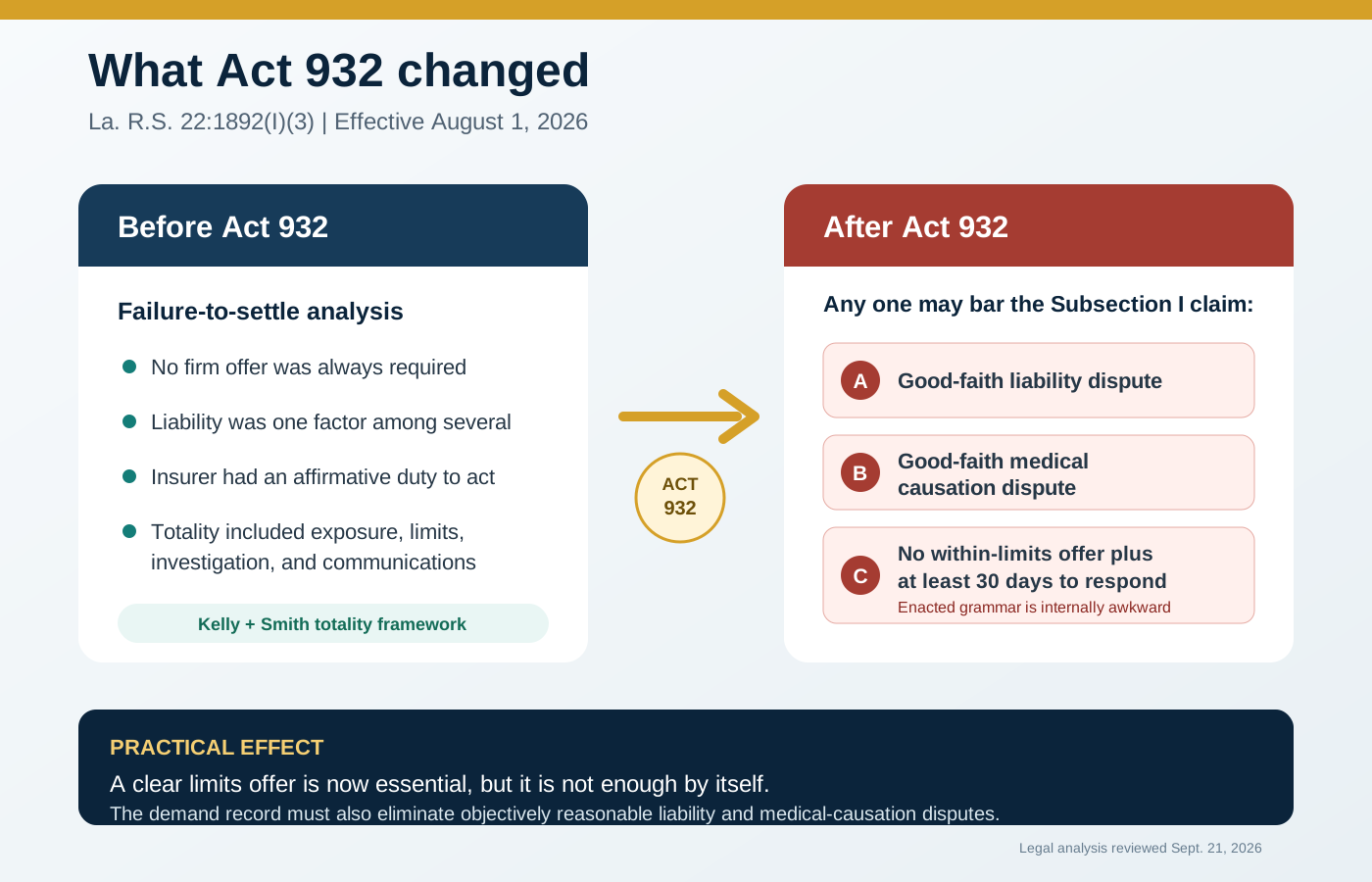
The new paragraph says Subsection I shall not create a cause of action against an insurer by the insured or the insured’s assignee in a personal-injury or bodily-injury claim when any of three conditions is present:
(a) There is a good faith dispute as to liability.
(b) There is a good faith dispute as to medical causation for the injuries alleged by the claimant.
(c) An offer has not been presented by or on behalf of a third-party claimant within the applicable policy limits, and the insurer has been given at least thirty days to respond.
Source: 2026 La. Acts No. 932, amending La. R.S. 22:1892(I).
The word “any” makes the three clauses disjunctive. An insurer needs only one. On the apparent intended reading, even a perfect limits offer does not preserve a Subsection I claim if the insurer proves a good-faith liability dispute or a good-faith medical-causation dispute.
Failure-to-settle analysis
- No firm offer was always required
- Liability was one factor among several
- Insurer had an affirmative duty to act
- Totality included exposure, limits, investigation, and communications
Any one may bar the Subsection I claim:
Why this escaped everyone’s attention
HB 1162 did not begin as a bodily-injury bill. The introduced version addressed contractor-license verification before payment of certain immovable-property repair claims. The personal-injury language appeared later in Senate Floor Amendment 3998 on May 18, 2026. The Senate approved the bill 35-0, and the House concurred 97-0.
The idea was not entirely new. A broader 2025 proposal, SB 111, used similar liability, causation, and limits-offer language and added a fourth condition concerning discovery. Governor Jeff Landry vetoed it, warning that it would make denials easier, add uncertainty, and severely limit insurer accountability. The 2026 version removed the discovery condition and limited the named plaintiff to the insured or assignee, but it retained the three provisions that matter most in injury claims. Was this gamesmanship at the legislature? Probably. Does it effect your injury claim handling? Definitely.
Subparts (a) and (b) are not harmless codification
Before Act 932, a genuinely reasonable dispute could defeat a claim that a refusal or delay was arbitrary, capricious, without probable cause, or a breach of the duty to make a reasonable settlement effort. Existing cases evaluated reasonableness from the facts known or reasonably available at the relevant time. That much is familiar.
But the old law did not make every reasonable dispute an automatic off switch. Under Smith v. Audubon Insurance Co., the probability of liability was one factor among others, including the likely damages, policy limits, and insurance strategy, as well as the investigation and communications. An insurer could face an unreasonable risk to its insured even where fault was not mathematically certain. The Louisiana Supreme Court later emphasized in Kelly v. State Farm that the insurer has an affirmative duty to gather facts and make a reasonable effort to settle. No firm settlement offer was then required.
Act 932 can be read to change both propositions. A “good faith dispute” under (a) or (b) may now bar the Subsection I cause at the threshold, even where the size of the excess exposure and the other Smith factors strongly favor settlement. And (c) is aimed directly at gutting Kelly‘s no-demand rule.
Surely “Disputed” cannot sensibly mean “denied in an answer” or “questioned by an adjuster.” The better reading is an objectively reasonable, contemporaneous dispute grounded in the facts known or reasonably available after an adequate investigation. But that’s not at all what it says, and you can count on insurers to create immunity by labeling everycase as disputed. Honestly, in my 26 years of practicing law, I don’t know that I’ve ever handled a case where either causation or liability was not in dispute.
The unanswered questions in (a) and (b)
- When is the dispute measured? At receipt of the offer, at expiration, at the alleged breach, when suit is filed, or at trial?
- Who carries the burden? The text says no cause is created when a condition is present, but it does not say whether the plaintiff must negate each condition or the insurer must prove it.
- How much of a dispute is enough? The statute does not say “material” or “substantial.” An insurer may argue that a dispute over one diagnosis triggers (b) for the entire claim.
- What does “liability” include? Tort responsibility and comparative fault are plausible readings. Treat coverage or damages as more aggressive extensions because neither is naturally synonymous with liability in this context.
- Can poor investigation manufacture good faith? Existing law says reasonableness is assessed from facts known or reasonably available. A carrier should not benefit from failing to investigate, but Act 932 does not define the standard.
Reed v. State Farm, First United Pentecostal Church v. Church Mutual, and Chisesi v. State Farm provide useful pre-Act examples of objective, fact-specific dispute analysis. None construes Act 932. This review located no published Louisiana Supreme Court or court of appeal opinion interpreting new paragraph (I)(3) as of September 22, 2026.
Subpart (c) does not literally say what the digest says
The apparent policy is easy to describe: an insured or assignee should not pursue a Subsection I claim unless a third-party claimant first makes a within-limits offer and gives the insurer at least 30 days to respond. That is how lawyers will likely operationalize the provision.
But that is not the logic of the enacted sentence. The enacted condition is:
The expected condition would have been:
The official resume digest does not repair the logic. It keeps the word “and” but reverses the second clause, describing no settlement offer and an insurer that has not been afforded at least 30 days. That is a third formulation, and it still does not say that the claimant must present an offer and allow 30 days. Under R.S. 24:177(E), a digest is not proof or an indication of legislative intent. And Kelly itself cautions that courts cannot rewrite statutes under the guise of interpretation.
| What happened | Literal (c) | Likely insurer position |
|---|---|---|
| Limits offer, 10 days | False because an offer was presented | Bar applies because fewer than 30 days were allowed |
| Limits offer, 35 days | False because an offer was presented | Condition satisfied by claimant |
| No offer; a court assumes fewer than 30 days from some other trigger | False under that assumption, but the statute identifies no trigger or response object | Bar applies because no offer was presented |
| No offer; a court assumes at least 30 days from some other trigger | Potentially true under that assumption, with the same missing-trigger problem | Bar applies because no offer was presented |
This is not a technicality to build a file around. A trial court may apply the literal conjunction, interpret the clause in light of the whole statute, find an absurd result, or treat the drafting error as unresolved. The safe practice is to comply with the strongest intended reading while expressly preserving the text argument.
“Respond” does not mean “accept”
Paragraph (c) speaks of whether the insurer was given time “to respond.” An actual response does not determine whether the offeror allowed at least 30 days. On the apparent intended reading, even an early rejection may not cure a shorter offer period; the claimant should extend or reissue rather than assume otherwise. A response also does not create immunity or establish that the decision was reasonable, and silence alone does not prove bad faith. The underlying question under (I)(1) remains whether the insurer fairly adjusted the claim and made a reasonable effort to settle.
The statute does not require a written offer, but the file does
Paragraph (c) does not specify a form. Louisiana Civil Code article 1927 recognizes that consent can sometimes be established orally, in writing, or by conduct. But a compromise must be in writing or recited in open court under Civil Code article 3072. A written offer, written authority, provable delivery, and written unqualified acceptance eliminate needless satellite disputes.
Does Act 932 gut Louisiana bad-faith law?
It guts an important route, but not the entire field. The answer depends on the claim, plaintiff, source of duty, and remedy.
| Claim or claimant | Likely effect of new (I)(3) | What to preserve |
|---|---|---|
| Insured or assignee alleging failure to settle a bodily-injury claim | Directly targeted | Negate (a) and (b), satisfy intended (c), plead alternative contract and jurisprudential theories |
| Third-party claimant suing in the claimant’s own name | Lead-in does not target that capacity, but existing law already limits generalized claims | Only specifically authorized direct statutory theories, plus direct action rights where available |
| First-party UM/UIM insured | Ambiguous: insured fits, but “third-party claimant” does not | Dual-track proof-of-loss/tender demand and 35-plus-day settlement offer |
| Property-damage claim without personal or bodily injury | Not within the PI/BI limitation | Existing Section 1892 payment duties and property-specific rules |
| Remedy under another subsection or independent contract law | Not textually eliminated, but boundaries are untested | Plead each source separately and avoid treating one as a label for another |
The phrase “this Subsection shall not create” matters
In Kelly and Smith v. Citadel Insurance Co., the Louisiana Supreme Court explained that the insurer’s duty to its insured arose from the insurance contract and fiduciary relationship and predated the statute. Act 932 does not say “no cause of action exists.” It says the provisions of Subsection I “shall not create” one in specified circumstances.
That wording supports a serious argument that an independent contractual or jurisprudential failure-to-settle action survives even if the statutory route does not. The insurer will respond that the amendment was designed to displace Kelly and would be meaningless if the same claim could simply be relabeled. This review located no published Louisiana Supreme Court or court of appeal opinion resolving that conflict. The prudent petition separately pleads and factually supports each available source of duty, while recognizing that statutory penalties and attorney fees may not travel with a nonstatutory theory.
“Cause of action” does not make factual disputes disappear
The label invites an insurer to file an exception of no cause of action or a Rule 12 motion. But Louisiana’s no-cause exception generally tests the petition on its face and does not decide contested evidence. Whether a dispute was objectively held in good faith, what information the insurer possessed, whether an offer was presented, and how long it remained open are ordinarily factual matters. Paragraph (c) also functions much like an affirmative defense because it adds a new fact that defeats an otherwise viable claim.
Do not wait for courts to allocate the burden. Plead the offer, receipt, expiration date, nonacceptance, absence of a reasonable liability dispute, absence of a reasonable medical-causation dispute, the carrier’s knowledge, and the resulting excess or economic damage. Insurers should specially plead every part of (I)(3) they intend to invoke.
Practical applications: how the amendment changes real cases
| File | Act 932 problem | Best practical response |
|---|---|---|
| Clear rear-end collision, fracture, $25,000 limit | Failure to make an offer can become the avoidable defense | Send an exact $25,000 offer, attached release, full proof, and 35 to 45 days after receipt |
| Intersection crash with conflicting accounts | A real comparative-fault dispute may trigger (a) | Obtain video, witnesses, EDR, admissions, and show value exceeds limits even after a reasonable fault reduction |
| Degenerative spine with prior treatment | Carrier invokes (b) based on preexisting condition or treatment gap | Obtain a treating-provider explanation and calculate an undisputed acute-injury floor that alone exceeds limits |
| Unknown policy limits | Claimant is expected to offer “within” a number the claimant cannot compel before suit | Request written limit certification, make carefully conditional language only if necessary, and reissue an exact offer after discovery |
| Multiple claimants competing for aggregate limits | A single claimant’s demand may not let the insurer protect all insureds and claimants | Consider a coordinated global or allocated proposal, disclose known claims, and give time for evaluation |
| Primary plus excess or umbrella | “Applicable policy limits” and allocation across layers are undefined | Notify each layer directly, state the allocation, satisfy exhaustion terms, and give each insurer its own full response period |
| Written settlement followed by payment delay | Broad reference to all of Subsection I creates an insurer argument even after compromise | Plead the written compromise, payment obligation, contract enforcement, and every separate statutory payment remedy |
| Mixed bodily injury and property damage | A bodily-injury dispute may muddy an otherwise payable property claim | Use separate demands and settlement instruments for BI and property damage |
The policy-limits disclosure trap
Louisiana does not currently give every third-party claimant a general presuit right to force disclosure of liability policy limits. A 2026 proposal that would have required disclosure, HB 281, did not become law and was left pending in House Insurance when the session ended. Once suit is filed, Code of Civil Procedure article 1423 permits discovery of insurance agreements that may satisfy a judgment.
Act 932 therefore creates a mismatch: it appears to demand a settlement offer “within the applicable policy limits” even though the claimant may not be entitled to know those limits before filing suit. The first letter should request every primary, excess, umbrella, remaining, per-person, per-occurrence, and aggregate limit, along with confirmation of erosion or prior payments. If the carrier refuses, consider timely suit and formal discovery. A formula such as “all applicable limits” may be attacked as indefinite, so reissue an exact-dollar offer once the number is known.
Effective date and transition cases
Act 932 has no express retroactivity clause. Under Civil Code article 6 and R.S. 1:2, substantive changes ordinarily apply prospectively. Because paragraph (I)(3) limits whether a cause of action exists, the better view is that it is substantive, not merely procedural.
That does not make the accident date the only relevant date. Bad-faith liability generally turns on insurer conduct. The most useful working matrix is, in my opinion is:
| Timing | Likely analysis | File strategy |
|---|---|---|
| Actionable refusal or failure completed before August 1, 2026 | Old law likely governs that accrued claim, even if suit comes later | Plead the pre-effective conduct and preserve nonretroactivity; also comply prospectively if the claim remains open |
| First actionable failure on or after August 1 | Act 932 likely applies, even if the crash, policy, or tort suit predates August 1 | Use the new protocol |
| Pre-August refusal merely continues afterward | A continuation may not be a new breach, but the characterization will be contested | Separate the original refusal from later decisions and communications |
| Pre-August refusal, but executable excess exposure arises after August 1 | Unresolved because wrongful conduct and claim accrual may occur on different dates | Preserve prospective-only and accrual arguments, then create a fresh compliant settlement opportunity if still possible |
| New settlement opportunity or new refusal after August 1 | A court may treat it as a discrete post-effective event | Send a fresh compliant offer and document the new evaluation |
| Response period starts before August 1 and expires after it | Post-effective expiration creates substantial Act 932 risk | Reissue or extend for a clean 35-plus-day post-effective window |
The Louisiana Supreme Court’s retroactivity cases, including Sher v. Lafayette Insurance Co., St. Paul Fire & Marine Insurance Co. v. Smith, and Manuel v. Louisiana Sheriff’s Risk Management Fund, support focusing on whether the amendment changes substantive rights and when the operative conduct occurred. Accrual is a separate issue: Smith v. Citadel held that the excess-failure-to-settle claim there accrued when the insured became exposed to an executable excess judgment. This review located no published Louisiana Supreme Court or court of appeal opinion reconciling those timing concepts for Act 932.
The plaintiff-side Act 932 protocol
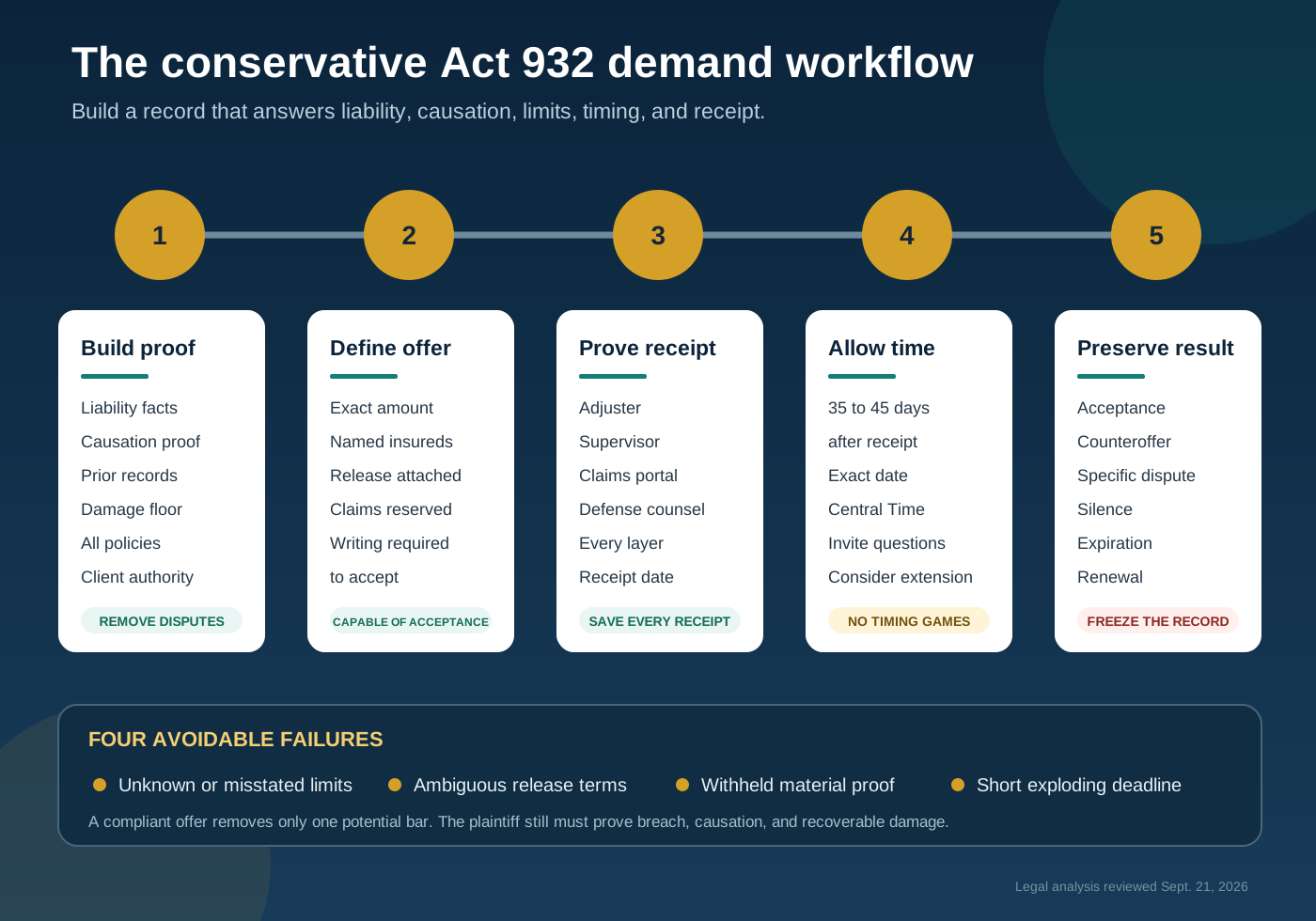
The safest response is not merely to add “30 days” to an old demand template. The demand record now has three jobs: make a definite offer, remove any reasonable liability dispute, and remove any reasonable medical-causation dispute.
-
Build proof
- Liability facts
- Causation proof
- Prior records
- Damage floor
- All policies
-
Define offer
- Exact amount
- Named insureds
- Release attached
- Claims reserved
- Written acceptance
-
Prove receipt
- Adjuster
- Supervisor
- Claims portal
- Every layer
- Receipt date
-
Allow time
- 35 to 45 days
- After receipt
- Exact date
- Central Time
- Invite questions
-
Preserve result
- Acceptance
- Counteroffer
- Specific dispute
- Silence
- Renewal
- Unknown or misstated limits
- Ambiguous release terms
- Withheld material proof
- Short exploding deadline
Before sending the offer
- Identify every claimant, capacity, insured, released party, policy, layer, and potentially applicable limit.
- Request declarations, the policy, remaining-limit certification, and information about erosion or competing claims.
- Resolve the liability record: reports, photos, video, EDR, witnesses, statutes, admissions, and comparative fault.
- Resolve medical causation: prior similar complaints, treatment gaps, intervening events, objective findings, and provider opinions.
- Calculate a conservative damage floor that exceeds the limit even after removing genuinely disputed items.
- Confirm liens, Medicare issues, authority, prescription, release scope, and client consent to an irrevocable offer.
The offer itself
- Use an unmistakable title. For example: “Irrevocable 35-Day Offer to Settle Within Applicable Policy Limits, La. R.S. 22:1892(I)(3)(c).”
- Use a present offer. “Claimant hereby offers” is different from “would consider,” “will recommend,” or an invitation to negotiate.
- State an exact amount. Tie it to certified remaining limits and identify whether the figure is per person, per occurrence, aggregate, primary, or excess.
- Define the exchange. Identify every released insured and claim, every reserved claim, costs and interest, the proposed release, and dismissal mechanics.
- Avoid unnecessary conditions. An apology, admission, confidentiality clause, extra-policy payment, impossible lien condition, or personal contribution can convert a clean limits offer into something else.
- Give at least 30 full calendar days after receipt. Thirty-five to 45 days is safer. Specify the date, time, and Central Time. Do not count the transmission date as day one.
- Define acceptance. Require an unqualified written acceptance actually received at a named email or address. Make clear that physical payment and release execution follow acceptance.
- Attach the proof. Use an indexed, stable packet with a short liability analysis, causation evidence, itemized damages, and conservative excess calculation.
- Invite specific questions. Ask the insurer to identify promptly any missing material or factual/legal basis for a liability or causation dispute and to request a reasonable extension before expiration.
- Request transmission. Ask the carrier to convey the offer and excess exposure to every insured, defense counsel, independent counsel, and implicated excess carrier, while requesting no privileged communication.
Under Civil Code article 1928, an offer that specifies a period for acceptance is irrevocable during that period. Obtain written client authority before sending. A purported acceptance that adds or changes terms is a counteroffer under article 1943, so a last-minute qualified response demands immediate attention.
Delivery and deadline proof
- Deliver to the adjuster, supervisor, designated claims address, and claims portal; after suit, send to defense or coverage counsel as appropriate.
- Send separately to each primary, umbrella, excess, and UM carrier. Do not assume one insurer will protect another.
- Use redundant, trackable methods and preserve email headers, portal receipts, delivery signatures, and the exact packet version.
- Obtain an express receipt acknowledgment. Calendar the receipt date, information check, courtesy reminders, exact expiration, and post-expiration memorialization.
- Keep reminders nonmodifying. Quote the same terms and deadline so the reminder does not accidentally revoke or change the offer.
If a surgery, causal opinion, prior record, surveillance response, or other material item changes the evaluation, send it promptly and renew the offer for a fresh 35-plus-day period. The insurer will otherwise argue that it never had a full statutory period to evaluate the complete package.
How to handle the insurer’s response
| Response | Immediate action |
|---|---|
| Unqualified timely acceptance | Confirm the written compromise, performance timeline, release, liens, dismissals, and reserved claims. Reject new terms hidden in a later release. |
| “Acceptance” with new terms | Treat as a potential counteroffer and seek unqualified written acceptance before the deadline. |
| Reasonable request for information | Respond promptly. If material, extend or reissue for a fresh full period. |
| Liability or causation dispute | Demand specific contemporaneous grounds, cure what can be cured, and renew. Do not rely on a conclusory denial as the whole record. |
| Limits tender without clear acceptance | Clarify whether it is an unconditional tender, settlement acceptance, or counteroffer. Do not assume a settlement exists. |
| Silence | Send nonmodifying reminders. After expiration, memorialize the exact deadline and lack of unqualified acceptance without unintentionally renewing the offer. |
| Claimed technical defect | Cure and reissue a clean offer when possible. Do not wager a valuable claim on a correctable form dispute. |
UM/UIM and other difficult applications
UM/UIM claims
The lead-in covers a cause by “the insured or his assignee,” which naturally includes a UM insured. But (c) asks for an offer by a “third-party claimant,” which does not naturally describe the insured’s own first-party UM claim. The text leaves the issue unresolved. A court could hold (c) inapplicable to UM while applying only (a) and (b), or it could extend the apparent offer rule despite the mismatch. This review located no published Louisiana Supreme Court or court of appeal opinion deciding the question.
Use a dual track. First, submit satisfactory proof of loss and demand an unconditional tender of every undisputed amount under Section 1892(A) and (B) and the McDill line of cases. Second, without conceding that (I)(3)(c) applies, make an exact within-UM-limits settlement offer open at least 35 days. State expressly that the tender demand is not conditioned on a release and is separate from the settlement offer.
Multiple claimants and limited aggregates
A demand that consumes an aggregate for one claimant may place the insurer between competing duties. Identify all known claimants and available limits. Consider coordinated mediation, allocation, or a global proposal. Give the carrier enough information and time to protect all insureds without turning the deadline into a manufactured trap.
Assignments and excess judgments
The statute expressly recognizes the assignee posture, but an assignee receives no greater right than the insured possessed. The assignment should specifically identify statutory, contractual, and jurisprudential claims; the insurer and policy; pre- and post-effective conduct; economic and excess damages; cooperation; records; and proceeds. A covenant not to execute is not the same as a full release or satisfaction of the insured’s liability.
Consent judgments require additional care. Policy consent-to-settle and no-action clauses, coverage positions, refusal-to-defend exceptions, insurer participation, collusion concerns, and the reasonableness of the stipulated amount can all become separate defenses. An adjudicated excess judgment remains the cleaner posture.
Minors, wrongful death, and survival claims
Confirm every beneficiary, representative, tutor, capacity, and required approval. The offer should identify who is bound and which claims are released. For a minor or interdict, account for mandatory court approval without making approval an impossible pre-acceptance condition.
Pleading and discovery after Act 932
Plead facts, not conclusions
A complaint or petition should identify the offeror, insured, assignee, policy, exact amount, limits, release, date and method of presentation, confirmed receipt, deadline, response, and nonacceptance. It should allege the facts showing why no objective good-faith liability or medical-causation dispute existed at the relevant time. Attach the offer, exhibits index, delivery proof, and response when procedure permits.
Plead alternative sources separately:
- Subsection I duties and remedies;
- any distinct duties and penalties under other parts of Section 1892;
- breach of the insurance contract and implied good-faith obligation;
- the jurisprudential excess-judgment or failure-to-settle theory recognized in Kelly and Smith v. Citadel;
- enforcement of any written compromise; and
- declaratory relief on coverage or statutory construction where appropriate.
Discovery should freeze the contemporaneous reason
The critical comparison will be between the carrier’s actual reason during the response period and a litigation-created explanation years later. Seek the nonprivileged claim diary and routing metadata; evaluations and authority requests; liability and medical reviews; transmission of the offer and excess warning to the insured and excess carrier; written reasons for rejection; limit calculations; and Act 932 guidelines or training.
Interrogatories and corporate-representative topics should require the insurer to identify every fact, document, witness, medical item, and legal theory supporting each claimed dispute; when it was first identified; who adopted it; what additional material was requested; who could authorize settlement; and why no acceptance or tender occurred.
Privileges, work product, reserve discoverability, and defense-counsel communications require careful motion practice. Target the factual basis, timing, decision process, and communications that were actually shared with or generated by the claims function.
A nonfrivolous but uphill floor-amendment issue
Louisiana Constitution article III, Section 15(C) says no amendment may make a change not germane to the bill as introduced. The possible challenge to new paragraph (I)(3) is that introduced HB 1162 concerned contractor-license verification for property repairs, while Senate Floor Amendment 3998 added limitations on bodily-injury bad-faith claims. Placement in Section 1892 does not by itself establish germaneness. A. & M. Pest Control Service v. LaBurre offers some support for that narrower proposition.
The obstacle is substantial. In Jones v. Board of Ethics and Louisiana Public Facilities Authority v. Foster, the Supreme Court construed germaneness broadly. Jones upheld a dramatic floor substitution. The State will argue that both versions regulate claims handling and insurer bad-faith exposure under the same statute, and that the introduced bill already contained a narrower bad-faith safe harbor.
The final title expressly mentions good-faith duties and limitations on causes of action, so a title challenge is weaker. The stronger issue is germaneness to the bill as introduced, which a later title change cannot answer. For the narrower proposition that an enrolled instrument is not invariably conclusive of compliance with mandatory constitutional procedure, Louisiana courts may inspect official legislative records. Shepherd v. Schedler, which involved constitutional-amendment procedure, rejects an impermeable federal-style enrolled-bill rule.
New paragraph (I)(3) raises a nonfrivolous and unresolved germaneness question under Article III, Section 15(C), although Jones and Foster make any challenge an uphill one. The strongest challenger would be an insured or assignee in a live case where the insurer actually invokes (I)(3), not someone seeking an advisory ruling.
Questions lawyers will ask
Does Act 932 require a presuit demand?
No. The text says an offer must be “presented” and gives a response period; it does not use the words “presuit” or “demand.” An offer during litigation can satisfy the apparent requirement. But a lawyer should not wait until the eve of trial if a meaningful settlement opportunity can be created earlier.
Is a 30-day letter enough?
Not by itself. The offer must be within applicable limits, definite enough to accept, supported by the information needed to evaluate liability and causation, and delivered in a way that proves receipt. Thirty days counted from mailing is unnecessarily risky. Use 35 to 45 days after confirmed receipt.
If liability is contested at all, is the bad-faith claim dead?
That is the insurer’s strongest literal argument, but “good faith” must do work. A merely asserted or manufactured disagreement should not qualify. Expect litigation over objective reasonableness, investigation, timing, materiality, and whether undisputed facts still demanded settlement. The amendment nevertheless gives insurers a materially stronger threshold defense than before.
What if only one injury is disputed?
The text refers to “medical causation for the injuries alleged” and does not say whether one disputed diagnosis bars the whole action. Build the value from undisputed injuries, explain aggravation of preexisting conditions, and show that the conservative undisputed floor still exceeds the limit. Preserve the argument that a peripheral dispute cannot immunize mishandling of the undisputed claim.
Does the carrier win merely by sending a response within 30 days?
No. The statute asks whether the insurer was given at least 30 days, not whether it actually responded. An early rejection does not necessarily cure a shorter offer period, and a prompt but arbitrary rejection can still be wrongful if a viable cause exists. Conversely, silence or expiration does not automatically prove every element of bad faith or causation of excess damages.
Should a claimant use an exploding demand?
No. Kelly disapproved gamesmanship and sudden-death tactics, and current Subsection J considers the parties’ good faith in providing information, making demands, setting deadlines, and attempting settlement. A documented, realistic offer is stronger than a trap.
What should insurers change?
Carriers should not treat Act 932 as automatic immunity. They should promptly route offers, confirm receipt, identify missing material, document the contemporaneous factual basis for any dispute, reassess when evidence arrives, pay or tender amounts that are independently due, inform the insured of excess exposure, involve all layers, and respond within the offered period.
The practical conclusion
Act 932 does not make Louisiana bad-faith law completely disappear. It does change the architecture of bodily-injury cases. The fight will move earlier, into the content and timing of the settlement offer, the quality of the liability and medical-causation record, and the precise source of the insured’s cause of action.
For plaintiffs, the avoidable mistake is proceeding as though Kelly‘s no-demand rule still controls every theory. For insurers, the avoidable mistake is assuming that a conclusory dispute or any timely “response” ends the inquiry. Until Louisiana appellate courts construe the paragraph, lawyers should comply with the apparent intended requirement, preserve the enacted-text arguments, and create a contemporaneous record strong enough to answer both.
Primary authorities and research links
- 2026 La. Acts No. 932, enrolled text
- HB 1162 legislative history, including official versions, votes, and actions
- Senate Floor Amendment 3998, adding the bodily-injury provisions
- Official digest of Act 932
- Kelly v. State Farm Fire & Casualty Co., 169 So. 3d 328 (La. 2015)
- Smith v. Citadel Insurance Co., 285 So. 3d 1062 (La. 2019)
- Troung v. Sanders, Louisiana Supreme Court treatment of a third-party claimant’s statutory claim
- Franks v. State National Insurance Co., a recent illustration of fact-intensive liability and causation analysis
- Governor’s 2025 veto message for SB 111
- La. Const. art. III, Section 15
Do not let a new technical defense decide a serious injury claim
If an insurer is delaying, disputing causation, or exposing an insured to an excess judgment, get a file-specific plan before the next demand or deadline.