


A serious burn can keep changing after the event that caused it. Swelling, blistering, infection, breathing problems, restricted movement, and scarring may become clearer over hours, days, or months. A useful Louisiana burn-injury claim therefore begins with medical safety and a reliable record, not a prediction about how quickly the injury will heal.
The legal questions are equally practical: what caused the burn, who controlled that source, which records still exist, and how has the injury affected treatment, work, and daily life?
When does a burn require urgent medical attention?
Emergency care should not be delayed to collect legal evidence. The MedlinePlus burn-evaluation guide explains that treatment at a burn center may be recommended for deep burns, larger second-degree burns, burns involving the face, hands, feet, genitals, or major joints, and chemical or electrical burns. The proper response depends on the injury and should come from medical professionals.
Smoke exposure presents a different danger. The CDC lists carbon monoxide symptoms that include headache, dizziness, weakness, nausea, vomiting, chest pain, and confusion. Trouble breathing, loss of consciousness, altered mental status, or other severe symptoms require immediate emergency attention.
For a minor thermal burn, current MedlinePlus first-aid guidance recommends cool water rather than ice and a clean covering. Chemical and electrical injuries need their own professional guidance. A legal article cannot determine burn depth or substitute for an examination.
Why can the first record be incomplete?
Burn severity is not described by pain alone. Clinicians consider depth, the percentage of body surface involved, location, cause, associated trauma, inhalation exposure, and the patient’s health. A deep burn may damage nerve endings, while a smaller burn on a hand or joint can still interfere substantially with function.
Early records may focus on stabilization. Later visits may document infection, wound-care changes, grafting, therapy, scar management, or limits on movement. That does not make the initial record irrelevant. It means the full medical timeline must be read rather than reduced to one photograph or one diagnosis code.
What should the evidence timeline include?
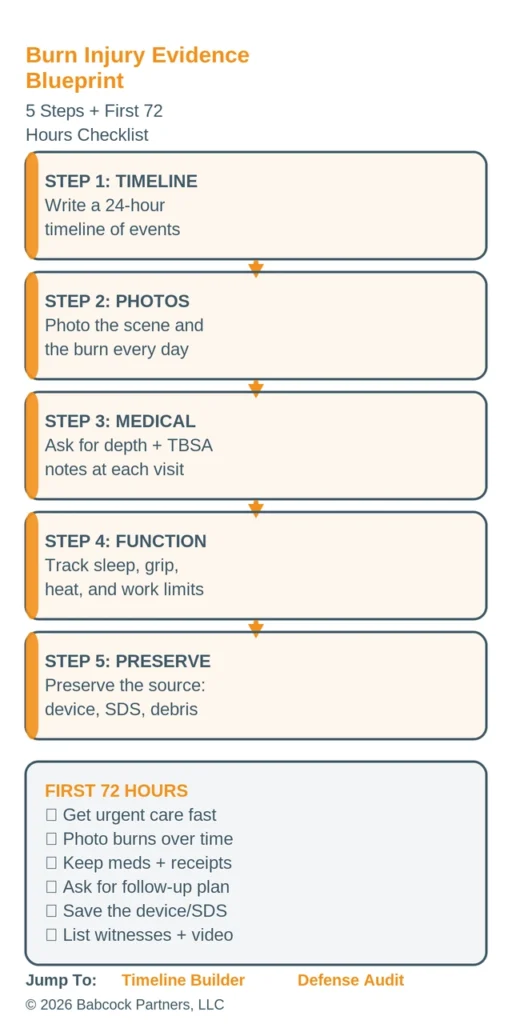
A useful timeline separates the event, medical course, and functional effects:
- the date, location, and source of the burn;
- the people or companies that owned, installed, maintained, or controlled the source;
- emergency response, smoke exposure, first examination, and discharge instructions;
- wound-care visits, medication, infection concerns, referrals, procedures, and therapy;
- dated photographs taken under reasonably consistent lighting;
- work restrictions, missed time, sleep disruption, and help needed with ordinary tasks; and
- changes in scarring, sensitivity, range of motion, or emotional health documented by appropriate providers.
Records should be accurate rather than dramatic. Note improvement as well as setbacks. If a symptom appears later, record when it began and what the treating clinician concluded.
Preserve the source before it is repaired or discarded
The physical source may be the most important evidence in the case. Depending on the event, it could be a burner, pressure cooker, water heater, battery, charger, appliance, chemical container, protective device, vehicle component, or industrial machine. Do not test, repair, clean, alter, or discard it. Photograph it in place when that can be done safely, keep packaging and instructions, and record model and serial numbers.
Other useful records can include fire-department reports, 911 recordings, surveillance video, maintenance and inspection logs, safety data sheets, rental paperwork, recall information, work permits, training records, and witness accounts. A written preservation request may be needed when another person or company controls the evidence.
The article about injuries at a Louisiana crawfish boil shows how control of a burner, pot, propane equipment, or property condition can change the liability analysis. The related guide on when a burn injury may require legal help discusses workplace, product, premises, and vehicle settings.
Who may be responsible for a burn in Louisiana?
Civil Code article 2315 supplies the general fault principle, but the specific claim depends on the source and the parties’ relationships. Potentially relevant actors can include:
- a property owner or custodian who controlled an unsafe condition;
- a manufacturer, seller, installer, or repair company connected to a product or system;
- a contractor or industrial company that controlled equipment or work practices;
- a driver or vehicle owner after a crash or vehicle fire; and
- an employer, workers’ compensation insurer, or responsible third party after a workplace burn.
A workplace injury does not automatically create a negligence claim against the employer. Workers’ compensation exclusivity, statutory-employer questions, and possible claims against non-employer third parties require a fact-specific review. A suspected product defect likewise requires preservation of the exact product and analysis under the Louisiana Products Liability Act, beginning with R.S. 9:2800.51.
How do medical and functional records prove damages?
Bills establish only part of a burn injury’s effect. The medical file may document wound care, grafting, medication, infection, rehabilitation, scar treatment, and future recommendations. Employment records may establish missed work, reduced hours, modified duties, or lost opportunities.
Functional proof should use concrete examples. A hand burn may affect grip, typing, cooking, or tool use. A burn across a joint may restrict movement. Facial scarring may require specialist care and affect social or work activities. Family observations, therapy records, accommodation requests, and a concise dated log can help connect those changes to the medical course.
Photographs are useful when they are dated and authentic. They should supplement, not replace, examinations and treatment records.
How are common insurer arguments tested?
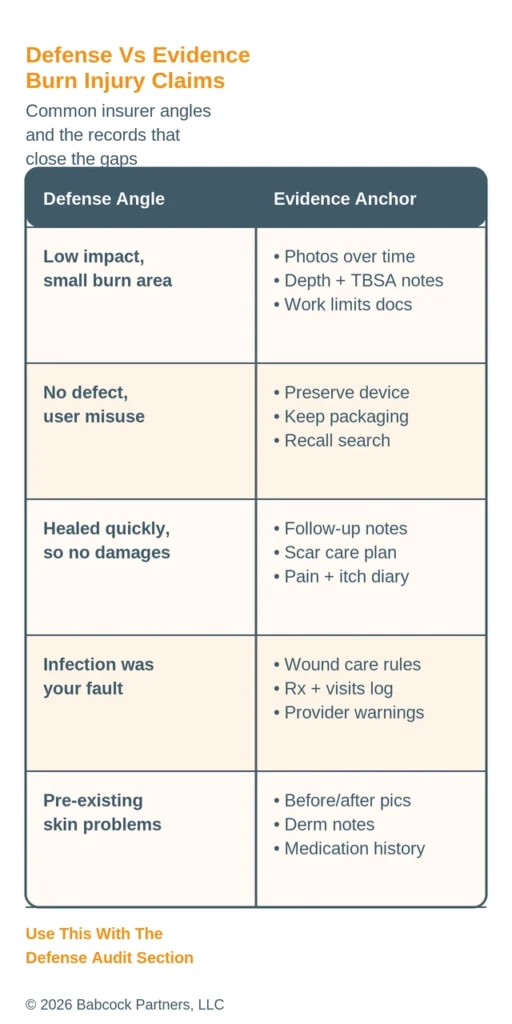
- The burn was minor: compare the full medical course, serial photographs, procedures, restrictions, and scar treatment rather than relying on the first description.
- The injured person misused the product: preserve the product, instructions, warnings, setup, witness accounts, and any electronic or maintenance data.
- An infection caused the later problems: review wound-care instructions, follow-up records, pharmacy history, and provider opinions about causation.
- The condition existed before the event: establish baseline skin, mobility, work, and treatment history with earlier records.
- The person recovered quickly: use actual work, therapy, scar-care, and daily-function records rather than assumptions based on appearance.
The strongest response is a complete and candid record. Overstatement creates another dispute and can obscure the evidence that matters.
Louisiana fault and filing rules depend on the incident date
Civil Code article 2323 governs comparative fault. The current 51 percent bar took effect January 1, 2026. An incident before that date may be governed by the earlier version, so the event date must be checked before describing the effect of an injured person’s fault.
Civil Code article 3493.1 provides a two-year prescriptive period for delictual actions and took effect July 1, 2024. Earlier injuries can involve the former one-year rule. Product, workers’ compensation, survival, wrongful-death, public-entity, and other specialized claims can present additional rules. Medical treatment and an insurance claim do not necessarily stop prescription.
Where can an injured person learn more?
The firm’s published New Orleans burn injury practice page discusses scarring, care, future needs, and evidence preservation. A case-specific review should start with the incident date, the original source evidence, the complete medical record, and the law that applies to the responsible parties.