


A daycare is not automatically liable whenever a child gets hurt. Young children fall, collide, and take ordinary risks even in a careful setting. Responsibility turns on what happened, who controlled the risk, whether reasonable precautions were taken, and whether a failure caused the injury.
The answer may involve an employee, the licensed center, a separate property owner, a contractor, or a product manufacturer. A licensing violation can be important evidence, but it does not replace proof of fault and causation.
Who may be responsible for a daycare injury?
Louisiana’s general fault rule appears in Civil Code article 2315. In a daycare case, the practical question is what each person or organization did or failed to do.
- A caregiver or other employee: The evidence may concern supervision, discipline, medication, food service, sleep practices, transportation, or the response to an emergency.
- The center or employer: Staffing, training, scheduling, policies, hiring, maintenance, and the employee’s work duties may matter. Civil Code article 2320 addresses responsibility for acts of employees in the functions in which they are employed.
- The property owner or custodian: A broken gate, unsafe playground surface, defective fixture, or another condition of the premises can raise a custody and notice issue under Civil Code article 2317.1.
- A maintenance or transportation contractor: Responsibility may follow the party that controlled a repair, inspection, vehicle, or outsourced service.
- A manufacturer or seller: A product claim may be relevant when playground equipment, a crib, a high chair, a toy, or another product failed and contributed to the injury.
These categories can overlap. The employee who was present may not be the person who chose the staffing plan, ignored an earlier repair request, or controlled the building.
What should a parent do first?
Attend to the child’s medical and safety needs before trying to reconstruct every detail. For an emergency, call 911. Give medical providers a factual account of what is known and what the daycare reported. Avoid filling gaps with assumptions.
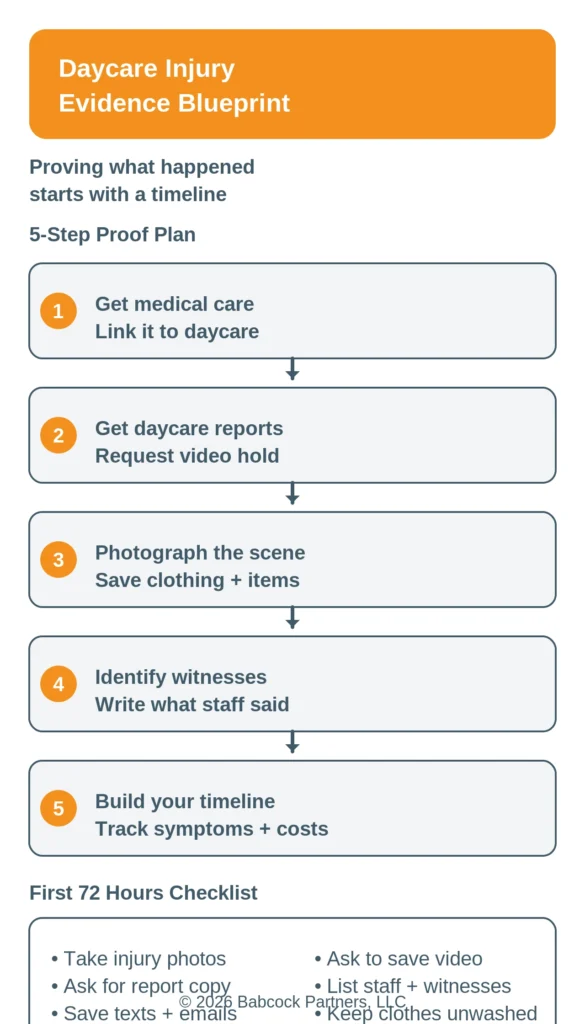
Ask the center for its written incident or injury report and identify the person who prepared it. Save the first version you receive, along with emails, app messages, photographs, and any later corrections. Record the time you were notified, the explanation given, and the names of the people present. A short, contemporaneous note is generally more reliable than a polished account written weeks later.
Do not repeatedly question a young child or suggest an answer. Write down the child’s spontaneous words as accurately as possible. When abuse or neglect is suspected, Louisiana DCFS directs reports to its Child Abuse and Neglect Hotline at 855-4LA-KIDS. A civil claim and a safety report serve different purposes, and one should not be used as a substitute for the other.
Licensing records can show what the center was required to do
The Louisiana Department of Education licenses early learning centers and publishes facility licensing information, including Bulletin 137 materials and incident-report resources. The applicable requirements depend on the provider type, the child’s age, the activity, and the date of the event.
Potentially relevant licensing subjects include:
- staff-to-child ratios and group size;
- supervision during indoor play, outdoor play, meals, sleep, and transitions;
- staff qualifications, orientation, continuing training, and background checks;
- medication, allergy, food, and emergency procedures;
- playground, crib, gate, vehicle, and equipment safety;
- incident documentation and required notifications; and
- records of licensing inspections, deficiencies, complaints, and corrective action.
A deficiency may help establish what went wrong, but it must be connected to the injury. A paperwork error unrelated to the event does not prove causation. Conversely, a center can be negligent even when no citation has been issued.
What evidence can explain how the injury happened?
Start with the records closest in time to the event. A daycare case may require:
- the incident report and every revised or supplemental version;
- surveillance video from the room, hallway, entrance, playground, or parking area;
- attendance sheets, classroom rosters, staff schedules, and break assignments;
- daily logs, sign-in and sign-out records, parent-app messages, and photographs;
- employee training, qualification, and disciplinary records relevant to the event;
- playground inspections, repair requests, maintenance logs, and product information;
- prior reports involving the same condition or practice, when they are legitimately discoverable;
- medical records, photographs of the injury, and notes about recovery and function; and
- names of staff, parents, visitors, emergency responders, and other witnesses.
Video and digital messages may be retained for only a limited time. A focused preservation request can identify the date, time range, room, child, staff members, and record types without asking the center to preserve everything it has ever created.
The evidence principles overlap with other child-safety cases. The article on Louisiana school bus accident responsibility explains how control, staff records, video, and a child’s path can resolve competing accounts. The guide to proving fault when accounts conflict addresses the broader use of physical and electronic evidence.
Common explanations need to be tested, not accepted or rejected automatically
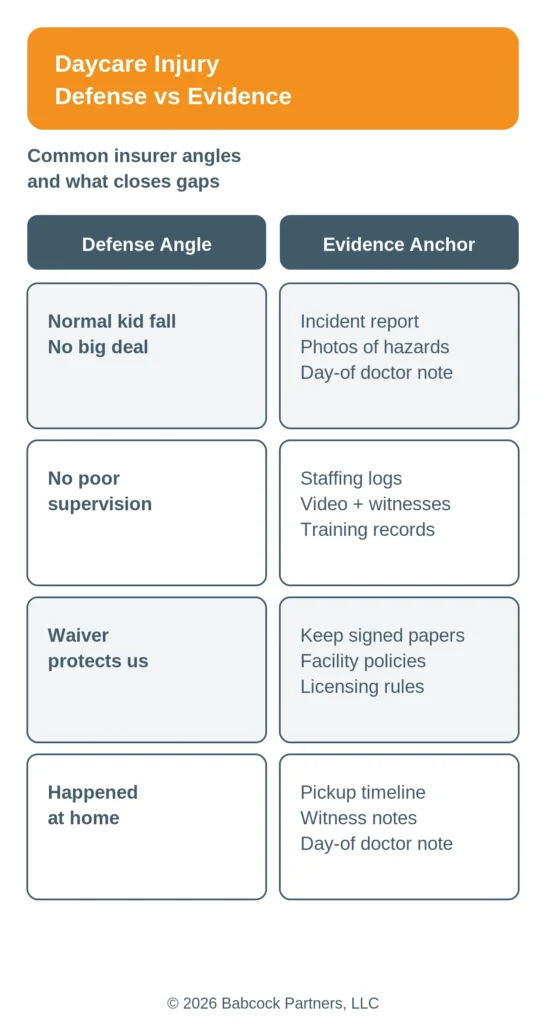
A center may say the injury was an ordinary childhood accident, that staffing was adequate, that the condition appeared without warning, or that the child’s prior health caused the symptoms. Each point should be compared with the records.
- Ordinary play: What activity was occurring, what supervision was present, and was the equipment appropriate for the age group?
- No notice of a hazard: When was the area last inspected, and do earlier photographs, complaints, or repair records show how long the condition existed?
- Staffing was adequate: Do the attendance sheets and staff schedules match what happened in the room at that time?
- The injury was minor: What do the medical findings and the child’s actual recovery show?
- Another child caused it: Was the interaction foreseeable, and were staffing, room arrangement, and intervention reasonable for the children’s ages?
The same discipline applies to a parent’s concern. A serious injury does not by itself prove negligent supervision. The aim is to identify the preventable act or condition, not to work backward from the outcome.
Comparative fault and filing deadlines
Civil Code article 2323 requires allocation of fault among those who contributed to an injury. Its current 51 percent bar took effect January 1, 2026. An older event may be governed by the prior version, so the date matters. In a case involving a child, age, capacity, the setting, and the conduct expected of adults require careful treatment rather than an adult standard applied by reflex.
Civil Code article 3493.1 states a two-year period for delictual actions and took effect July 1, 2024. Older injuries and certain product cases involving minors can present different rules. Licensing complaints and safety investigations do not stop a civil filing period. The injury date, potential defendants, and theory of recovery should be checked early.
How should the child’s harm be documented?
Fault evidence and injury evidence answer different questions. Medical records should document the diagnosis, treatment, restrictions, and prognosis. Parents can also preserve school or daycare absences, therapy records, photographs, out-of-pocket expenses, and concise notes about sleep, mobility, eating, behavior, and activities. Avoid turning the record into a daily legal argument or predicting permanent harm before qualified professionals can evaluate it.
The firm’s published child injury practice page discusses supervision records and pediatric documentation in more detail.