Who’s Liable for Road Work Zone Accidents in Baton Rouge?


Deployed airbag after a car accident, representing a collision near a road work construction zone in Baton Rouge.


Editorial & Legal Accuracy Notice (Louisiana)

This blog contains general legal and safety information and is not legal advice. Laws and deadlines can change, and outcomes depend on specific facts.

Last reviewed / updated: March, 2026

Reviewed, updated, and authored by: Stephen Babcock, Louisiana injury lawyer

This guide explains how liability is analyzed after a Baton Rouge road work zone crash and what to preserve before the scene changes. Use it to build a clean timeline and avoid proof gaps that insurers exploit.

Road work zone accidents in Baton Rouge often happen in the “in-between” moments—when lanes shift, cones move, and drivers react late. The hardest part is not describing the crash, but proving what the work zone looked like at the exact time you entered it.

Our approach is simple: treat a work-zone crash like a moving scene and lock down proof fast. We are not built for volume. We are built for leverage. Speed + evidence preservation + insurer-insider knowledge + trial-ready preparation = The Babcock Benefit. In road work zone accidents in Baton Rouge, leverage often comes from photos, video, and the traffic-control paper trail.

If you are dealing with injuries or vehicle damage, start with our Baton Rouge car accident practice page and then use the steps below to protect the work-zone evidence. You can also check our Baton Rouge hub for local resources and related crash topics.

Download the printable toolkit (PDF) and keep it with your crash paperwork. It includes both infographics plus a one-page checklist you can hand to a family member.

If you are inside the first 72 hours, call (225) 500-5000 or use the free case review form before evidence changes.

Firm links: Client Reviews | Contact | Locations

Who Is Liable for Road Work Zone Accidents in Baton Rouge?

Most road work zone accidents in Baton Rouge come down to negligence—who created an unsafe condition and who failed to respond safely to it under La. Civ. Code art. 2315. Work zones also invite shared fault questions when La. Civ. Code art. 2316 is applied to choices like speed, attention, following distance, and merge timing.

  • Driver conduct following distance, attention, speed, and merge decisions
  • Work-zone setup sign sequence, taper length, cone spacing, barriers, lighting
  • Visibility + notice weather, glare, night work, confusing detours
  • Proof quality time-stamped photos/video and a clean, consistent timeline

What Counts as a Work Zone Crash?

Federal highway rules define a work zone as an area marked by signs, channelizing devices, barriers, markings, or work vehicles, and they treat it as starting at the first warning sign and ending at the last device or “END ROAD WORK” sign in 23 CFR Part 630, Subpart J. That same rule says a work zone crash can include collisions tied to traffic slowed or stopped because of the work, even if the first harmful event occurred before the first warning sign.

Term Plain-English Meaning Why It Matters
Work zone A marked area where construction, maintenance, or utility work affects traffic flow. It helps explain why traffic patterns, lanes, and sightlines changed.
Work zone crash A crash in or related to the work zone, including backups linked to the work. It points you toward evidence beyond the impact point, like sign placement and tapers.
TTC plan The temporary traffic control plan that describes how traffic is managed through the zone. The federal work zone rule notes TTC plans should be consistent with MUTCD Part 6, which becomes a checklist for what to document.

What Evidence Matters Most After a Baton Rouge Work Zone Wreck?

The fastest way to improve a work zone case is to preserve “setup” proof—what signs, cones, and lane markings existed and how they guided drivers at the moment you entered. Because temporary traffic control is designed to move road users safely through changing conditions, MUTCD Part 6 is a practical roadmap for what to photograph and request.

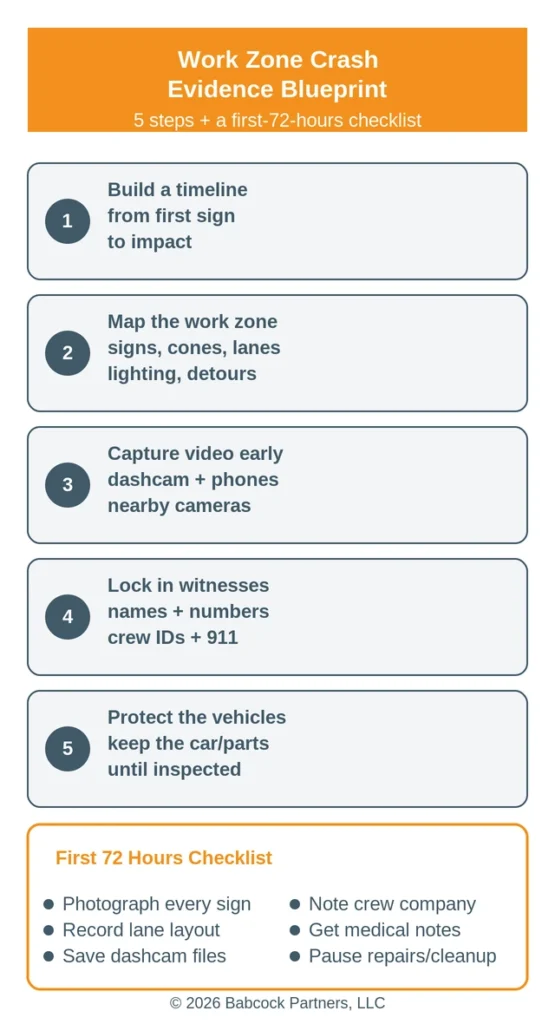
  1. Time-stamped photos of signs, tapers, channelizing devices, and lane markings
  2. Video from dashcams, phones, and nearby businesses before it is overwritten
  3. Vehicle preservation and data points that show speed changes and braking
  4. Witness and responder identifiers so statements can be confirmed later
  5. A clean medical and work-impact record if you were injured

Scene Proof: Signs, Cones, Lighting, and Lane Markings

Start by documenting the approach to the work zone, not just the final resting positions. Walk back (safely) to capture the first warning sign, the taper, and any lane shift markers, because those details change quickly after traffic resumes.

If the crash involved a chain reaction, note where traffic was slowing and where the first brake lights started. Work zone rear-end collisions are common, so the patterns we see on our rear-end accident page often apply in work zones too.

Video Proof: Dashcams, Phones, and Nearby Cameras

Dashcam files are often the cleanest way to show lane layout, speed changes, and the “surprise moment” when a closure appears. Save originals immediately, then make a second backup, because clips get overwritten or compressed during sharing.

If a business faces the roadway, ask quickly whether they have exterior cameras and how long footage is kept. This is why we push for same-day video requests in road work zone accidents in Baton Rouge, because leverage often depends on footage you cannot recreate.

Paper Trail: Work Orders, Traffic Control, and Inspections

In many work zones, there is a plan for temporary traffic control and a record of how the setup was inspected and adjusted. Even when those documents exist, they may not match the on-the-ground setup, so your photos help test whether the plan was followed.

If the crash involved a large truck, add the trucking timeline and driver logs to your evidence list, because stopping distances and lane geometry can be different in work zones. Our truck accident page explains the extra layers that often show up in commercial vehicle crashes.

Vehicle Preservation: Keep the Car, the Parts, and the Data

Work zones often create disputes about speed and reaction time, so physical damage patterns matter. If the vehicle is drivable, avoid unnecessary repairs until the evidence is documented, and keep all parts that were replaced.

When a distraction is alleged, identify what was happening in the seconds before impact and preserve phone-related records in a careful way. The behavior patterns we discuss on our distracted driving page can become the center of the fault fight in work zone crashes.

Timeline Builder: What to Do in the First 72 Hours?

In the first 72 hours, your goal is not to “argue the case” but to lock down the facts that will later control fault and credibility. A short, organized timeline often beats a long story, because it shows where the work zone started, what changed, and how the collision unfolded.

  1. Within hours: Photograph the approach, the taper, and the last sign you saw before impact.
  2. Day 1: Save dashcam and phone video in original format and write down witnesses and crew identifiers.
  3. Day 1–2: Preserve the vehicle and request tow/storage paperwork so parts are not lost.
  4. Day 2–3: Start a short symptoms-and-activities log if you are hurt, and keep medical visit notes together.
  5. Anytime: Avoid recorded statements until you know what evidence exists and what facts are still unknown.

That is what we mean by leverage in road work zone accidents in Baton Rouge: you preserve proof first, and you talk second. Once the cones move and video overwrites, insurers fill the gaps with assumptions.

Quick reference: the 5-step work zone crash evidence blueprint + first-72-hours checklist. (Download the printable PDF below.)

Defense Audit: How Insurance Companies Argue Work Zone Cases

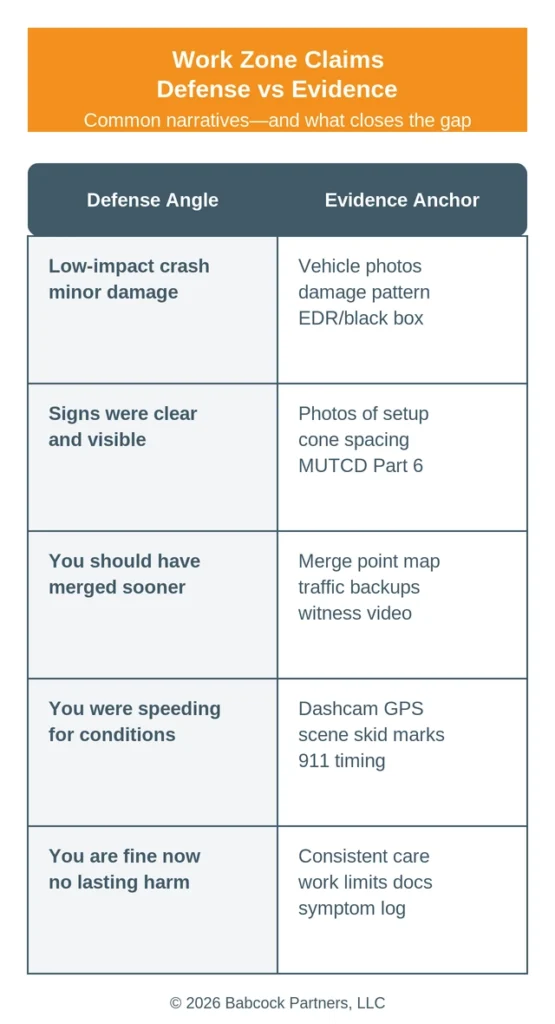
Work zone claims are often defended by shifting attention away from the setup and onto the driver’s choices. The fastest counter is a clean evidence anchor for each narrative, so the file stays about proof instead of opinions.

Defense Narrative Evidence Anchor That Helps
“The signs were clear—you should have merged earlier.” Photos/video of the actual sign sequence, taper length, and merge point from the driver’s viewpoint.
“This was a low-impact bump, so injuries don’t make sense.” Full vehicle photos, repair documentation, and consistent medical notes tying symptoms to function.
“You were distracted or speeding, so it’s mostly your fault.” Dashcam timeline, witness statements, and any data that shows braking and lane position changes.
“The work zone was properly controlled.” A side-by-side comparison of the documented setup versus what MUTCD-style temporary traffic control expects.
“You’re fine now, so the claim is exaggerated.” Follow-up care records, work restrictions, and a simple daily function log when symptoms fluctuate.

This is why we build a “defense audit” early: you can predict the arguments and gather the missing records before the insurer uses uncertainty as leverage. A tighter file also reduces the chance of being boxed into a rushed, one-sided statement.

Common work zone defense narratives—and the documentation that closes the gaps.

Who Can Share Fault in a Louisiana Work Zone Crash?

Louisiana’s comparative-fault framework in La. Civ. Code art. 2323 allows percentages of fault to be assigned to everyone who contributed to the injury, even if they are not all in the same lawsuit. In road work zone accidents in Baton Rouge, that usually means looking at the drivers involved and the temporary traffic control choices that guided traffic into the conflict.

  • Other drivers: late merges, following too closely, distracted driving, or unsafe speed for conditions
  • Commercial vehicles: longer stopping distances and lane geometry issues during lane shifts
  • Work-zone operations: sign sequence, taper layout, barriers, and whether conditions matched the plan
  • Secondary triggers: stalled vehicles, sudden lane blockages, or unclear detours upstream

How the 2026 Comparative Fault 51% Bar Changes Strategy

As of January 1, 2026, the updated text of La. Civ. Code art. 2323 says you cannot recover damages if your fault is 51% or more. That makes early evidence about speed, following distance, and work-zone notice more valuable, because small percentage swings can decide whether a claim survives.

  • Document the first warning sign you encountered and the distance to the lane shift.
  • Preserve video that shows the traffic backup and the timing of braking.
  • Keep your statements consistent with the facts you can prove, not assumptions.

What we see in practice

We see insurers try to turn work zone cases into simple “rear driver” stories even when the lane closure setup created surprise and confusion. We also see real evidence vanish quickly: cones are moved, markings are repainted, and camera systems overwrite on a short loop.

  • Work-zone photos taken the next day often look different from the moment of impact.
  • Dashcam files are commonly overwritten within a week if they are not saved immediately.
  • Vehicle evidence gets compromised when repairs happen before documentation.

This is why we treat the first week as an evidence triage window instead of a negotiation window. When the proof is organized early, road work zone accidents in Baton Rouge become less about blame language and more about verifiable facts.

Mistakes That Can Quietly Hurt Work Zone Claims

Most preventable problems come from good-faith “cleanup” decisions that erase context. If you avoid these mistakes, you usually preserve options without making the claim combative.

  • Waiting days to photograph the approach and sign sequence
  • Letting dashcam clips stay on the device until they overwrite
  • Repairing the vehicle before documenting damage and parts
  • Guessing about speed or distances in a recorded statement

Before You Talk to an Insurer: A Short Script

You do not have to be rude to be careful, and you do not have to answer every question immediately. The goal is to confirm basics and then pause until you have your documents and timeline in front of you.

  1. “I’m getting medical care and gathering records; I will follow up after I review everything.”
  2. “Please send requests in writing so I can respond accurately.”
  3. “I’m not ready for a recorded statement today.”

If you want a case-specific plan for preserving work zone proof, start with our car wreck practice page and then use the toolkit to organize what you already have. If you prefer a print copy, Download the printable toolkit (PDF) here.

Louisiana Law Snapshot (Updated 2026)

Louisiana generally gives you two years to file most injury claims, and waiting can make evidence harder to obtain. Louisiana also uses comparative fault, and the current statute includes a 51% bar that can block recovery if you are assigned most of the blame.

  • Two-year delictual prescription: La. Civ. Code art. 3493.1 sets a two-year prescriptive period for delictual actions, generally running from the day the injury or damage is sustained.
  • Comparative fault + 51% bar: La. Civ. Code art. 2323 reduces damages by your percentage of fault and bars recovery when your fault is 51% or more.

Free Case Review for Baton Rouge Work Zone Accidents

If you were hurt in a work zone crash, the fastest way to protect your options is to protect the evidence before the zone changes again. We are not built for volume. We are built for leverage.

That leverage mindset is what we call the Babcock Benefit, and it starts with fast proof preservation and a trial-ready file. Call (225) 500-5000 and use the free case review form so we can triage the evidence clock and the fault issues. Evidence moves in work zones, insurers push early narratives, and the 51% bar can turn small details into big outcomes.

These items are helpful to have with you when you call, but do not delay calling because you do not have them. If you have them handy, keep them nearby for the call.

  • Crash report number and responding agency
  • Photos or video of the work zone approach
  • Dashcam file location or device information
  • Tow yard and repair shop contact details
  • Medical visit dates and provider names

Call Today If…

  • The work zone setup is already changing or the signs are coming down
  • Your vehicle is headed to salvage, repair, or a storage lot that charges daily
  • An insurer is pushing for a recorded statement right away
  • You have symptoms that are evolving over the first week

What Happens Next

  1. We triage the evidence: scene proof, video sources, and vehicle preservation steps.
  2. We spot deadlines and the likely fault fights, then plan a documentation strategy.
  3. We manage insurer contact so your first “official” story matches provable facts.

For additional background on crash claims, you can also review car accident claim help. Then return here for the work-zone-specific evidence steps.

×