

You can pursue a Louisiana car accident claim even if you were not physically injured. The claim may be limited to damage to the vehicle and related financial losses, such as towing, storage, a rental car, or other reasonable transportation costs. The useful question is not simply whether you can sue. It is whether the amount in dispute and the available proof justify a lawsuit rather than an insurance claim or another practical resolution.
Do not assume immediately after the crash that no injury occurred. Some symptoms appear later. If pain, dizziness, confusion, numbness, or another concern develops, seek appropriate medical care and report the symptom accurately. This article focuses on a genuinely property-only claim.
What can a property-only claim include?
Louisiana Civil Code article 2315 requires a person whose fault causes damage to repair it. When no bodily injury is claimed, the recoverable loss may still include:
- the reasonable cost to repair the vehicle;
- the vehicle’s pre-crash value if it is a total loss;
- towing and reasonable storage charges;
- reasonable rental or loss-of-use expenses;
- damage to personal property inside the vehicle; and
- diminished value when the evidence and Louisiana law support it.
A claim is not worth a fixed amount merely because another driver was at fault. The measure of loss depends on repair records, valuation evidence, policy terms, the reasonableness of expenses, and any dispute over comparative fault.
Start with the correct source of payment
You may present the claim to the at-fault driver’s liability insurer. If you purchased collision coverage, you may also be able to use your own policy, subject to its deductible and terms, while your insurer pursues reimbursement. The Louisiana Department of Insurance explains in its current Consumer’s Guide to Auto Insurance that collision coverage pays for accident damage to your car regardless of fault, subject to the policy and deductible.
Using your own collision coverage does not decide who caused the crash. It can be a practical way to begin repairs while fault is investigated. Ask the carrier in writing how the deductible will be handled and whether it will seek recovery from the other insurer.
What should you preserve before repairs begin?
Property claims often turn on records that disappear once the vehicle is repaired, moved, or sold. Preserve:
- wide and close photographs of every side of the vehicle;
- interior damage, deployed airbags, the odometer, and the vehicle identification number;
- scene photographs, witness information, and the crash report number;
- the first estimate and every later supplement;
- tow-yard and storage invoices;
- rental agreements, rideshare receipts, and dates the vehicle was unavailable;
- maintenance records and pre-crash photographs that show condition and options; and
- all valuation reports and comparable vehicles used by an insurer.
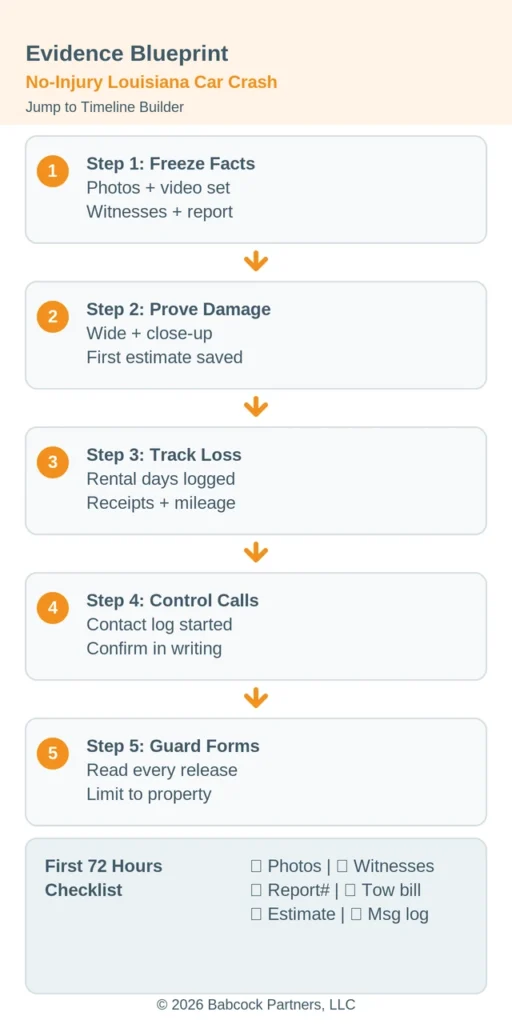
The Louisiana Department of Insurance recommends obtaining a written repair estimate that identifies the work, parts, and labor. Its guide to auto insurance after an accident also explains that a vehicle owner may select the repair facility. Tell the adjuster which shop you choose before work starts and keep the insurer’s approvals and objections in writing.
What if the insurer calls the vehicle a total loss?
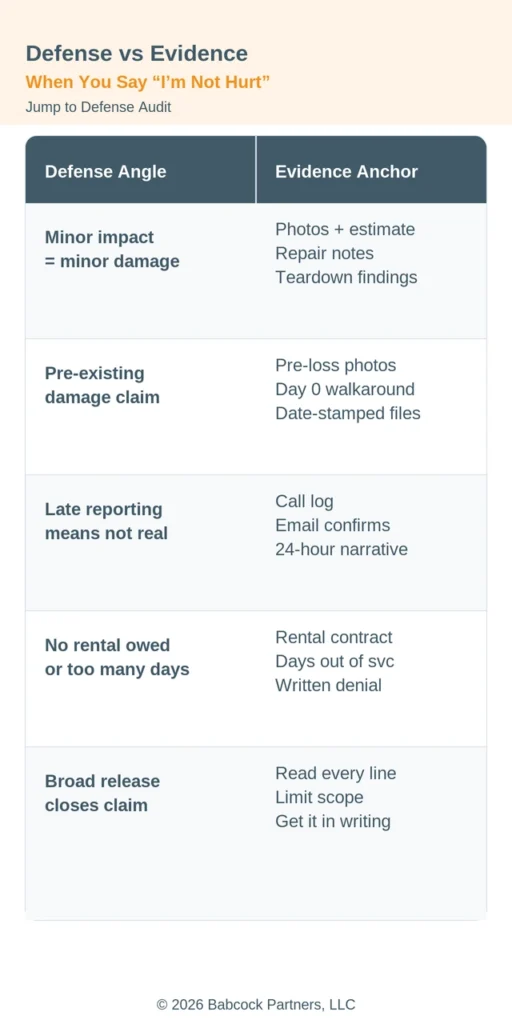
Ask for the complete valuation report, including the vehicle identification number, trim, mileage, options, condition adjustments, comparable vehicles, taxes, and fees. Check each input. A valuation can be wrong even when the arithmetic is correct because it used the wrong model, omitted an option, or relied on a vehicle that was not reasonably comparable.
If you want to keep the vehicle, ask how the salvage deduction and title requirements will affect the payment. Do not assume that retaining a totaled vehicle is economical until you understand the repair cost, title status, insurability, and resale consequences. Our article on Louisiana total-loss valuation disputes explains those issues in more detail.
Can you recover rental costs or loss of use?
Possibly. The source of payment matters. Your own carrier usually owes rental reimbursement only if you purchased that coverage, and the policy may impose daily and total limits. The Louisiana Department of Insurance states that when another driver’s negligence damaged the car and that driver’s insurer causes delay, the liability insurer should pay rental costs for a reasonable repair period.
Keep the rental reasonable and document why you needed it. If you did not rent a vehicle, other proof may be relevant to loss of use, but the legal and factual analysis is not automatic. See our guide to rental reimbursement and loss of use in Louisiana.
Be precise about any release
A property-damage payment and a bodily-injury claim are different categories, but a release can be drafted broadly enough to affect both. Read the entire document before signing. If the agreement is supposed to settle only vehicle damage, the language should accurately state that scope. This is especially important if symptoms appeared after the first estimate or if medical evaluation is still underway. Our article on accepting a property-damage payment before an injury claim is complete discusses the distinction.
When does a lawsuit make practical sense?
A lawsuit may be available, but it is not always the most efficient response. Compare the amount genuinely in dispute with filing costs, expert or appraisal costs, delay, and the effort required. A modest repair supplement may be resolved by providing the missing documentation or using the insurer’s appraisal or complaint process. A larger dispute involving fault, a total-loss valuation, diminished value, extended loss of use, or a broad release may justify legal advice.
A Louisiana vehicle property-damage lawyer can review the documents and explain whether the dispute is suitable for representation. Keep in mind that some lawyers who handle injury cases do not accept property-only matters because fees and litigation costs can consume a substantial part of a modest recovery.
Louisiana deadlines and fault rules still apply
For many Louisiana property-damage claims arising from a crash on or after July 1, 2024, Civil Code article 3493.1 provides a two-year prescriptive period beginning on the day the damage is sustained. Older events and special defendants or claim types may involve different rules. Negotiations do not necessarily stop prescription.
For causes of action governed by the version effective January 1, 2026, Civil Code article 2323 generally bars recovery when the claimant is 51 percent or more at fault. A claimant who is less than 51 percent at fault may recover damages reduced by that percentage. Preserve the crash evidence even when the dispute initially appears to involve only repair costs.