

A texting crash is not proved simply because a phone was somewhere in the vehicle. The important questions are what the driver was doing, when the driver looked away, and whether that loss of attention helped cause the collision. Phone records may answer part of that inquiry, but the vehicle, scene, witnesses, and application data often matter just as much.
Louisiana’s wireless-device law changed the baseline
Louisiana Revised Statute 32:59 now broadly prohibits operating a wireless telecommunications device while driving on a public road unless the vehicle is lawfully stationary or an exception applies. The statute covers more than texting. It addresses calls without hands-free use, social media, photographs and video, application use, manual data entry, and physically holding or supporting a device.
The statute includes exceptions for emergencies, certain official duties, hands-free navigation, and other listed circumstances. It also distinguishes enforcement in school and highway construction zones from enforcement elsewhere. Violations before January 1, 2026 were subject to a warning provision; the current penalty provisions apply after that date.
A citation can be relevant, but it does not automatically decide a civil injury claim. A claimant still must connect the driver’s conduct to the collision and prove the resulting harm. Conversely, the absence of a citation does not establish that distraction played no role.
Build the timeline in seconds, not minutes
The critical interval is often short. Identify when the vehicle began drifting, failed to brake, accelerated, crossed a lane line, or entered the intersection. Then compare that movement with the driver’s device activity and the other available data.
Useful sources can include:
- carrier call and message metadata, when legally obtainable;
- device and application records showing screen activity, navigation, or uploads;
- vehicle event data, infotainment connections, and driver-assistance alerts;
- traffic, business, doorbell, and dashboard video;
- 911 calls, witness accounts, and the investigating officer’s observations;
- photographs of tire marks, debris, sight lines, and vehicle damage.
These records must be interpreted carefully. A message timestamp may show when a server processed data, not necessarily when a driver read it. A connected phone may have been used by a passenger. Navigation activity may be hands-free. A strong reconstruction tests those alternatives instead of treating one record as conclusive.
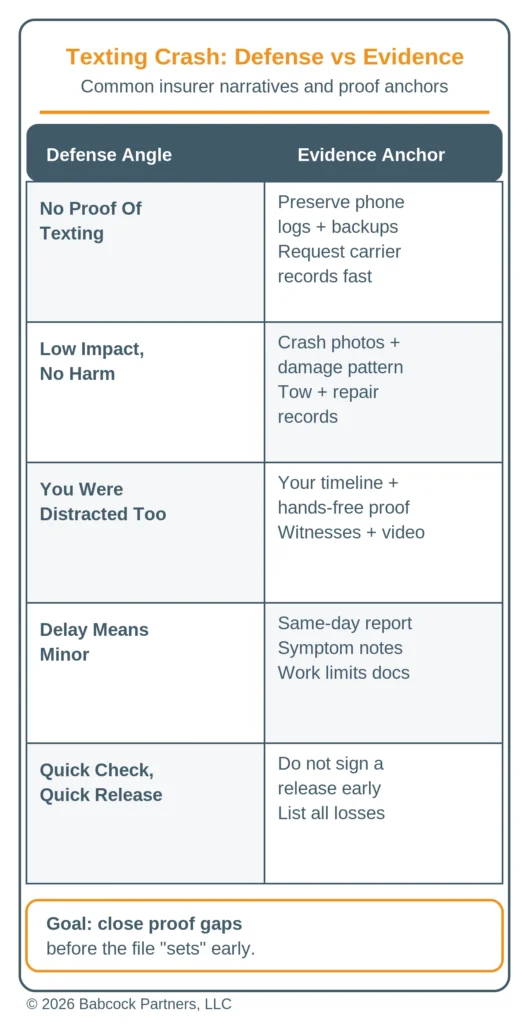
Preserve the records before routine deletion
Ask law enforcement for the report number and identify nearby cameras as soon as possible. Photograph the intersection, traffic controls, lane markings, and any obstruction that affected visibility. Save your own phone, photographs, messages, and location information without editing or selectively deleting material.
Formal preservation requests may be necessary for the other driver’s carrier, device, cloud accounts, employer, vehicle manufacturer, or fleet system. Not every source will retain the same information, and privacy and discovery rules control what can be obtained. The goal is not an indiscriminate search of someone’s phone. It is a targeted request tied to the crash interval and a disputed issue.
The Louisiana car accident checklist covers immediate scene proof, while the guide to getting the crash report explains the follow-up process.
Distraction can exist without a text message
NHTSA describes distracted driving as any activity that diverts attention from driving. That includes eating, talking with passengers, adjusting entertainment or navigation, and using a phone. Texting is especially dangerous because it can involve visual, manual, and mental distraction at the same time.
In a civil case, the investigation should remain open to the actual cause. A driver may have been speeding, fatigued, impaired, or unable to see around an obstruction. Mechanical problems and roadway design may also matter. Proving that a driver touched a phone is not a substitute for reconstructing why the vehicles collided.
Both drivers’ conduct may be examined
An insurer may argue that the injured driver was also distracted, speeding, or failed to react. Louisiana’s comparative-fault statute makes the details important. Preserve your own device and vehicle data as carefully as the other driver’s. Honest, complete evidence is the best answer to a blame-shifting argument.
Do not give a detailed recorded statement while injured, medicated, or before you understand the report and available evidence. Give law enforcement the facts you know, seek treatment, and avoid speculation. If an early statement contains a meaningful error, correct it clearly rather than allowing the mistake to grow.
Medical proof remains a separate part of the case
Phone evidence may establish fault, but it does not establish the extent of an injury. Follow the treating provider’s recommendations and describe symptoms accurately. Keep records of missed work, activity limits, transportation expenses, and the way the injury affects daily tasks. A high-value distraction case can still be weakened by gaps in medical care or vague proof of damages.
A Louisiana texting-and-driving accident lawyer can identify the narrow records that matter, preserve them before they disappear, and connect the device timeline to the collision and medical evidence.
Editorial and legal accuracy notice
Sources checked: September 26, 2026
This article provides general Louisiana legal information, not legal advice. Device records, fault, deadlines, and available claims depend on the incident date and facts.