Louisiana Car Accident Checklist: Evidence and Deadlines


Editorial & Legal Accuracy Notice (Louisiana)

This blog contains general legal and safety information and is not legal advice. Laws and deadlines can change, and outcomes depend on specific facts.

Last reviewed / updated: March, 2026

Reviewed, updated, and authored by: Stephen Babcock, Louisiana injury lawyer

This guide offers practical Louisiana car accident legal tips to help you preserve evidence, communicate carefully with insurers, and understand key deadlines.

A Louisiana car accident turns into a claim fast, often before you feel ready. If you treat the first day like evidence triage, you protect your options later. This article focuses on the practical steps that make your story provable. It also explains where insurance companies look for gaps.

Our approach after a crash is simple: capture proof early, then build a file that holds up under pressure. We are not built for volume. We are built for leverage. Speed + evidence preservation + insurer-insider knowledge + trial-ready preparation = The Babcock Benefit. In Louisiana car accident cases, leverage comes from a clean timeline, credible records, and preserved video.

If you are inside the first 72 hours, call (225) 500-5000 or use the free case review form before evidence changes.

Firm links: Client Reviews | Contact | Locations

What Should You Do After a Louisiana Car Accident?

Start with safety, then lock in the facts while the scene is unchanged. In a Louisiana car accident, strong claims start with a checklist: call for help, photograph the scene, collect witness contacts, and draft a timeline before memories fade.

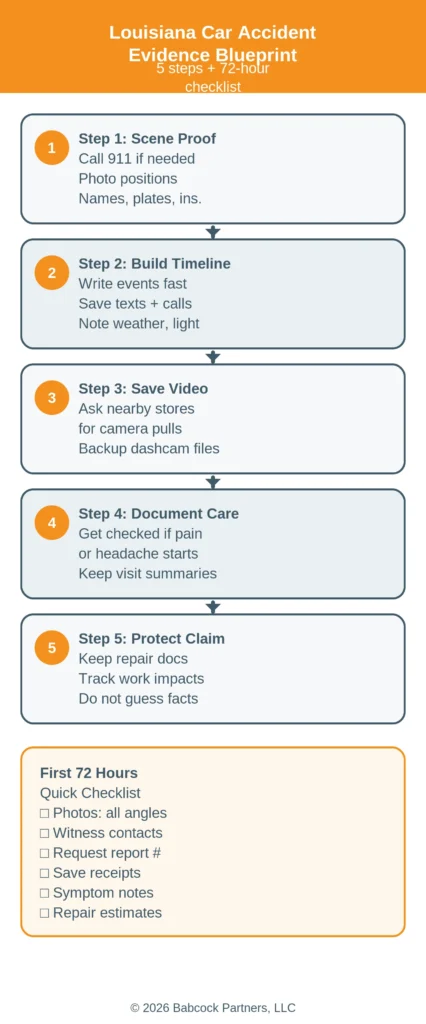
  1. Get to a safe spot if you can do so safely and check for injuries.
  2. Call 911 for emergencies and request help when the scene is dangerous.
  3. Photograph vehicle positions, damage, the roadway, and any debris.
  4. Exchange names, plates, and insurance details, and collect witness contacts.
  5. Write a quick timeline while details are fresh and save phone data.
  6. Start a claim folder for receipts, towing paperwork, and repair documents.

If you are in Baton Rouge, this same checklist applies whether the crash is on I-10, Airline Highway, or a neighborhood street. You can also review our Baton Rouge car accident page to see how we approach evidence and insurer communication in local cases. If your crash happened elsewhere in the metro area, the Baton Rouge hub can help you navigate related resources.

When you speak at the scene, stick to facts you personally know. It is fine to help with basics like exchanging information, but avoid guessing speeds, distances, or who “must have” seen what. Those guesses tend to show up later as inconsistencies.

What Evidence Matters Most in a Louisiana Car Accident Claim?

Evidence in a Louisiana car accident claim does two jobs: it shows how the crash happened and it shows what the crash changed in your life. The strongest files blend scene proof, a consistent symptom and care record, and “non-medical” items like video, phone data, repair paperwork, and witness statements.

  • Scene photos and video that show vehicle positions, lanes, signage, and lighting.
  • Witness names, phone numbers, and short statements in their own words.
  • Dashcam footage, nearby business cameras, and doorbell video if available.
  • Repair estimates, towing and storage bills, and photos taken before repairs.
  • A written timeline that matches your call logs, texts, and receipts.
  • Symptom notes and medical visit summaries that stay consistent over time.

Rear-end crashes are a common example of how a simple case still needs clean proof. La. R.S. 32:81 addresses following too closely, but a citation alone does not replace photos, measurements, and witness accounts. That is why we treat “easy liability” as a myth until the file proves it.

Property damage documentation matters even when you feel fine at first. If the insurer disputes repairs, total loss, or value, our property damage page explains the records that help. It also shows how to keep the paperwork organized.

Quick reference: a 5-step evidence blueprint and first-72-hours checklist to help preserve proof after a Louisiana car accident. (Download the printable PDF below.)

How Do You Build a Crash Timeline That Insurers Cannot Ignore?

An insurer can debate opinions, but a timeline is hard to argue with when records support it. Anchor each event to a source, like a photo timestamp, a 911 log, a tow receipt, or an appointment summary, and update the list as new records arrive.

Time Window What to Capture Best Source
0–2 hours Scene photos, witness contacts, vehicle positions, weather, and lighting Phone camera timestamps and a short written note
Same day Tow and storage paperwork, first symptoms, and who you notified Receipts, call logs, and a simple symptom journal
Days 1–7 Repair estimates, missed work documentation, and follow-up plans Employer email, estimates, and appointment summaries
Weeks 2–6 Consistency check between symptoms, care, and daily function limits Visit summaries and a weekly “what changed” note

This is why we preserve video and phone data early. Many systems overwrite footage on a short loop. Once it is gone, it is gone.

If the crash involved a distracted driver, save details that show inattention in real time. Examples include your call log, passenger photos, and witness observations. Our distracted driving page covers common proof gaps, but your timeline is still the backbone of the file.

Should You Talk to the Insurance Adjuster Right Away?

You should report a crash to start the claim, but you do not have to fill every silence with guesses. Share the basics you know, ask what documents the insurer needs, and pause before any recorded statement or broad authorization until you understand what is being requested.

Usually Safe to Share Better to Slow Down On
Date, time, location, and the vehicles involved Exact speeds, distances, or “I did not see them” guesses
Basic injuries you notice and where you went for care Opinions about fault, blame, or what another driver intended
Where your car is located and whether it is drivable Broad medical history discussions unrelated to the crash

Adjusters often sound friendly because they are collecting information. Be polite, but treat the call like a recorded business conversation even if they do not say it is recorded. If you are unsure, it is reasonable to ask for questions in writing and respond after you review your documents.

What Can Hurt a Louisiana Car Accident Claim?

Most claim damage happens after the crash, when small decisions create proof gaps. If you want to protect a Louisiana car accident claim, avoid actions that erase context, create inconsistencies, or make it look like the crash did not matter.

  • Repairing or selling the vehicle before you photograph and document damage fully.
  • Deleting texts, photos, or social media posts connected to the crash timeline.
  • Waiting weeks to seek care while symptoms steadily worsen without explanation.
  • Giving a detailed statement while still shaken and unsure of basic facts.
  • Posting “I’m fine” updates that conflict with later medical or work records.
  • Relying on a ticket alone instead of building a complete evidence file.

That is what we mean by leverage: when your file answers the obvious defenses, the insurer has fewer places to push. The goal is not to “win an argument.” The goal is to remove doubt with records that match.

What we see in practice

In real cases, we see the same pressure points repeatedly: missing video, rushed repairs, and early statements that do not match later records. We focus on building a claim file that answers predictable questions before the insurer uses those gaps to reduce value.

  • Video exists, but nobody requests it until the system overwrites it.
  • Vehicles get repaired quickly, and the “before” condition is lost.
  • Witnesses are real, but contact details never get collected.
  • Symptoms are real, but the first week has no written record.
  • Adjuster notes turn into the “story” because the driver never wrote one.
  • Damage photos are close-up only, so context like lanes and signs is missing.

We also see cases where people do everything “right” but still get pushed for more proof. For example, a driver may have clear rear-end impact photos, yet the insurer still argues the timing of symptoms. This is why we build the timeline and documentation from day one, not from the demand letter forward.

How Do You Counter Common Insurance Defenses After a Louisiana Car Accident?

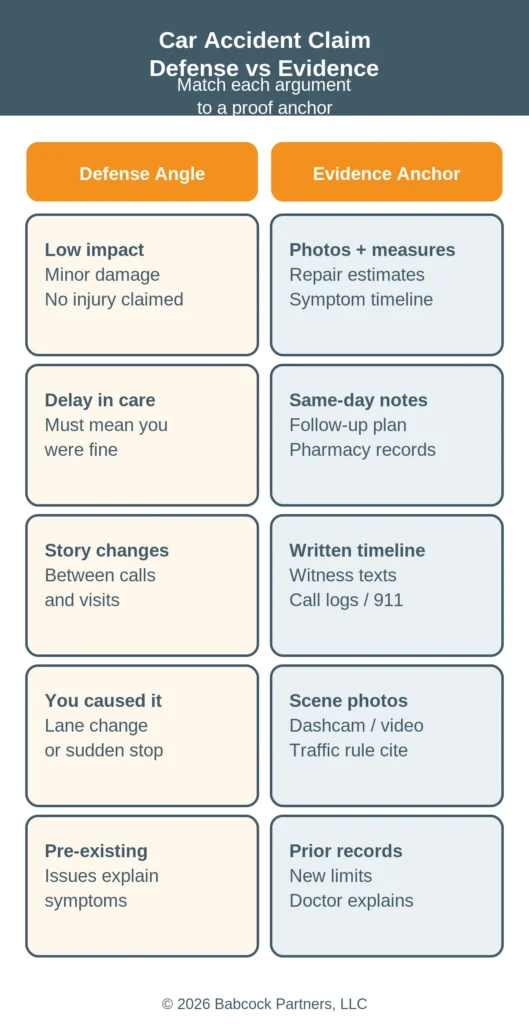
You do not counter defenses with louder opinions; you counter them with matching records. List the likely themes, then pair each one with a specific proof anchor to keep the file consistent from the first call through litigation.

Common Defense Angle Evidence Anchor That Helps
“Low impact means no injury.” Wide-angle scene photos, repair estimates, and a symptom timeline that begins early
“You waited too long for care.” Same-day notes, follow-up plans, pharmacy receipts, and consistent visit summaries
“Your story keeps changing.” A written crash timeline tied to call logs, receipts, and witness texts
“You share fault.” Lane and signage photos, dashcam footage, and witness viewpoints from the scene
“It was pre-existing.” Before-and-after function notes, prior records, and a clear description of new limits

If you want a deeper look at how we handle evidence and insurer strategy, review our car accident practice page and compare it to your current file. This is where many Louisiana car accident claims either gain leverage or lose it, based on whether the documentation matches the defense narratives.

Common defense narratives after a Louisiana car accident—and the documentation that closes the gaps.

When Should You Talk to a Lawyer Quickly?

You do not need to “wait and see” to get basic guidance on protecting a claim file. Talk to a lawyer quickly if the crash involves serious injury, unclear fault, or an insurer pushing fast paperwork, because those situations create irreversible evidence gaps.

  • You are in the first 72 hours, and video or witness proof could disappear.
  • The crash involved a commercial vehicle, rideshare, or multiple insurers.
  • You are being asked for a recorded statement or a broad medical authorization.
  • Your vehicle is a total loss or is being moved between storage locations.
  • You missed work or your symptoms are changing day by day.

Louisiana Law Snapshot (Updated 2026)

Deadlines and fault rules create real urgency, even when injuries feel manageable at first. La. Civ. Code art. 3493.1 sets a two-year delictual prescription for most crash lawsuits, and La. Civ. Code art. 2323 requires fault to be allocated, with the Jan. 1, 2026 version barring recovery at 51% or more fault.

Rule Plain-English Takeaway
Two-year delictual prescription Most injury lawsuits must be filed within two years, so do not let “waiting for the adjuster” run the clock.
Comparative fault Your recovery can be reduced based on your share of fault, even if the other driver caused most of the crash.
51% bar under the 2026 version If you are found 51% or more at fault under the amended rule, you may recover nothing.

These rules are simplified for a blog format. The right deadline and fault analysis can depend on details like who was involved, where it happened, and how fault gets allocated. That is one reason we focus on early evidence preservation instead of waiting for a dispute to appear.

Free Case Review: Protect Your Claim File

We are not built for volume. We are built for leverage. If you want help with a Louisiana wreck claim, call (225) 500-5000 and use the free case review form.

We can triage evidence, spot deadlines, and pressure-test the insurer’s narrative early. You do not need perfect paperwork to start that conversation.

We talk about the Babcock Benefit as a practical mindset: move fast, preserve proof, and prepare the case like it will be challenged. Call quickly because video disappears, vehicles get repaired or sold, and early insurer paperwork can lock in a story before the facts are collected.

These items are helpful to have with you when you call, but do not delay calling because you do not have them. If you have them handy, keep them nearby for the call.

  • Crash date, location, and the names of the drivers involved
  • Photos or video from the scene and vehicle damage
  • Witness names and phone numbers
  • Towing, storage, and repair estimates
  • A short list of symptoms and activity limits since the crash

Call Today If…

  • You are within 72 hours and video or witnesses may be lost
  • The insurer is pushing a recorded statement or a release
  • Fault is unclear or multiple vehicles are involved
  • Your vehicle is a total loss or is being moved between lots

What Happens Next

  • We triage evidence fast and identify the “must-get” records first.
  • We spot deadlines and build a timeline that matches documents, not guesses.
  • We handle insurer communication strategy so the file stays consistent.
×