

After a crash, the car may be towed before you know whether you are hurt. An adjuster may call while you are still trying to get home. Five choices made in that unsettled period can affect the record months later: waiting to address symptoms, guessing in an insurance call, losing scene evidence, signing a broad release, and overlooking another responsible party or policy. None calls for a perfect response at the scene. Each calls for an accurate one.
1. Treating new symptoms as an afterthought
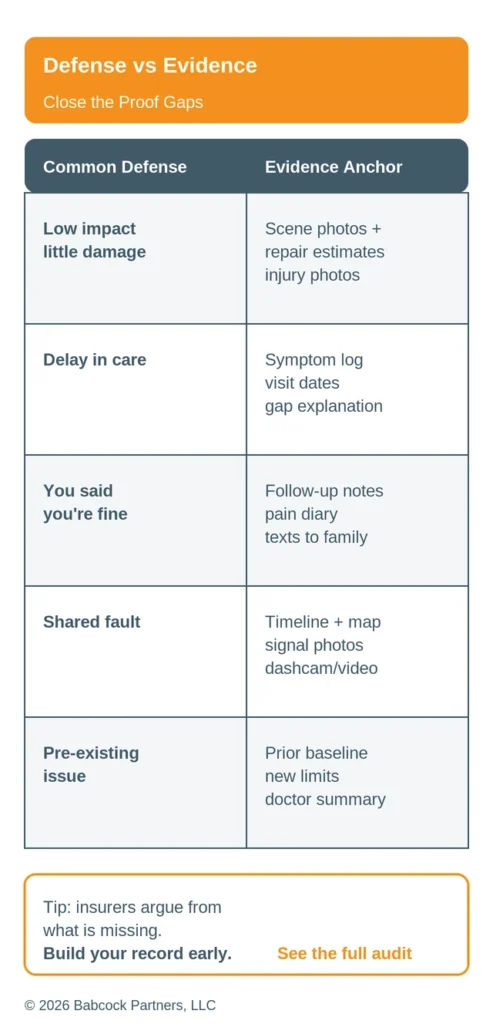
Get appropriate medical help for new or worsening symptoms, especially after a head impact or when you feel dizzy, confused, weak, or in severe pain. Tell a clinician what happened and describe symptoms as they develop, without guessing at a diagnosis. A visit is for your health. The contemporaneous record can also help distinguish a new problem from a condition that existed before the collision.
Keep appointment instructions, bills, and a brief account of changes in work and daily activity. If there is a gap in care, note why. Our article on what to do after a Louisiana car accident covers the immediate safety and documentation steps.
2. Filling gaps in an early insurance conversation
Reporting a claim may be necessary under a policy, but a prompt report does not require a confident answer to every question. Give known basics, including the date, place, vehicles, and report information. If you did not see the traffic signal or cannot estimate speed, say so. Do not adopt another person’s summary merely to end a call. Read any requested statement or authorization before agreeing to it, and retain a copy of what you provide.
Fault matters because Civil Code article 2323 allocates negligence. The amendment effective January 1, 2026 bars recovery under its rule when an injured person’s negligence is 51 percent or more; below that level damages are reduced by that share. The date of the collision matters when determining which rule applies. A photograph or witness account may answer a disputed point more reliably than a rushed estimate.
3. Letting the scene disappear from the file
Photograph vehicle positions and damage, the road layout, traffic controls, debris, lighting, and any visible injury when it is safe to do so. Save original files and note the names of witnesses. If a tow truck moves a vehicle, keep the yard name and paperwork. Nearby camera footage may be overwritten, so identify potential sources early and ask that relevant footage be preserved. A police report helps fix the incident details, though it will not necessarily contain every useful witness or image. See how to obtain a Louisiana crash report once the investigating agency is known.
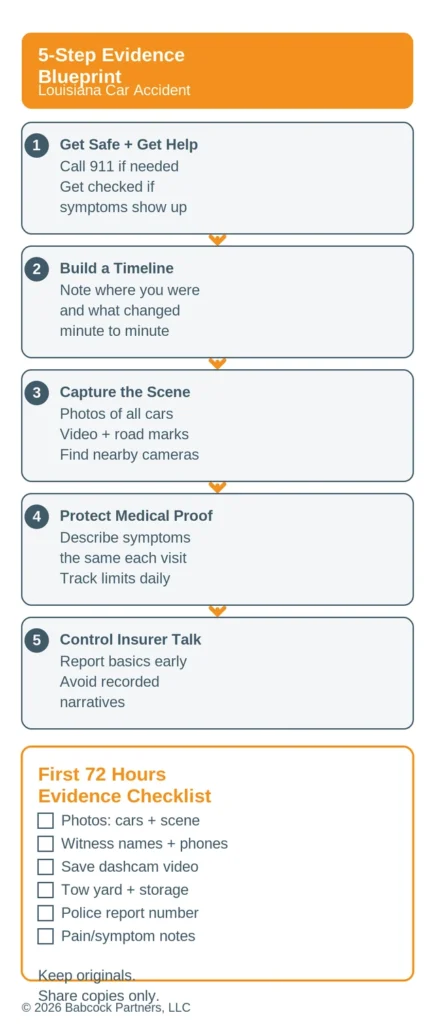
Write a short timeline while memories are fresh: direction of travel, what you saw immediately before impact, what happened next, whom you spoke to, and when symptoms appeared. Mark an estimate as an estimate. Do not alter originals to make them look clearer; keep any edited copies separately.
4. Signing before the injury and repair picture is clear
A quick payment can be welcome when a vehicle is unusable. But first check whether the document resolves only property damage or also releases bodily injury and future claims. Louisiana Civil Code article 3071 treats a compromise as a contract settling a dispute or uncertainty. The exact words of a release and the parties it covers matter. If symptoms are still changing or bills are outstanding, understand those terms before signing. Our account of how a car accident settlement moves from claim to payment explains the sequence in more detail.
5. Assuming one driver and one policy tell the whole story
The driver may have been working, driving someone else’s car, or operating a commercial vehicle. Those facts can affect who is responsible and what insurance is available. Civil Code article 2320 addresses employer responsibility for acts of employees in the exercise of their work functions. It does not make every employer responsible for every trip. Preserve the vehicle markings, company name, driver information, and any account of the trip’s purpose rather than assuming the answer.
It also helps to separate a vehicle repair dispute from an injury claim and to read each policy or settlement document for its scope. The Baton Rouge car accident practice page describes how we investigate fault, coverage, medical proof, and insurer communications when those issues overlap.
For many Louisiana delictual actions, Civil Code article 3493.1 provides a two-year prescriptive period from the day injury or damage is sustained. It took effect July 1, 2024; an earlier event or special claim can require a different analysis. Evidence can disappear well before any filing deadline. If you need to discuss a crash while records are still available, call (225) 500-5000.