


Editorial & Legal Accuracy Notice (Louisiana)
This blog contains general legal and safety information and is not legal advice. Laws and deadlines can change, and outcomes depend on specific facts.
Last reviewed / updated: March, 2026
Reviewed, updated, and authored by: Stephen Babcock, Louisiana injury lawyer
This page explains five post-crash mistakes that can weaken a Louisiana car accident claim and gives a practical checklist to protect evidence and paperwork.
A car accident can feel “handled” once everyone exchanges insurance cards, but claims are won and lost in the days that follow. Most problems start as small choices: a casual comment, a missing photo, or a rushed signature. This guide is built to help you keep the record clean and the facts stable.
After a car accident, we start by locking down the facts before stories harden. We are not built for volume. We are built for leverage. Speed + evidence preservation + insurer-insider knowledge + trial-ready preparation = The Babcock Benefit. In this guide, that leverage means avoiding five post-crash mistakes that insurers use to shift blame and shrink value.
If you are inside the first 72 hours, call (225) 500-5000 or use the free case review form before evidence changes.
Firm links: Client Reviews | Contact | Locations
Prefer a print checklist you can share with family? Download the printable toolkit (PDF). It includes both infographics plus call-prep notes.
What Are the Biggest Mistakes to Avoid After a Car Accident in Louisiana?
The biggest mistakes are the ones that create proof gaps: delays in care, loose statements, missing evidence, early releases, and missed coverage layers. If you want a single place to start, this Baton Rouge car accident page explains the basics of a claim, while the list below shows what to avoid in the first week.
- Waiting to get checked because you “feel fine.”
- Telling a detailed story to insurance while you are still shaken.
- Letting photos, video, and witness details disappear.
- Signing releases or taking quick money before the injury picture is clear.
- Assuming it is a simple two-car claim when other coverage may exist.
Each mistake is fixable if you move fast and write things down. The goal is not to “lawyer up” every fender-bender. The goal is to keep the record accurate so you are not forced to defend avoidable contradictions later.
Why Do These Mistakes Matter Under Louisiana Law?
In Louisiana, fault allocation and documentation quality usually decide how hard a claim becomes. The modified comparative fault rule in La. Civ. Code art. 2323 makes early statements and missing evidence especially risky because insurers can push “shared fault” narratives.
- Fault percentage matters: A clean timeline and clear photos reduce room for blame-shifting.
- The deadline matters: The two-year prescriptive period in La. Civ. Code art. 3493.1 makes early case triage important, even if you hope it resolves quickly.
- Paperwork matters: The Louisiana Department of Insurance guide on auto insurance after an accident highlights how claim decisions depend on the records you provide and what is missing.
Leverage note: This is why we push evidence preservation early—once a camera overwrites footage or a car is repaired, no later argument can recreate that proof. That is what we mean by leverage when we say the first record should be protected.
Mistake 1: Should You Get Checked Even If You Feel Fine?
Yes, you should consider an evaluation if you have new pain, dizziness, headache, numbness, or confusion after a crash. The point is not to “build a case,” but to protect your health and create an accurate first record for what you felt and when.
- Write down symptoms the same day, even if they seem minor.
- Get checked if symptoms appear or worsen over 24–72 hours.
- Ask for discharge instructions and follow them.
- Keep follow-up appointments consistent if a provider recommends them.
Delayed symptoms are common in crash injuries, and the Mayo Clinic’s whiplash overview explains that symptoms often start within days. If you hit your head or develop new head symptoms, the CDC’s concussion symptom guidance lists warning signs that should not be ignored.
Build a Clean Medical Paper Trail
Insurers compare every record to every other record, and small inconsistencies get exaggerated. Use plain language, stick to what you felt, and avoid guessing about diagnosis. If imaging is normal early, that does not automatically mean you are “fine,” so keep the focus on function, limits, and what changed from your baseline.
Mistake 2: Should You Give a Detailed Story to Insurance Right Away?
No, you should not give a long, polished narrative while you are still processing the crash and your symptoms may still be changing. You can report the basics, but treat early calls as fact-only and avoid filling gaps with guesses.
- Share time, location, vehicles, and insurance information.
- Decline to estimate speed, distance, or reaction time if you are unsure.
- Do not agree to “quick paperwork” you have not read.
- Save detailed explanations for when you have your notes in front of you.
This is where many “shared fault” arguments start: an unclear statement becomes a clean quote. If distraction played a role, document what you observed and consider reading our distracted driving page so you know what facts often matter without arguing at the scene.
Leverage note: This is why we keep insurance communications tight and documented—insurers decide from what is written down, not what you meant. That is what we mean by leverage when we reduce the room for narrative spin.
Mistake 3: How Do You Keep Evidence From Disappearing?
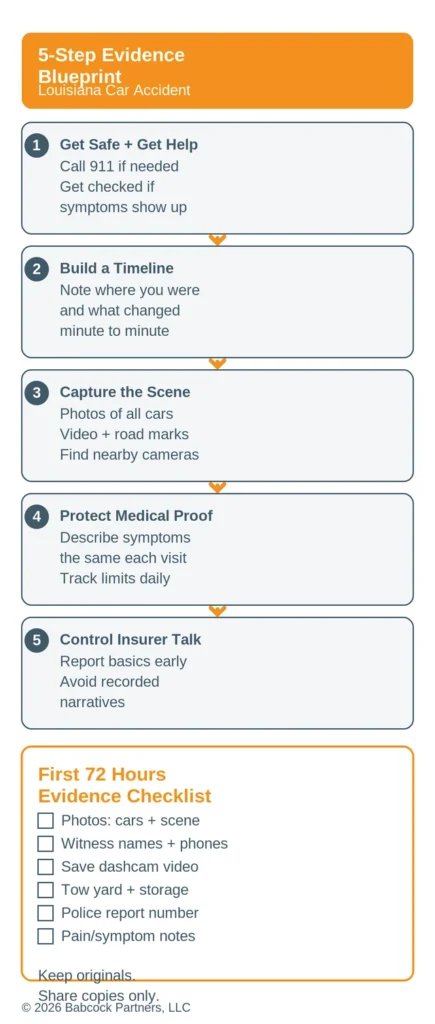
You keep evidence by treating the first 72 hours like a preservation window: photos, video, witnesses, and vehicle condition can change fast. A simple, repeatable checklist beats good intentions every time.
- Photograph all vehicles from every corner, plus close-ups of impact points.
- Capture the full scene: lanes, signals, signs, lighting, and skid marks.
- Write down witness contact details immediately.
- Identify nearby cameras and request preservation before overwrite.
Evidence Preservation That Actually Works
Back up originals the same day and share copies only. If your car is towed, write down the tow yard, storage paperwork, and any release forms before you sign them. If a commercial truck is involved, the evidence clock can be even faster, which is one reason our truck accident practice page emphasizes early preservation steps.
Mistake 4: When Is It Too Early to Settle?
It is too early to settle when you do not yet understand the injury picture, the documentation is incomplete, or you are being asked to sign a broad release. Once you compromise a dispute, La. Civ. Code art. 3071 treats that compromise as a contract, so a rushed signature can lock the door behind you.
- Do not sign “full and final” language while symptoms are still changing.
- Ask what records the insurer relied on and what records they do not have.
- Get your timeline and photos organized before discussing fault or value.
- Confirm every damage category is documented, including property issues.
Early offers often feel like relief, especially when a car is totaled or you missed work. Still, property issues can be their own fight, so if you have a repair or valuation dispute, our property damage page explains common paperwork and documentation problems that can show up in the same claim file.
Mistake 5: Why Is It Risky to Assume It Is a Simple Two-Car Claim?
It is risky because serious crashes often involve more than one responsible party and more than one policy layer. If you assume “one driver, one policy,” you may miss facts that change how liability or coverage is analyzed.
- Was a driver working, in a company vehicle, or driving for a delivery platform?
- Is the vehicle owned by someone other than the driver?
- Are there additional policies (fleet, umbrella, rideshare, employer)?
- Are there separate claims for property damage and injury records?
Louisiana recognizes employer responsibility in certain situations, and La. Civ. Code art. 2320 is one of the core provisions people hear referenced when “course and scope” becomes an issue. If you are unsure where your case fits, our car accident practice page explains the types of coverage questions that often come up after a crash.
What Should You Do in the First 72 Hours After a Car Accident?
Focus on three goals: safety, a clean record, and preservation of proof that will not exist later. If you do those things, you reduce the room for blame-shifting and you make future medical and insurance conversations easier.
- Document: Take scene photos, vehicle photos, and save video.
- Write: Start a simple symptom and activity log the same day.
- Preserve: Identify witnesses and nearby cameras before overwrite.
- Organize: Keep a single folder for every email, estimate, and bill.
- Pause: Avoid long explanations until you have notes in front of you.
If you are still at the scene, safety comes first. If you are already home, the next best move is to organize the file: photos, report number, tow info, and a short timeline you can repeat consistently.
How Do You Build a Crash Timeline That Holds Up?
A timeline holds up when it is simple, consistent, and based on facts you can explain without guessing. The goal is to write down the “who, what, where, and when” before small details fade or get replaced by assumptions.
| Timeline Item | What to Write Down |
|---|---|
| Before the crash | Where you were coming from, direction of travel, lane, speed range if you truly know it. |
| Impact sequence | What you saw first, what you did next, and where each vehicle ended up. |
| After the crash | What you felt right away, who you spoke with, and what photos or video you captured. |
| First 72 hours | Symptoms that appeared later, appointments, meds, missed work, and daily limits. |
Leverage note: This is why we build a timeline early—if your story stays consistent, it is harder to paint normal uncertainty as “changing stories.” That is what we mean by leverage when we protect the first narrative.
What Defense Angles Do Insurers Use, and How Do You Answer Them?
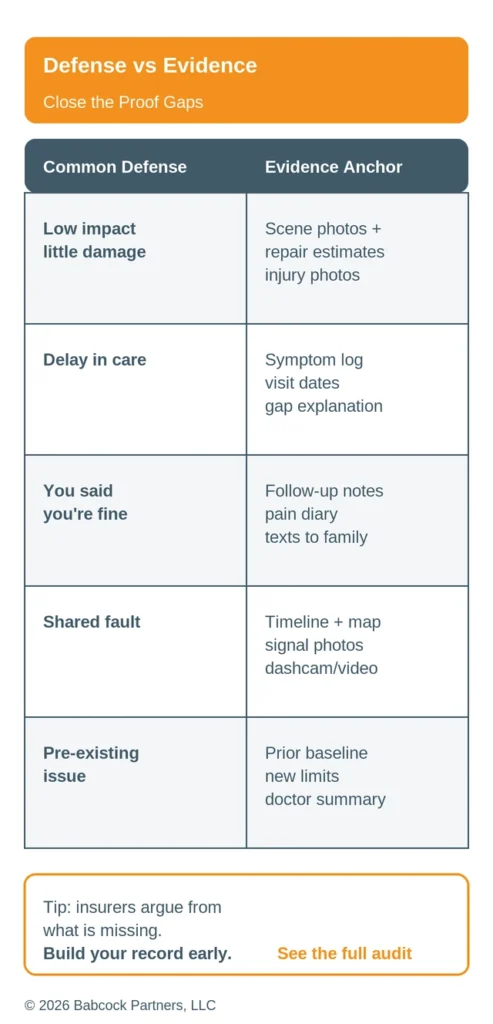
Insurers often argue from what is missing: no treatment, no photos, no witnesses, or no clear timeline. You answer those angles by building specific “evidence anchors” that match the predictable narratives.
| Defense Angle | Evidence Anchor That Helps |
|---|---|
| Low impact “There was barely any damage.” |
Wide photos, close-ups, repair estimates, and a symptom timeline tied to function. |
| Delay “You waited, so it must not be serious.” |
Same-day notes, appointment dates, and a short explanation for any gaps. |
| Statements “You said you were fine.” |
Follow-up notes, texts to family, and consistent reporting at each visit. |
| Shared fault “You contributed to the crash.” |
Scene photos, signal/sign photos, dashcam video, and a clean timeline. |
| Baseline “This is pre-existing.” |
Prior baseline records (if any), new limits, and a provider’s functional notes. |
If you want a simple rule, answer one claim with one anchor: photos for damage disputes, dates for delay arguments, and clear timelines for fault fights. When fault becomes contested, La. Civ. Code art. 2323 is the basic comparative fault framework insurers point to when they argue for reduced responsibility or a bar to recovery.
What we see in practice
What we see in practice is that insurers are consistent: they look for gaps, inconsistencies, and early quotes they can repeat later. We also see people underestimate how fast evidence disappears, especially video and witness contact info. When those gaps show up, the claim often turns into a fight about “shared fault” or “unrelated symptoms” instead of what really happened.
We also see that drivers who keep a simple file do better in the long run because they can answer questions without guessing. That does not mean every crash needs litigation. It means the record is harder to distort when it is organized and consistent.
A Quick Do-This, Not-That Table
If you want a fast way to remember what matters, use this table as your “do this instead” guide. It is designed to keep your record clean without turning every conversation into a dispute.
| Common Mistake | Better Move | Why It Matters |
|---|---|---|
| “I feel fine, so I’ll wait.” | Write symptoms the same day and get checked if they appear or worsen. | The Mayo Clinic explains some symptoms start within days, so timing notes help. |
| Giving a detailed story while shaken | Share basics only, then use your written timeline later. | Fault arguments grow from early statements and missing context under La. Civ. Code art. 2323. |
| Letting evidence disappear | Back up photos/video and identify cameras immediately. | Video overwrite and repairs can erase proof you cannot recreate later. |
| Signing releases too early | Do not sign broad language until you understand the record. | A settlement compromise in La. Civ. Code art. 3071 is treated as a contract. |
| Assuming one policy is the whole story | Check for work use, ownership layers, and additional coverage. | Employer issues can matter, and La. Civ. Code art. 2320 is often part of that analysis. |
Talk to a Lawyer Quickly If These Facts Apply
Some crashes have faster evidence loss, more parties, or higher fault stakes than the average claim. When those red flags exist, early triage helps you avoid missed proof and avoidable deadline pressure.
- A commercial truck, delivery vehicle, or work vehicle is involved.
- You suspect distraction, impairment, or a driver who is denying what happened.
- There are head symptoms, numbness, or worsening pain over 24–72 hours.
- Your car is totaled, towed, or at risk of being repaired before photos are complete.
- You are being pushed to sign a release or give a detailed statement quickly.
Want the same checklist in your glove box? Download the printable toolkit (PDF). Print it, then keep the digital originals backed up.
Louisiana Law Snapshot (Updated 2026)
Most crash claims have real deadlines, and waiting can shrink your options even if your claim is valid. The quickest way to protect yourself is to document early and get case-specific advice before a deadline or evidence loss becomes irreversible.
- Two-year prescription: For many delictual actions, La. Civ. Code art. 3493.1 sets a two-year prescriptive period that generally starts when injury or damage is sustained.
- Comparative fault and the 51% bar: Under the updated rule in La. Civ. Code art. 2323, a claimant found 51% or more at fault is barred from recovery for crashes on or after January 1, 2026.
Free Case Review and Next Steps
We are not built for volume. We are built for leverage.
In plain terms, the Babcock Benefit is about moving early, preserving proof, and staying trial-ready so the claim is harder to discount. Call (225) 500-5000 and use the free case review form if you are facing a fast-moving evidence clock, a push for statements, or pressure to sign releases.
These items are helpful to have with you when you call, but do not delay calling because you do not have them. If you have them handy, keep them nearby for the call.
Checklist for Your Call
- Crash report number (or the agency that took the report)
- Best photos and videos you have saved
- Names and phone numbers for witnesses
- Tow yard location and repair or estimate details
- Your symptom timeline in 5–10 bullet points
Call Today If…
- You are within the first 72 hours and have not preserved photos or video
- You have head symptoms, numbness, or pain that is getting worse
- You are being pushed to give a detailed statement or sign a release
- A work vehicle, delivery driver, or commercial truck is involved
- Fault is disputed or the other driver is changing their story
What Happens Next
- Evidence triage: we identify what can be preserved now and what may be lost soon.
- Deadline spotting: we flag prescriptive and process issues tied to your facts.
- Insurance contact strategy: we help control communications and reduce narrative risk.
For more background on how we handle these cases, you can also review help with a Louisiana crash claim and bring any questions to the call.