

The minutes after a Louisiana car accident are disorienting. Start with immediate safety and medical needs. The insurance and legal questions can be handled more reliably once the scene is safe and the first facts have been preserved.
You do not need to decide at the roadside whether anyone will file a lawsuit. You do need an accurate record of the vehicles, people, roadway, and early symptoms before those details change.
Start with safety and emergency care
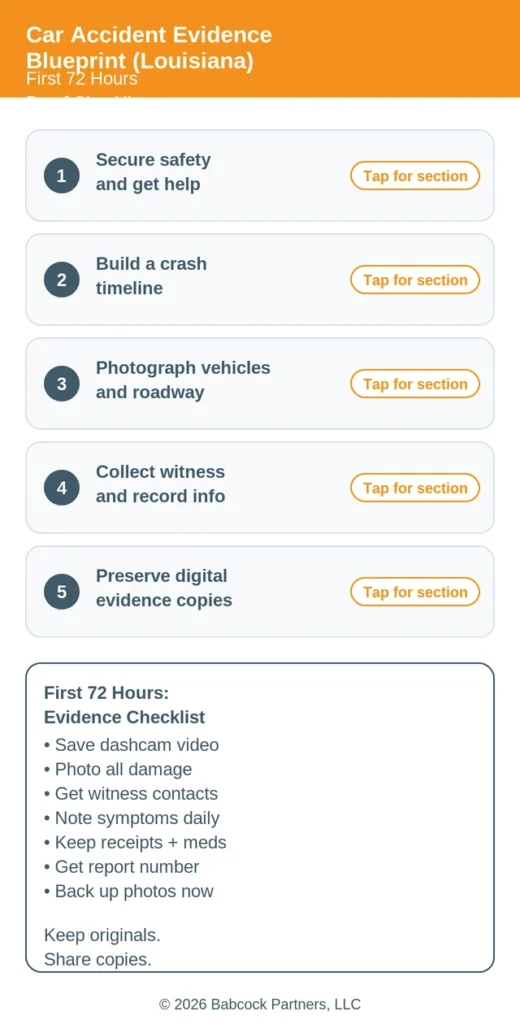
Call 911 when anyone may be injured, a vehicle creates a road hazard, a driver may be impaired, or the scene otherwise requires emergency help. Follow the dispatcher’s instructions. Do not step into moving traffic or take photographs from an unsafe location.
Some injuries are not obvious during the first rush of adrenaline. New or worsening pain, confusion, weakness, breathing difficulty, loss of consciousness, or other concerning symptoms need appropriate medical attention. This article cannot diagnose an injury or determine when a particular person may drive safely.
What information must Louisiana drivers exchange?
Louisiana R.S. 32:398 requires notice to the appropriate law-enforcement agency when a crash causes injury, death, or more than $500 in property damage. The statute also requires a driver to provide identifying and vehicle-registration information and, when requested and available, exhibit a driver’s license to an injured person or someone attending damaged property.
Collect the other driver’s name, contact information, license plate, insurer, policy information, and vehicle description. Photograph documents only with permission and keep the images secure. If the driver is unable or unwilling to provide information, tell the responding officer rather than escalating the encounter.
Photograph the whole scene, not only the damaged bumper
When it is safe, take wide photographs that show vehicle positions, lanes, intersections, signs, signals, sight lines, lighting, weather, debris, skid or tire marks, and nearby businesses or homes that may have cameras. Then take closer photographs of damage, license plates, deployed airbags, damaged restraints, and relevant interior contact points.
Do not rely on one angle. A close view may show damage but hide where the vehicles stopped. A wide view may show the roadway but miss a scrape or broken light. Record the time and nearest street, exit, address, or mile marker.
Ask witnesses for facts, not conclusions
Independent witnesses can be difficult to locate once they leave. Ask for a name, telephone number, and email address. Note where the witness was standing or driving and what part of the event the person actually saw.
A witness who heard the impact but did not see the traffic signal can still describe where the vehicles stopped or what a driver said afterward. Preserve the observation without coaching the person or asking for a legal opinion about fault.
Find video before it is overwritten
Look for dash cameras, doorbell cameras, traffic cameras, transit vehicles, delivery vehicles, and cameras on nearby businesses. Record their locations even if the owner cannot provide footage immediately. Some systems overwrite recordings quickly, so a focused preservation request may be important.
Save original phone photographs and videos rather than relying only on screenshots or social-media copies. Back up dashcam footage before the device records over it. Keep any download confirmation, file date, and communication showing where the recording came from.
Build a short timeline while the details are fresh
A useful timeline records what happened without filling gaps with guesses:
- the route, direction of travel, lane, and traffic control;
- the first moment the other vehicle or hazard became visible;
- braking, steering, horn, or signal use that you actually remember;
- the point and sequence of impacts;
- where the vehicles and debris stopped;
- the names and locations of witnesses;
- what was reported to police, emergency personnel, and insurers; and
- the onset of symptoms, medical visits, work limits, and repair or tow events.
If you do not know a speed, distance, or sequence, say so. A careful uncertainty is more reliable than a confident estimate created later.
Keep the vehicle and repair record organized
Record the tow yard, storage location, and claim number. Save estimates, total-loss valuations, rental records, photographs taken before repair, and communications about salvage. If liability is seriously disputed, vehicle data or components may need to be preserved before repair or disposal.
Do not authorize destructive testing simply because someone asks for the vehicle. Inspection terms may need to address notice, participation, documentation, and preservation of removed parts.
Report the claim without guessing
Policies commonly require timely notice, but notice is different from volunteering a detailed recorded statement to every insurer. Identify the crash and provide accurate basic information. Ask which company and policy the caller represents, whether the conversation is recorded, and how to obtain a copy of any statement.
Do not speculate about fault, future treatment, or whether every symptom has resolved. Do not sign a broad medical authorization or release without understanding its scope and effect. Keep copies of what you send.
Our guide to proving fault when drivers disagree explains how physical evidence, witnesses, electronic records, and traffic rules fit together. The article on what to do after a Ruston car accident applies the same priorities in a local setting.
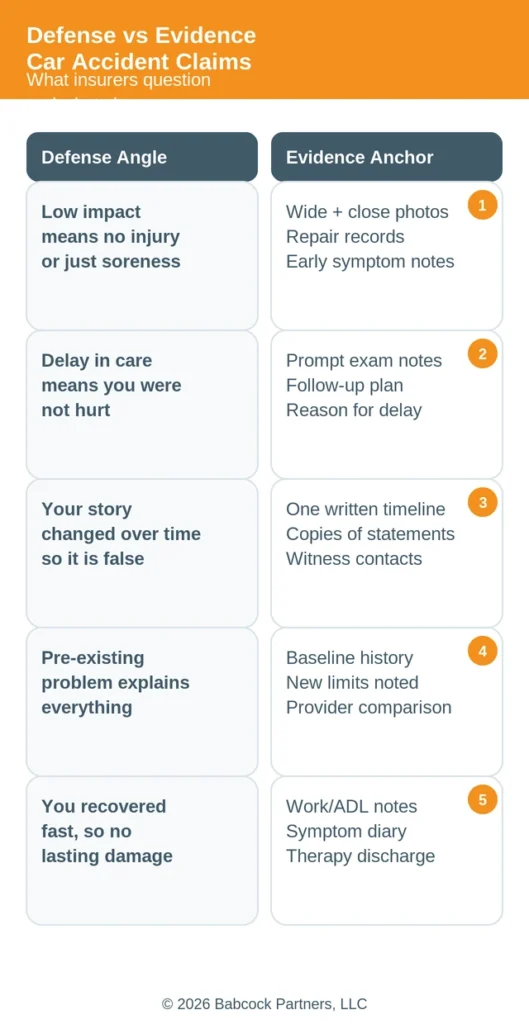
How are common crash defenses tested?
- The impact was too small to cause injury: compare complete vehicle evidence with the medical history and clinical findings rather than using property damage as a diagnosis.
- The injured person waited for care: document when symptoms began, what occurred during any delay, and what the treating providers concluded.
- The account changed: compare each statement with the original scene evidence and determine whether the difference is material or a detail learned later.
- The condition was preexisting: use earlier records to establish baseline symptoms and function, then identify the post-crash change.
- The claimant caused the crash: test that assertion against lane markings, vehicle damage, video, witness accounts, traffic rules, and electronic data.
Consistent records matter, but copying the same scripted statement into every conversation does not make it more reliable. Correct a genuine error promptly and preserve both the correction and the source material.
Louisiana fault and filing law depends on the crash date
Civil Code article 2323 governs comparative fault. The current 51 percent bar took effect January 1, 2026. Crashes before that date may be governed by the earlier version, so the event date must be checked before describing the effect of shared fault.
Civil Code article 3493.1 provides a two-year prescriptive period for delictual actions and took effect July 1, 2024. An earlier crash can involve the former one-year rule. Claims involving death, public entities, minors, workers’ compensation, federal defendants, or other special circumstances can have different requirements. An insurance claim or ongoing treatment does not necessarily stop prescription.
Where can an injured driver learn more?
The firm’s published Baton Rouge car accident practice page discusses evidence preservation, insurer contact, fault, medical proof, wage loss, and coverage. A case-specific review should begin with the crash date, complete scene and vehicle evidence, the police report, insurance policies, and the full medical timeline.