


Editorial & Legal Accuracy Notice (Louisiana)
This blog contains general legal and safety information and is not legal advice. Laws and deadlines can change, and outcomes depend on specific facts.
Last reviewed / updated: March, 2026
Reviewed, updated, and authored by: Stephen Babcock, Louisiana injury lawyer
This guide explains how a Louisiana car accident settlement typically moves from “claim opened” to “release signed,” with a focus on evidence, documentation, and avoiding common proof gaps.
Most people want the same thing after a crash: a fair outcome without endless back-and-forth. The fastest way to get there is to treat your claim like a file that must “prove itself” with dates, records, and clean documentation. This post breaks the car accident settlement process into steps you can follow even if you have never filed a claim before.
We build settlement leverage by spotting proof gaps early and filling them with records. We are not built for volume. We are built for leverage. Speed + evidence preservation + insurer-insider knowledge + trial-ready preparation = The Babcock Benefit. In a car accident settlement, leverage often comes from the timeline and the paper trail, not from arguing on the phone.
If you are inside the first 72 hours, call (225) 500-5000 or use the free case review form before evidence changes.
Firm links: Client Reviews | Contact | Locations
Toolkit Download the printable toolkit (PDF) to keep the checklists, tables, and infographics in one place. It is designed to be easy to print or save on your phone.
How Does a Car Accident Settlement Work in Louisiana?
A car accident settlement is usually a negotiated payment where you resolve an injury or property damage claim without a trial. In most cases, you open the claim, document fault and losses, negotiate with the adjuster, and sign a release once you are ready to close the claim.
- Open the claim: Report the crash and get a claim number.
- Build the timeline: Write down what happened and what changed after.
- Collect proof: Photos, estimates, bills, work notes, and records.
- Evaluate disputes: Fault arguments, coverage issues, and missing documents.
- Negotiate: Use dates and records to support each point.
- Close carefully: Review the release before you sign.
If your wreck happened in or near Baton Rouge, compare your situation to the claim paths we see most often on our Baton Rouge car accident page. Then keep your file organized so the claim story stays consistent from the first call to the final offer.
NAIC’s consumer guide on filing an auto claim explains that insurers typically assign an adjuster to investigate and estimate damages. That investigation is where many settlement delays start, because the adjuster will ask for documents and will note any gaps or conflicts in the timeline.
This is why we treat the first week as an evidence-and-documentation sprint, even when you hope to settle quickly. A clean timeline and clean records create leverage because they leave less room for “maybe” and “we need more time.”
Timeline Builder: What Documents Move a Settlement Forward?
The documents that speed a car accident settlement are the ones that lock down dates, damages, and the “why” behind your losses. When you can hand an adjuster a clear timeline with supporting records, negotiations often move faster and with fewer surprises.
| Document | What It Proves | Best Practice |
|---|---|---|
| Crash report + report number | Parties, location, basic narrative, and identifiers | Louisiana State Police Traffic Records explains how to request reports and notes that reports may take time to be available. |
| Scene photos and video | Damage, lane positions, debris, signs, and lighting | Back up files immediately and label them by date and location. |
| Repair estimate(s) | Vehicle damage scope and repair basis | Save every version if supplements are added later. |
| Medical bills and visit list | Care dates, billing trail, and continuity | Keep a simple visit log even if you are still treating. |
| Work note(s) and wage records | Time missed and work restrictions | Ask for clear dates and restrictions in writing. |
| Out-of-pocket receipts | Concrete expenses tied to the crash | Keep mileage, prescriptions, rentals, and towing together. |
For many people, the biggest “hidden delay” is not the adjuster’s workload; it is missing paperwork. Louisiana Department of Insurance’s guide to auto insurance after an accident describes how claims rely on investigation and documentation, including damage evaluation and supporting information.
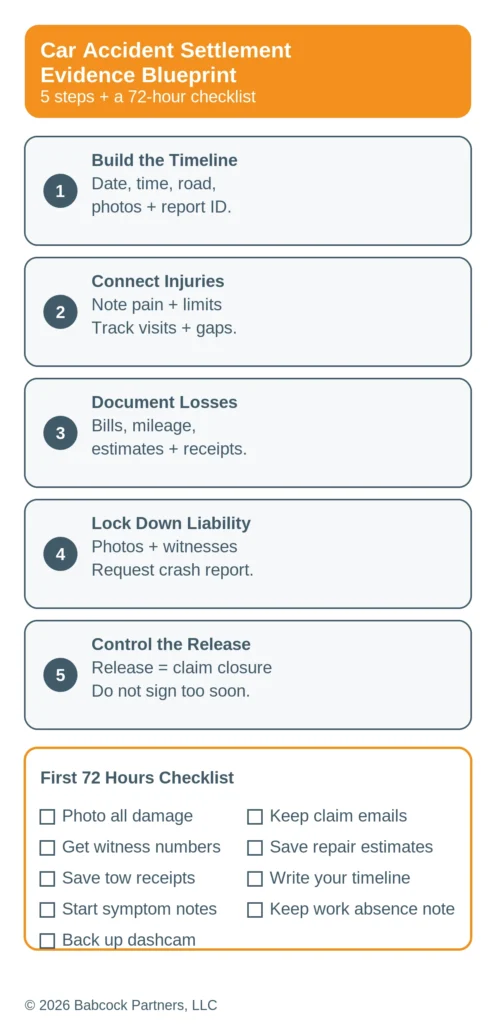
First 72 Hours: Quick Evidence Checklist
In the first 72 hours, focus on saving what can disappear and writing down what you will forget. You are not trying to “prove the whole case” in a weekend; you are preserving the pieces that are hardest to recreate later.
- Photograph vehicles, plates, and roadway marks.
- Write down witness names and phone numbers.
- Back up dashcam or phone video before it overwrites.
- Save towing, storage, rental, and estimate paperwork.
- Start a simple symptom and activity log with dates.
- Keep claim numbers and every insurer message.
How Do Insurers Evaluate Settlement Value?
Insurers usually evaluate settlement value by comparing what you claim to what you can prove with documents, dates, and consistency. When a category of loss lacks proof, the adjuster has more room to dispute it or reduce it.
- Fault clarity: How clear the evidence is on who caused the crash.
- Medical documentation: A consistent care timeline and billing trail.
- Work impact: Written restrictions and time missed with dates.
- Property damage proof: Estimates, photos, and valuation support.
- Credibility signals: Few gaps, few contradictions, clean records.
If your claim includes vehicle repairs or a total loss dispute, keep property damage paperwork in its own folder and treat it like a mini-case. If you need a deeper property focus, our property damage claim page explains common valuation and documentation issues without guessing at numbers.
That is what we mean by leverage when we answer “we need more proof” with organized records instead of frustration. Adjusters negotiate around what they can defend in their file, so your job is to make your file hard to dismiss.
What Evidence Disappears Fast After a Crash?
Evidence disappears fast when it lives on someone else’s system or on a device that overwrites automatically. The goal is to identify those “vanishing points” early and preserve them before they are gone.
- Surveillance video from businesses and nearby homes
- Dashcam data that overwrites after a set number of hours
- Vehicle condition after repairs, towing, or disposal
- Witness memory and contact information
- Roadway conditions that change with weather or construction
This is why we prioritize saving video, photos, and identifiers before debating settlement numbers. Once evidence is gone, the claim turns into a credibility contest, and that rarely helps an injured person.
What Are Common Insurance Defense Angles in a Settlement?
Common defense angles are patterns insurers use to create doubt about fault, injury connection, or the size of your losses. If you anticipate those angles early, you can gather the records that answer them before negotiations stall.
| Defense Angle | Evidence That Counters It |
|---|---|
| “Low impact, so no injury.” | Photos from multiple angles, repair estimates, symptom timeline, and consistent visit dates. |
| “You waited to get care.” | Same-day notes, first-visit date, and a clear reason for any delay. |
| “You had treatment gaps.” | Visit list, work restriction notes, and documentation explaining the gap. |
| “It’s pre-existing.” | Baseline records, new symptoms after the crash, and a clear provider narrative. |
| “You share fault.” | Scene photos, witness statements, dashcam video, and a consistent crash timeline. |
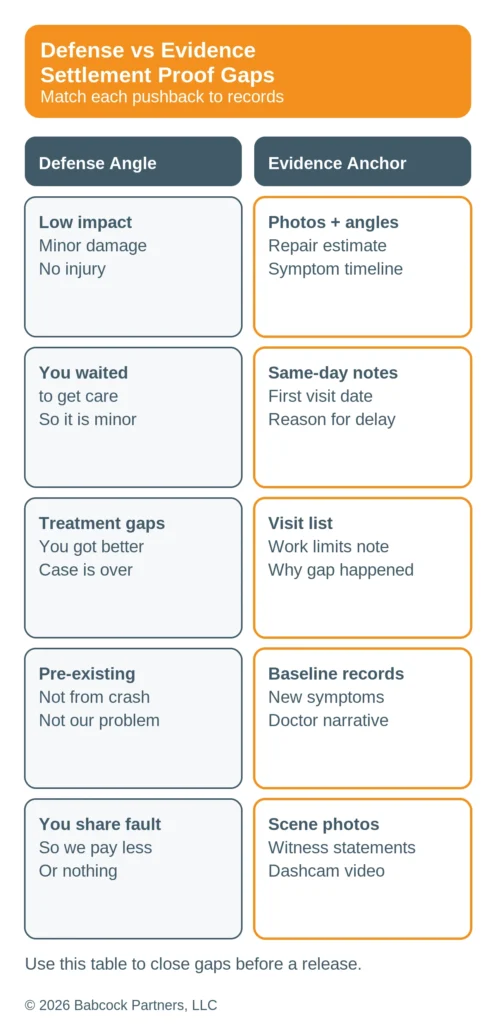
That is what we mean by leverage when we match each pushback to a specific record with a specific date. The goal is not to “win an argument” but to remove uncertainty from the adjuster’s file.
What we see in practice
We see settlements slow down when the claim file has gaps that invite doubt about fault, causation, or damages. We also see claims move faster when people build a clear, chronological record and avoid signing away rights too early.
- Early statements get misunderstood and later feel “locked in.”
- Property damage documents arrive, but medical or work documentation lags behind.
- Treatment gaps get treated as recovery unless the gap is explained in writing.
- People feel pressured to close quickly and sign a release before the file is complete.
Negotiations often turn on small details: the date a symptom started, the day a doctor restricted work, or whether a repair estimate changed after teardown. Those details are boring, but they are the kind of proof that makes an adjuster comfortable paying rather than disputing.
When a case does not settle, it is usually because the parties disagree about fault or about what the records show. We do not assume litigation is necessary in every case, but we do assume the file must be trial-ready if the insurer refuses to be reasonable.
When Should You Talk to a Lawyer During the Settlement Process?
You should talk to a lawyer when the insurer’s questions outpace your documentation or when evidence may disappear before you can preserve it. The earlier you identify the real issues, the easier it is to build a clean record and avoid preventable mistakes.
- Talk to a lawyer quickly if the insurer asks for a recorded statement and you feel unsure about timelines.
- Talk to a lawyer quickly if you have a serious injury, work restrictions, or a growing treatment trail.
- Talk to a lawyer quickly if fault is disputed or you suspect “shared fault” arguments are coming.
- Talk to a lawyer quickly if you are being pushed to sign forms you do not understand.
If you want a quick overview of how we approach these cases, start with our car wreck case page and then narrow the focus to your timeline and proof gaps. If the crash happened in Baton Rouge, you can also use the Baton Rouge hub to find related local resources and practice areas.
What Is a “Full and Final” Settlement Release?
A “full and final” release is a document that closes a claim, usually in exchange for a settlement payment. Once you sign it, you can give up the right to pursue additional compensation for the same claim, so you should treat it as the real finish line.
- Release language matters: read what claims and parties it covers.
- Timing matters: do not sign before you understand missing records.
- Scope matters: confirm whether it covers property, injury, or both.
- Finality matters: treat it as irreversible unless counsel advises otherwise.
Cornell Law School’s Wex definition of a release explains that a release is an agreement to give up a claim, which is why insurers care so much about getting it signed. If something feels rushed, slow down and ask for the release in writing so you can review it carefully.
Toolkit If you want a simple settlement file checklist you can share with a spouse or family member, Download the printable toolkit (PDF) and use it as your one-stop folder guide. It is built to help you spot proof gaps before negotiations stall.
Louisiana Law Snapshot (Updated 2026)
Louisiana has a two-year delictual prescription for many personal injury claims, which can make early issue-spotting critical. Louisiana also uses comparative fault rules that can reduce recovery when fault is shared, and the updated rules create a 51% bar after January 1, 2026.
| Rule | What It Means in Plain English | Why It Matters for Settlements |
|---|---|---|
| Two-year prescription | La. Civ. Code art. 3493.1 sets a two-year deadline for many delictual actions, starting from the day injury or damage is sustained. | Delays can reduce leverage because evidence fades and deadlines approach. |
| Comparative fault + 51% bar (post–Jan. 1, 2026) | La. Civ. Code art. 2323 explains comparative fault, and under the updated framework a claimant at 51% or more fault cannot recover. | Fault evidence is not “technical”; it can control whether a settlement exists at all. |
Free Case Review: Next Steps
We are not built for volume. We are built for leverage. If you want help evaluating a car accident settlement, we use the Babcock Benefit approach to preserve evidence, build clean documentation, and prepare the claim as if it must stand up in court.
Call (225) 500-5000 and use the free case review form when you are ready, because evidence can change, witnesses can disappear, and release pressure often ramps up without warning. If you are facing a deadline, a fault dispute, or a fast settlement offer, those are reasons to get advice quickly.
These items are helpful to have with you when you call, but do not delay calling because you do not have them. If you have them handy, keep them nearby for the call.
- Crash location, date, and report number (if available)
- Photos or video from the scene and vehicle damage
- Claim number(s) and adjuster contact information
- Repair estimate(s) and rental or towing paperwork
- A simple list of medical visits and work restrictions
Call Today If Any of These Apply
- The insurer wants a recorded statement or broad medical authorizations.
- You are being asked to sign a “full and final” release quickly.
- Fault is disputed or “shared fault” is being raised.
- You have a serious injury, growing treatment, or missed work.
- Key evidence may disappear (video, dashcam, witnesses, vehicle condition).
What Happens Next
- Evidence triage: we identify what can vanish and act to preserve it.
- Deadline spotting: we map prescription issues early and plan around them.
- Insurer contact strategy: we control communications and keep the file consistent.
This is why we focus first on proof and timing, not on arguments. When your documentation stays clean, your negotiation position gets stronger, and the settlement discussion tends to be more grounded.