

On February 3, 2026, a 42-inch natural gas pipeline ruptured near Mae’s Beach and Johnson Bayou in Cameron Parish. The fire burned for hours, one person was injured, and the federal pipeline-safety regulator ordered the operator to keep the affected segment shut down while it completed testing, a root-cause analysis, and a restart plan.
This article separates what the federal record confirms from what remains under investigation. It also explains which records may matter to a person who was injured, exposed, displaced, or affected at work or on nearby property.
What does the federal order confirm?
The Pipeline and Hazardous Materials Safety Administration, commonly called PHMSA, issued a Corrective Action Order to Delfin Offshore Pipeline, LLC on February 6, 2026. The order describes preliminary findings, not a final civil-liability decision.
Scroll horizontally to see all columns. Use the arrow keys when the table is focused.
| Point | What PHMSA reported |
|---|---|
| Time and place | The rupture occurred at about 11:14 a.m. local time on February 3 near Mae’s Beach and Johnson Bayou, about a half-mile south of Louisiana Highway 82. |
| Pipeline | The line is a 42-inch natural gas pipeline running about 30 miles from an offshore platform to a station near Johnson Bayou. It had been out of service since 2012. |
| Activity underway | Delfin was using compressed natural gas to move a cleaning pig with a caliper inspection tool through the line. |
| Immediate effects | PHMSA reported a fire roughly 50 to 80 feet wide, about 4 to 5 feet of ejected pipe, an estimated release of 56 million cubic feet of natural gas, and one person taken to a hospital. |
| Preliminary cause | The order says the cleaning pig appeared to have struck a closed valve. PHMSA also cautioned that its investigation was ongoing and that the preliminary findings could change. |
Local reporting also described emergency precautions in the area. Those early reports help reconstruct the public response, but the PHMSA order is the more authoritative source for the pipeline, the federal investigation, and the corrective measures.
What did PHMSA require after the rupture?
The order did more than direct Delfin to repair the visible break. It required an independent technical review of the failure and the entire affected segment before operations could resume.
Scroll horizontally to see all columns. Use the arrow keys when the table is focused.
| Required step | Why it matters |
|---|---|
| Keep the segment shut down | The pipeline cannot operate until the PHMSA Southwest Region director authorizes it. |
| Inspect the damage | Delfin had to submit an inspection plan and provide weekly findings while the work continued. |
| Test the failed pipe | Mechanical and metallurgical testing must preserve chain of custody and address the pipe, soil, and foreign material. |
| Complete a root-cause analysis | An independent third party must document the decision process, contributing factors, and lessons that may apply elsewhere on the line. |
| Prepare for any restart | A restart plan requires PHMSA approval, hydrostatic testing, staged pressure increases, leak surveillance, and coordination with local emergency officials. |
| Develop a remedial work plan | The operator must evaluate whether similar conditions or other integrity threats exist elsewhere on the segment. |
The federal order may produce records that are important later, including inspection reports, testing protocols, laboratory findings, failure analysis, operating records, and communications with regulators. The order itself does not decide who can recover damages or how much a particular claim is worth.
What should someone near a suspected pipeline leak do?
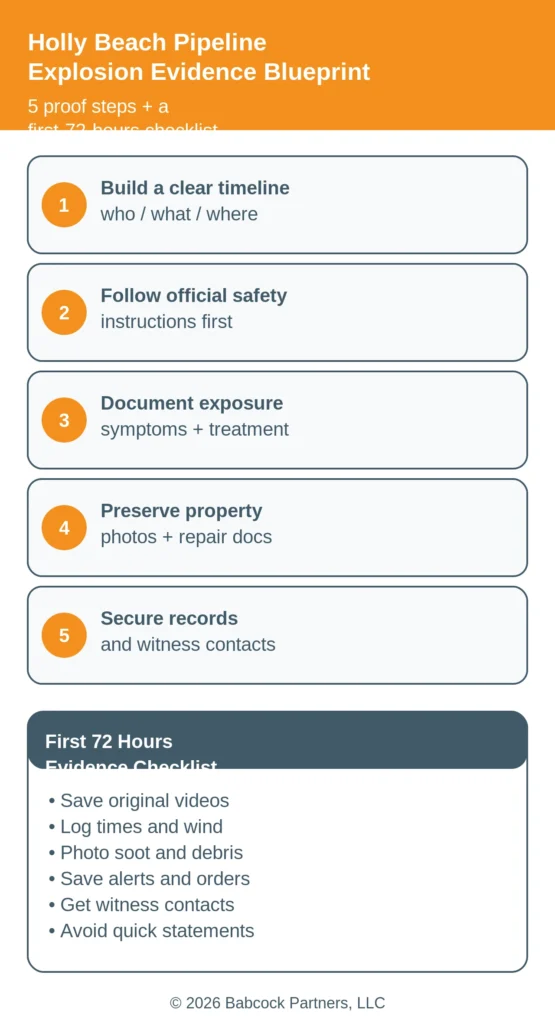
Safety comes first. PHMSA’s public guidance tells people who suspect a pipeline leak to leave the area immediately, avoid ignition sources, and call 911 from a safe place. Do not approach the site to take photographs or try to identify the source yourself.
If you experienced burns, breathing problems, unusual irritation, dizziness, or another symptom, seek appropriate medical care. Tell the provider when and where the symptom began without guessing about a diagnosis. A medical record made close in time to the event can be useful, but care should never be delayed merely to create evidence.
Which records may matter?
Different claims require different proof. A worker’s injury file may center on job assignments and safety procedures. A nearby property claim may turn on photographs, repair estimates, cleanup records, and proof of the property’s prior condition. An exposure claim may require medical and environmental evidence that connects a specific substance, route, dose, and condition.
- Original photographs and video: preserve the original files and their metadata, not only social-media copies.
- Alerts and instructions: keep emergency texts, school notices, evacuation or shelter messages, and screenshots that show their timestamps.
- Location and timeline: record where you were, when you first noticed the event, and when you left or received instructions.
- Medical records: retain discharge papers, test results, referrals, prescriptions, bills, and a measured symptom history.
- Work records: preserve job assignments, training, personal protective equipment records, time sheets, incident reports, and wage information.
- Property records: photograph conditions before cleanup or repair, obtain written estimates, and keep invoices and receipts.
- Communications: save messages with an employer, contractor, operator, agency, or insurer. Note the date, time, name, and substance of calls.
People dealing with a serious burn can find more detail in our guide to hiring a lawyer after a burn injury. The article on the Plaquemine chemical plant chlorine leak explains why exposure symptoms and causation should be documented carefully. For a broader discussion of incident records and legal theories, see Louisiana utility lawsuits.
Who may be responsible?
Responsibility cannot be determined from the size of the fire or the issuance of a corrective order alone. The evidence may involve the pipeline owner or operator, contractors involved in the inspection run, equipment manufacturers, property owners, employers, and other entities. Contracts, operational control, written procedures, valve status, communications, training, and technical testing may all affect the analysis.
Louisiana Civil Code article 2315 provides the general starting point for many negligence claims. A claimant still must prove a legally recognized duty, breach, causation, and compensable damage. For an injured worker, workers’ compensation and a possible claim against a responsible third party may involve different rules. Our published plant explosion practice page explains how operational control, engineering evidence, and third-party responsibility can fit together.
What deadlines apply in Louisiana?
For many Louisiana injury and property-damage claims arising on or after July 1, 2024, Civil Code article 3493.1 provides a two-year prescriptive period beginning on the day the injury or damage is sustained. That is not a universal deadline. Claims involving a public entity, workers’ compensation, maritime law, product liability, wrongful death, minors, or another special rule may require different notices or filing dates.
For an event on February 3, 2026, Civil Code article 2323 can also affect recovery. A claimant found 51 percent or more at fault generally cannot recover damages. A claimant below that threshold generally has damages reduced by the assigned percentage. Fault in a pipeline case is fact-specific, and the regulatory investigation does not replace the civil proof required in court.
Sources
- PHMSA, Corrective Action Order to Delfin Offshore Pipeline, LLC, issued February 6, 2026.
- PHMSA Corrective Action Order, CPF No. 4-2026-028-CAO.
- PHMSA, Pipeline Leak Recognition and What to Do.
- KPLC, initial February 3 report.
- KPLC, February 5 follow-up.
- Louisiana Civil Code article 2315.
- Louisiana Civil Code article 3493.1.
- Louisiana Civil Code article 2323.
Editorial and Legal Accuracy Notice
This article provides general legal and safety information, not legal or medical advice. PHMSA described its cause findings as preliminary, and later investigation results may change the factual record. Legal rights and deadlines depend on the particular facts.
Sources checked: September 28, 2026.