Editorial & Legal Accuracy Notice (Louisiana)
This blog contains general legal and safety information and is not legal advice. Laws and deadlines can change, and outcomes depend on specific facts.
Last reviewed / updated: March, 2026
Reviewed, updated, and authored by: Stephen Babcock, Louisiana injury lawyer
This guide explains how to protect yourself after a Louisiana car accident involving an uninsured driver, with a focus on evidence, coverage, and next steps you can control.
When the other driver has no insurance, the problem is not just payment—it is proof. You still have to show how the crash happened, what it did to you, and what it cost. The steps below help you build that proof while the facts are fresh, and they match the same evidence-first approach we use on our Baton Rouge car accident practice page.
Our job is to turn a chaotic crash scene into a clean evidence file that an insurer cannot ignore. We are not built for volume. We are built for leverage. Speed + evidence preservation + insurer-insider knowledge + trial-ready preparation = The Babcock Benefit. In uninsured driver cases, leverage comes from proving fault, proving the no-coverage gap, and documenting your losses early.
If you are inside the first 72 hours, call (225) 500-5000 or use the free case review form before evidence changes.
Firm links: Client Reviews | Contact | Locations
Download the printable toolkit (PDF) if you want the checklist in one place. It includes both infographics and a one-page “what to gather” table.
What Should You Do After a Louisiana Crash With an Uninsured Driver?
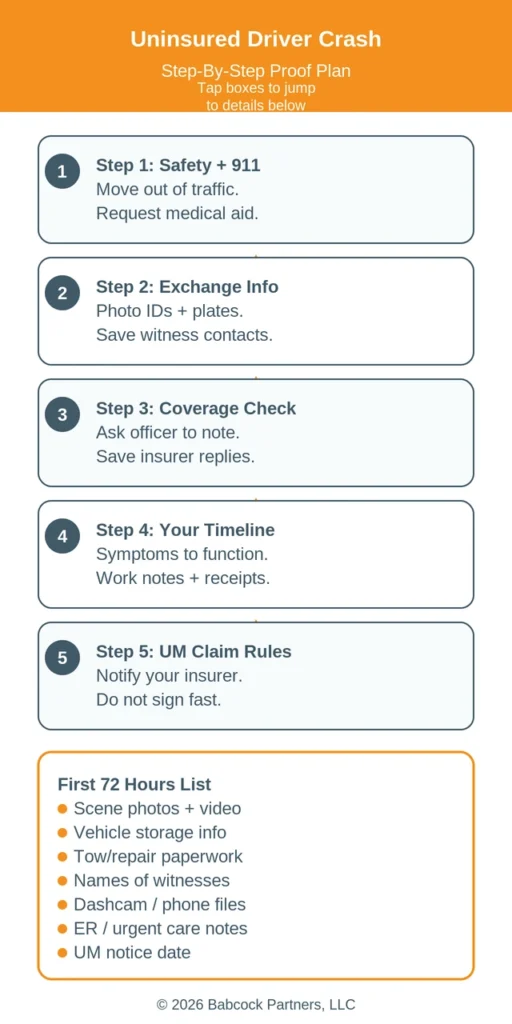
After a crash with an uninsured driver, focus on safety, a paper trail, and proving the coverage gap before stories change. Louisiana’s crash-report duties in La. R.S. 32:398 make a police report and information exchange especially important when the other driver cannot show insurance.
- Get safe and get help: Call 911, request medical help, and ask for a report number.
- Photograph the basics: Plates, damage, roadway context, and any visible injuries.
- Collect identity info: Driver name, owner name, contact details, and witness contacts.
- Lock in “no coverage” proof: Document what the driver shows you and what they do not.
- Start your UM plan: Notify your insurer and keep a clean timeline of symptoms and costs.
Because Louisiana is a fault-based state, you usually still have to prove negligence to recover. La. Civ. Code art. 2315 is the foundation for that fault concept, and it is why photos, witnesses, and clear reporting matter even when the at-fault driver has no policy.
That is what we mean by leverage: an uninsured driver wreck is often a documentation contest, not a fairness contest. If the other driver disappears or gives inconsistent information, your ability to prove fault and losses can decide whether your uninsured motorist claim gets paid.
What Should You Do in the First 72 Hours?
In the first 72 hours, your goal is to preserve perishable evidence and stabilize your record of what happened. The most common “holes” we see later are missing photos, missing contact data, and no clear baseline for pain, limits, or missed work.
- Back up photos and video to a second location, and keep originals.
- Write a short timeline: time of crash, symptoms, and how your day changed.
- Save towing, storage, rental, and repair documents in one folder.
- Request the crash report when it is available and keep the report number.
- Notify your insurer in writing and save the claim number and adjuster name.
If you need help setting up that proof file, our team uses the same playbook on serious collision cases described on our car accident case page. The goal is to keep your early statements, records, and dates consistent from day one.
How Do You Confirm the Other Driver Is Uninsured?
You confirm “uninsured” by documenting what the driver provides at the scene and what official records show afterward. When the other driver cannot produce proof of coverage, a police report and follow-up verification become critical anchors for your UM claim file.
- Photograph what they show you: Insurance card, expired card, app screen, or “no card” statement.
- Ask the officer to note it: A report narrative can capture “no insurance provided” and ownership details.
- Pull the crash report: Louisiana State Police Traffic Records Unit explains how drivers can request records, and the official crash report portal is often the fastest path for many reports.
- Save follow-up communications: Texts, voicemails, and any insurer denials tied to the driver.
This is why we push to get the report number, photos of the license plate, and witness contacts before the vehicles move or get repaired. The earlier you lock those basics in, the fewer “proof gap” arguments appear later.
How Does Uninsured Motorist Coverage Work in Louisiana?
Uninsured motorist coverage is designed to step in when the at-fault driver has no insurance or not enough insurance, but the details depend on your policy choices. Louisiana’s uninsured motorist statute (La. R.S. 22:1295) sets the default rule that UM coverage is part of an auto policy unless it is validly rejected or altered.
| Coverage Piece | What It Usually Addresses | Proof You Should Preserve |
|---|---|---|
| UM Bodily Injury | Injuries and related losses when the at-fault driver is uninsured or underinsured | Medical visit notes, symptom timeline, and wage/expense documentation |
| UM Property Damage | Vehicle repair or total loss when the at-fault driver is uninsured, if your policy includes it | Photos, repair estimates, storage bills, and valuation documents |
| Economic-Only UM | Measurable costs with limits on non-economic damages, depending on the selection | Receipts, wage loss proof, and a clean causation timeline |
For consumers, the Louisiana Department of Insurance’s auto insurance guide is a helpful plain-language overview of common coverages and policy terms. When UM limits or UM form issues matter, Louisiana Department of Insurance Bulletin 08-02 is one example of how the state explains the official UM selection form and why proper completion can become a dispute point.
Do not assume the other driver being uninsured automatically means your insurer will “just pay.” That is what we mean by leverage: UM claims can feel like first-party claims, but they are still evaluated like a contested liability file, and gaps in your proof can be treated like reasons to reduce value or deny parts of the claim.
Timeline Builder: The Records That Make or Break an UM Claim
A strong uninsured driver claim reads like a timeline, not a pile of documents. The goal is to show a clear sequence from crash impact to symptoms to treatment to financial loss, with dates that match across records.
- Crash moment: photos, video, witness names, and the police report number.
- Same day: first symptoms, first medical visit if needed, and the first “can’t do normal life” notes.
- First week: follow-up care, work restrictions, repair estimates, and insurer communications.
- Ongoing: consistent treatment notes, updated costs, and any missed-work documentation.
- Resolution steps: demand package, recorded-statement strategy, and settlement document review.

If your vehicle will be repaired or totaled quickly, preserve your own photos first and ask the tow yard to keep the vehicle location documented. This is why we treat the first week as an evidence clock: once parts are replaced or the vehicle is sold, “what the damage shows” becomes an argument instead of a photograph.
Defense Audit: Common Uninsured Driver Denials and What Closes the Gaps
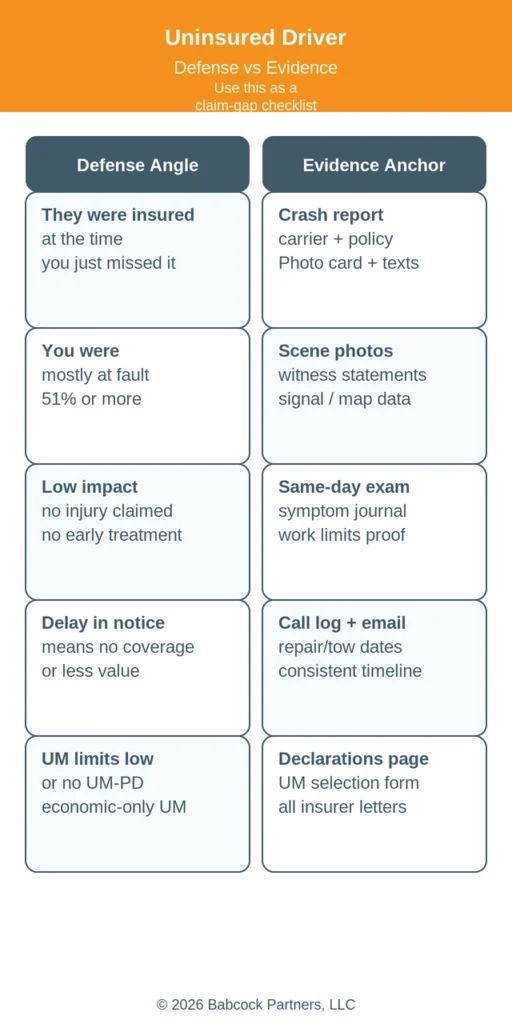
Insurance defenses in uninsured driver cases usually track predictable “proof gaps.” If you pre-build the evidence anchors below, you reduce the chances that the insurer can turn uncertainty into a denial.
| Common Defense Angle | Evidence Anchor That Helps |
|---|---|
| Coverage dispute: “They were insured” or “you cannot prove no coverage.” | Crash report carrier field, photos of any card/app screen, and saved insurer communications. |
| Shared fault: “You caused it” or “you are 51% or more at fault.” | Scene photos, independent witnesses, and a consistent story across records. |
| Minor impact: “Low damage means no injury.” | Early medical documentation, symptom timeline, and function limits at work or home. |
| Delay: “Late notice” or “gap in care.” | Call logs, appointment log, and a written explanation that matches dates. |
| Policy framing: “UM limits are low” or “no UM property damage.” | Declarations page, UM selection form, and the full paper trail of adjuster requests. |

If you were injured, the legal analysis still runs through fault and comparative fault. La. Civ. Code art. 2323 is Louisiana’s comparative fault rule, and it is why insurers often look for any record inconsistency they can use to argue you should bear more of the blame.
If your crash fits the “serious injury or high-stakes coverage dispute” category, you can also read more about how we handle these files on our Baton Rouge car accident representation page. It can help you spot the missing records before the insurer frames the story for you.
What About Vehicle Damage and Total Loss When the Other Driver Has No Insurance?
Vehicle damage after an uninsured driver wreck is usually handled through your own policy, and the proof still matters. You want clean photos, repair estimates, and valuation documents so the insurer cannot treat a total-loss or diminished-value issue as “unsupported.”
- Before repairs: photograph every side, the VIN label area, and the interior if airbags deployed.
- Get written estimates: keep the first estimate and any supplements.
- Track storage and towing: those charges can grow fast and become leverage points.
- Save valuation inputs: comparable listings, options packages, and mileage proof.
For a deeper look at documentation problems that come up in vehicle claims, see our Baton Rouge property damage claim page. Keeping valuations tied to documents, not opinions, helps prevent avoidable disputes.
What Mistakes Can Hurt an Uninsured Driver Claim?
The most damaging mistakes are usually paperwork mistakes, not “bad luck” mistakes. If your file has gaps, insurers can argue uncertainty and push you into a low-value settlement posture.
- Letting the car be repaired or sold before you preserve detailed photos.
- Giving a recorded statement while you are still foggy on timing and symptoms.
- Posting about the crash or your injuries in a way that conflicts with your records.
- Skipping follow-up care and creating a “gap” that gets blamed on something else.
- Signing a broad release without understanding what you are giving up.
If an adjuster asks you to “just sign so we can move this along,” slow down and get clarity. A disciplined paper trail helps prevent pressure tactics from becoming permanent paperwork.
What we see in practice
In uninsured driver cases, we see the same pressure points show up again and again: missing scene evidence, incomplete crash reports, and early statements that do not match later medical notes. We also see insurers treat “uninsured” as a reason to demand extra proof, even when the crash facts are clear.
- Proof gap pattern: “No insurance” is often asserted, but not documented in a way the insurer accepts.
- Timeline pattern: people feel worse later, but they do not document the early baseline.
- Paperwork pattern: releases and authorizations get signed too quickly to “keep things moving.”
Our practical focus is to convert uncertainty into records: a clean timeline, consistent documentation, and a preserved scene file. That structure is what lets you negotiate from a position of leverage instead of reacting to whatever narrative the adjuster chooses.
When Should You Talk to a Lawyer Quickly?
You should talk to a lawyer quickly when the uninsured driver crash has high deadlines, high damages, or a fast-moving evidence problem. The point is not drama; it is to protect proof and prevent avoidable paperwork mistakes while you are still healing. Talk to a lawyer quickly if any of the triggers below apply.
- The other driver fled, gave false info, or the vehicle owner is unclear.
- You have a head injury, fractures, or any injury that changes work or daily function.
- The insurer is pushing a fast settlement or a broad release.
- Your vehicle is at risk of being repaired, totaled, or sold before documentation is complete.
- You are facing a disputed fault story or multiple vehicles.
Download the printable toolkit (PDF) to keep the defense-audit checklist and timeline builder in front of you while you gather records. This download is informational and is not a substitute for legal advice.
Louisiana Law Snapshot (Updated 2026)
Two timing rules drive most Louisiana crash cases: how long you have to file, and how fault can reduce or bar recovery. Start with the two-year deadline in La. Civ. Code art. 3493.1 and the comparative-fault rule in La. Civ. Code art. 2323, then confirm how the facts fit your situation.
- Prescription: many delict claims use a two-year filing deadline, but exceptions can apply.
- Comparative fault: fault can be split, and after Jan. 1, 2026, 51% or more fault can bar recovery.
Because uninsured driver cases can trigger extra coverage disputes, do not treat “we are still investigating” as a pause on deadlines. Preserve evidence and spot time limits early, even if medical care is ongoing or liability feels obvious.
Free Case Review and Next Steps
If you were hit by an uninsured driver, you do not have to guess your way through a UM claim. We are not built for volume. We are built for leverage.
- Evidence moves fast: repairs, video overwrites, and missing witness info.
- Paperwork matters: recorded statements and releases can lock in mistakes.
- Deadlines are real: waiting can limit options even with clear fault.
Our Babcock Benefit approach is simple: preserve evidence early, build a clean timeline, and communicate with insurers from a trial-ready posture. If you want context on what that looks like, review our Louisiana auto-wreck framework, then call (225) 500-5000 and use the free case review form so we can triage evidence and spot deadlines before they get used against you.
These items are helpful to have with you when you call, but do not delay calling because you do not have them. If you have them handy, keep them nearby for the call.
- Crash report number and the other driver’s name
- Your auto policy declarations page
- Photos/video of the scene and vehicles
- Medical visit dates and provider names
- Work miss notes and a simple expense list
Call Today If Any of These Are True
- The other driver has no insurance, fled, or gave inconsistent information
- You are being asked to sign a release quickly
- Your vehicle is about to be repaired, totaled, or sold
- You have a head injury, back pain, or new limits on daily function
- You are worried about a disputed-fault story
What Happens Next
- Evidence triage: we identify what can disappear first and secure it.
- Deadline spotting: we map time limits and notice requirements to the facts.
- Insurer contact strategy: we control the paper trail and reduce avoidable “gotcha” gaps.