

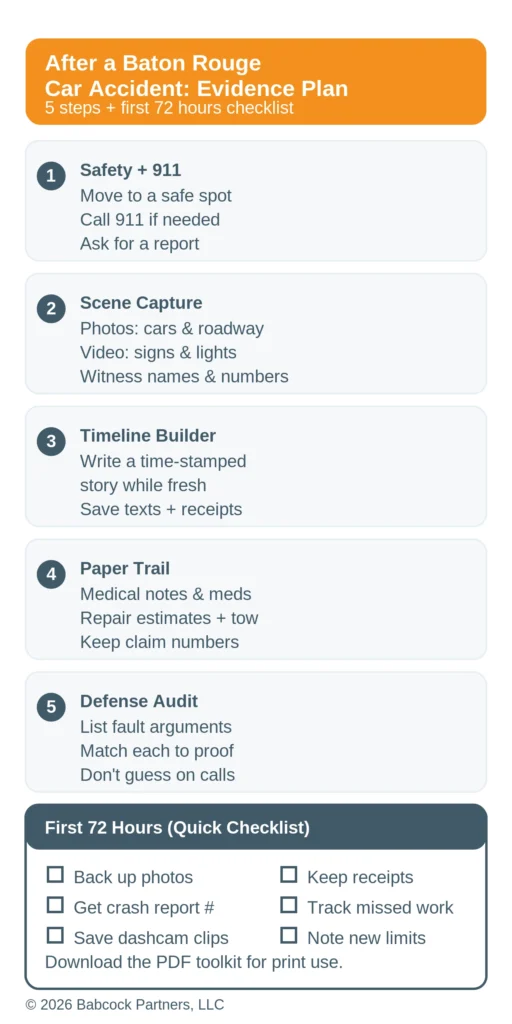
A Baton Rouge crash can become difficult to reconstruct within hours. Traffic resumes, vehicles are towed, witnesses leave, and nearby cameras continue recording over old footage. The first objective is safety and medical care. The next is to preserve a reliable account of the vehicles, roadway, people, and early symptoms without guessing about facts that are not yet known.
You do not need to decide at the scene whether a lawsuit will follow. A careful record keeps options open while the medical and insurance picture develops.
Move out of danger and request the right help
Call 911 when anyone may be injured, a vehicle blocks traffic, a driver may be impaired, or the scene otherwise requires emergency assistance. Follow the dispatcher’s instructions. Do not stand in an active lane or try to move a person with a suspected serious injury unless remaining in place creates a greater danger.
If vehicles can be moved safely and the responding agency directs that they be moved, first note or photograph their positions when possible. The location of damage, debris, tire marks, and final rest can help explain the collision later. Safety comes before documentation.
Exchange information without debating fault
Collect the other driver’s name, contact information, license plate, insurer, policy information, and vehicle description. Also record the responding officer’s name, agency, and report or item number. If a vehicle belongs to a business, identify the company and any unit or fleet number shown on it.
Louisiana Revised Statute 32:398 addresses notice to law enforcement after crashes involving injury, death, or more than $500 in property damage and requires drivers to provide specified identifying and registration information. If another driver cannot or will not cooperate, tell the officer rather than escalating the encounter.
Photograph the roadway as well as the vehicles
Start with wide photographs showing the lanes, intersection or roadway, traffic controls, lighting, weather, construction, sight lines, vehicle positions, and debris. Then take closer images of damage, license plates, deployed airbags, damaged restraints, broken lights, and relevant interior contact points. Photograph each vehicle from several angles.
Record the nearest street, intersection, address, exit, or mile marker. A close view may show damage but conceal the roadway layout. A wide view may show the scene but miss a scrape or broken component. Both are useful when fault is disputed.
Get witness details before people leave
Ask witnesses for a name, telephone number, and email address. Note where each person was standing or driving and which part of the event the person actually observed. Someone who did not see the impact may still have seen a traffic signal, heard a statement, or observed where the vehicles stopped.
Do not ask a witness to agree with a theory of fault. Preserve the observation in the witness’s own words. If the witness is willing to provide a short written or recorded account, document the person’s permission and keep the original file.
Locate video before it is overwritten
Look for dash cameras, doorbell cameras, business surveillance, transit vehicles, delivery vehicles, and cameras facing the roadway. Record the location and apparent direction of each camera even if the owner cannot provide footage immediately. Some systems retain recordings only briefly, so a focused preservation request may be time sensitive.
Copy dash-camera footage before the device records over it. Keep original phone photographs and videos, not only screenshots or social-media versions. Preserve the original file names, dates, and any message or download record showing where the material came from.
Pay attention to symptoms that appear later
Adrenaline, confusion, and the practical demands of the scene can make symptoms difficult to assess. Seek appropriate medical care for new or worsening pain, weakness, numbness, confusion, breathing difficulty, loss of consciousness, or other concerning symptoms. This article cannot diagnose an injury or determine when a particular person may drive safely.
Tell treating professionals how the collision occurred and when each symptom began or changed. Save discharge instructions, prescriptions, referrals, work restrictions, appointment records, and out-of-pocket receipts. A medical record should reflect the patient’s actual condition rather than language copied from an insurance form.
Build a short, factual timeline
Write down the route, direction of travel, lane, traffic control, first moment the hazard became visible, sequence of impacts, vehicle positions, witness locations, and what was reported to police and insurers. Add the onset of symptoms, medical visits, work limits, towing, repair, and rental events as they occur.
Separate personal memory from information learned later. If speed, distance, or sequence is uncertain, say so. A careful uncertainty is more credible than an estimate created after repeated conversations. Keep emails, letters, portal messages, and text messages in the same date order.
Protect the vehicle and repair record
Record the tow yard, storage location, claim number, and person who controls the vehicle. Save estimates, supplements, invoices, total-loss valuations, rental records, and photographs taken before repair. When liability is seriously disputed, vehicle data or components may need to be inspected before repair or disposal.
Do not authorize destructive testing merely because someone requests access to the vehicle. Inspection terms may need to address notice, participation, documentation, and preservation of removed parts. If the vehicle is declared a total loss, find out when and where it will be moved before signing title or salvage paperwork.
Report the claim without filling gaps
Insurance policies commonly require timely notice. Provide accurate identifying information and ask which company, policy, and insured the caller represents. Keep the claim number and a dated record of communications. Notice does not require a person to guess about speed, fault, diagnosis, or future recovery.
Before giving a detailed recorded statement, signing a broad medical authorization, or accepting a settlement, understand the request and its consequences. A statement taken before the evidence is gathered may preserve an incomplete version of events. A full release can end a claim even if treatment or vehicle evaluation is unfinished.
Test common insurance arguments against the records
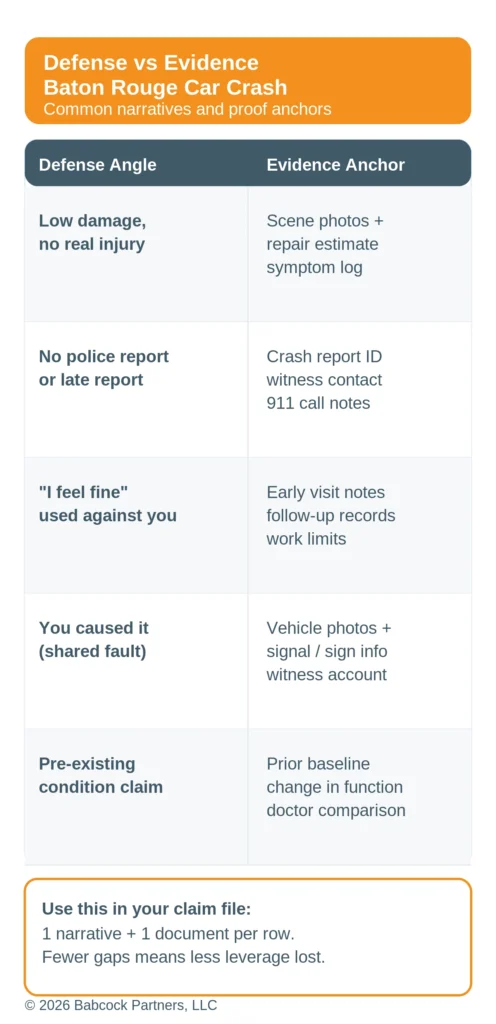
An insurer may argue that the impact was too small to cause injury, that delayed treatment breaks causation, that a condition was preexisting, or that the injured driver shares fault. None of those issues should be answered with a slogan. Compare the position with the complete vehicle evidence, medical history, clinical findings, witness accounts, roadway evidence, and communications created close to the crash.
Our guide to proving fault when drivers disagree explains how physical evidence, witnesses, electronic records, and traffic rules fit together. The article on what to do after a Ruston car accident applies the same evidence principles in another Louisiana setting.
Louisiana fault and filing rules depend on the crash date
Louisiana Civil Code article 2323 governs comparative fault. The current 51 percent bar took effect January 1, 2026. A crash before that date may be governed by the earlier version, so the event date must be checked before describing the effect of shared fault.
Louisiana Civil Code article 3493.1 provides a two-year prescriptive period for delictual actions and took effect July 1, 2024. An earlier crash can involve the former one-year rule. Claims involving death, public entities, minors, workers’ compensation, federal defendants, or other special circumstances can have different requirements. An insurance claim or continuing treatment does not necessarily stop prescription.
Where Baton Rouge drivers can learn more
The firm’s published Baton Rouge car accident service page discusses evidence preservation, insurer contact, fault, medical proof, wage loss, and available coverage. A case-specific review should begin with the crash date, exact location, responding agency, complete scene and vehicle evidence, insurance policies, and medical timeline.
This article provides general legal and safety information, not medical advice or a prediction about a particular claim. Current health concerns should be addressed by an appropriate medical professional.