

A rear-end collision claim is ready to settle only when the important facts are clear enough to value it. That usually means understanding who caused the crash, what injuries the collision caused, how those injuries affected daily life and work, what treatment may still be needed, and which insurance policies apply. A fast offer can be useful in a minor property-damage claim. In an injury claim, speed can also hide expenses or consequences that have not yet come into focus.
There is no dependable average settlement for a Louisiana rear-end collision. Two crashes that look similar in photographs can produce very different medical findings, wage losses, coverage questions, and litigation risks. The better question is whether the evidence supports each part of the claim and whether the proposed release accounts for the losses that are reasonably known.
Rear impact does not end the fault inquiry
Louisiana law requires a driver to leave a reasonable and prudent following distance in light of speed, traffic, and highway conditions. That rule often makes the following driver’s conduct central to a rear-end case. It does not make every rear driver automatically responsible for every loss.
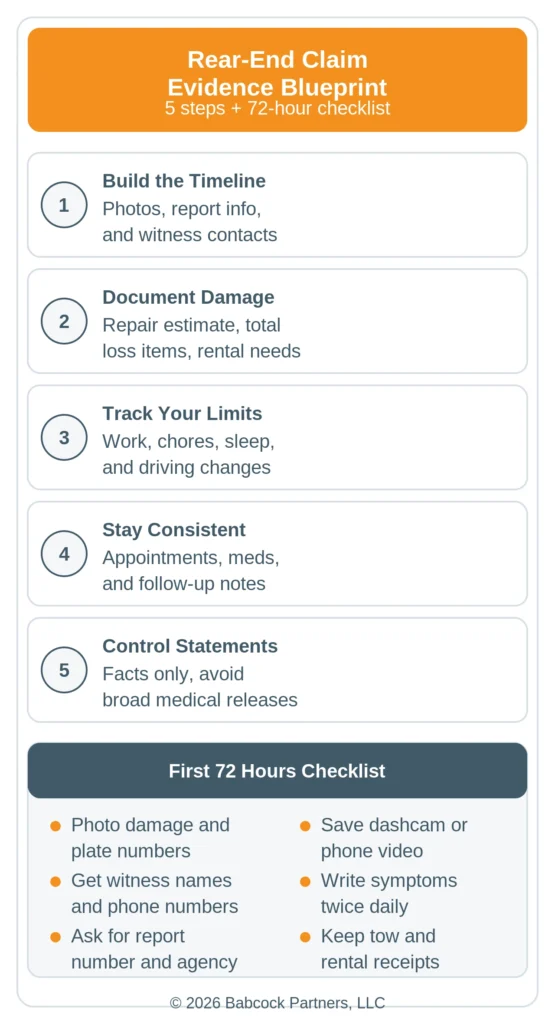
Useful liability evidence can include photographs of the vehicles and roadway, witness information, traffic-camera or dash-camera video, repair estimates, electronic vehicle data when available, and the police report. In a chain-reaction crash, the sequence of impacts matters. So can a lane change, a disabled vehicle, missing brake lights, or the conduct of another driver. A citation or police report can be important evidence, but the insurer or court still evaluates the complete record.
Louisiana’s current comparative-fault rule can also affect recovery. For causes of action arising on or after January 1, 2026, a claimant found 51 percent or more at fault cannot recover damages. A claimant found less than 51 percent at fault may recover, but the award is reduced by that percentage. Earlier crashes may be governed by the prior version of the law, so the collision date matters.
Medical evidence connects the collision to the claimed injury
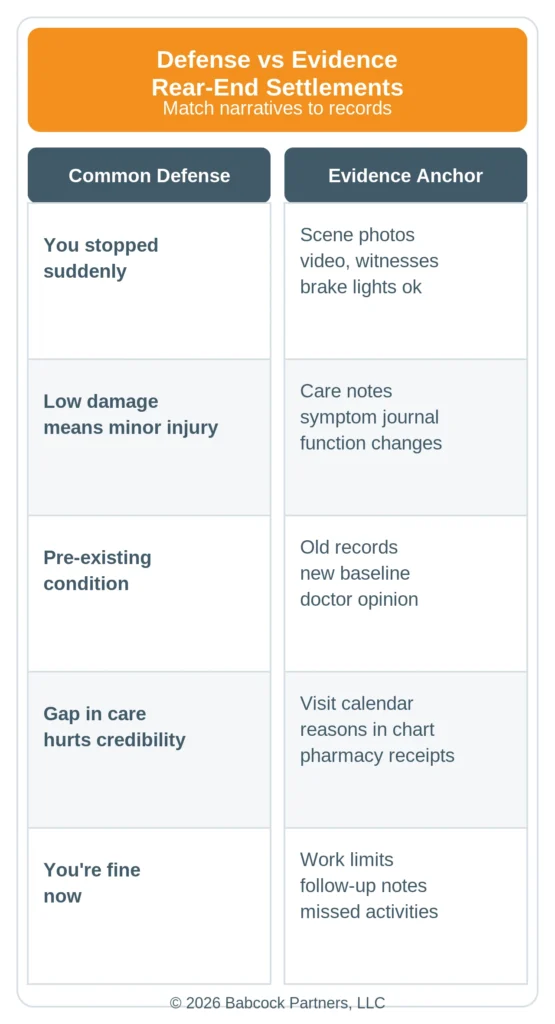
Rear-end impacts can produce neck and back complaints, but the collision direction alone does not establish a diagnosis. Medical records are most useful when they show the symptoms reported, the clinician’s findings, the diagnosis, the recommended care, work or activity restrictions, and the patient’s response over time. Prior injuries or degenerative findings do not automatically defeat a claim. They do make it important to distinguish the person’s condition before and after the collision.
Some symptoms are not obvious at the scene. MedlinePlus notes that whiplash pain can appear after an accident rather than immediately. A person who develops pain, dizziness, headache, weakness, numbness, confusion, repeated vomiting, or other concerning symptoms should seek medical guidance based on health needs, not on a claim strategy. The CDC advises prompt evaluation when a concussion or mild traumatic brain injury is suspected and identifies worsening headache, repeated vomiting, slurred speech, weakness, seizures, increasing confusion, unequal pupils, and inability to wake as danger signs. Call 911 or seek emergency care immediately for these danger signs.
Gaps in treatment are not all alike. A record may show that symptoms resolved, that a clinician recommended home care, or that transportation, work, cost, or another health problem interrupted care. Honest documentation is more useful than trying to follow a manufactured schedule. This is also why an insurer should not value an injury solely from bumper damage. Photographs describe the vehicles. Medical evidence addresses the person.
For more on preserving records without turning recovery into a paperwork exercise, see these car-accident documentation tips and the discussion of symptoms that may appear after a crash.
What usually drives settlement value
A fair evaluation separates the claim into supported losses rather than multiplying medical bills by a standard number. The important categories may include:
- Medical expenses: reasonable past charges and, when supported, the cost of probable future care.
- Lost income: missed time, reduced hours, or diminished earning ability documented through employment, tax, medical, and vocational records as appropriate.
- Physical and personal effects: pain, limitations, loss of enjoyment, and changes in household or family activities shown through specific facts.
- Property loss: repair cost, total-loss value, towing, storage, rental, and other recoverable vehicle-related expenses.
- Fault and proof risks: conflicting accounts, unavailable witnesses, preexisting symptoms, disputed treatment, or another cause of the claimed loss.
- Available coverage: the at-fault driver’s liability insurance, applicable uninsured or underinsured motorist coverage, medical-payments coverage, and any additional responsible person or business.
Policy limits can cap what one insurer will pay even when the documented loss is greater. Coverage analysis should therefore happen early. It may require reviewing the declarations page and policy language, identifying the owner and driver of each vehicle, and determining whether a driver was working or using a commercial vehicle. Coverage is contract-specific, so the presence of a policy does not guarantee that a particular provision applies.
Why a settlement amount is not the same as the client’s net recovery
A gross settlement may need to pay medical-provider balances, health-insurer reimbursement claims, Medicare or Medicaid interests, litigation expenses, and attorney fees. The existence and amount of those deductions should be investigated before a client evaluates the net result. Some balances or reimbursement claims may be disputed or negotiable. Others may carry legal consequences if ignored.
This accounting is especially important when several people are injured or when available liability limits are low. Accepting the full policy limit is not always the end of the analysis. There may be other coverage, but there may also be contractual notice, consent, or subrogation issues that need attention before funds are accepted.
When the claim may be ready for a demand
A demand is more useful after the claimant and lawyer can explain the collision, diagnosis, treatment, current condition, work loss, out-of-pocket costs, and applicable coverage. In a short-lived injury, that point may arrive relatively soon. In a case involving surgery, unresolved symptoms, permanent restrictions, or uncertain future care, a responsible evaluation may take longer.
Waiting for medical clarity does not stop legal deadlines. Louisiana Civil Code article 3493.1 generally provides a two-year period for delictual actions arising on or after July 1, 2024. Older accidents and claims involving government bodies, minors, deaths, or other special circumstances may present different rules or notice requirements. A person should not use the general period as a personal filing calculation without checking the facts and the law that applied on the accident date.
Once a demand is submitted, an insurer may request records, seek clarification, accept the demand, deny it, or make a counteroffer. Negotiation should focus on the actual disputes. A broad demand followed by an equally broad low offer tells the parties very little. A useful response identifies which medical charge, period of disability, coverage issue, or factual allegation is contested and what evidence addresses it. These insurance negotiation considerations explain why complete information and careful communication matter.
Read the release before accepting payment
A settlement normally requires a release. Its language determines which people and entities are protected and which claims are being surrendered. Before signing, confirm that the document matches the agreement, that property-damage and injury claims are handled as intended, and that liens or reimbursement claims have been addressed. A release may end the right to seek additional payment even if symptoms worsen or another bill arrives later.
Do not assume that depositing a check is merely an administrative step. The check, accompanying letter, and release may contain settlement terms. If the scope is unclear, get advice before signing or negotiating the payment.
A careful review is more useful than an online estimate
A rear-end collision settlement should reflect the evidence, the governing law, the available coverage, and the terms that will end the claim. Stephen Babcock’s Baton Rouge rear-end accident practice evaluates those issues together rather than promising a formula based on photographs or medical bills. To discuss a Louisiana collision, call (225) 500-5000 or request a case review.
Primary sources
- Louisiana Revised Statutes 32:81, following too closely
- Louisiana Civil Code article 2323, comparative fault
- Louisiana Civil Code article 3493.1, delictual actions
- National Highway Traffic Safety Administration, Event Data Recorders
- MedlinePlus, Whiplash
- Centers for Disease Control and Prevention, Symptoms of Mild TBI and Concussion