Editorial & Legal Accuracy Notice (Louisiana)
This blog contains general legal and safety information and is not legal advice. Laws and deadlines can change, and outcomes depend on specific facts.
Last reviewed / updated: March 11, 2026
Reviewed, updated, and authored by: Stephen Babcock, Louisiana injury lawyer
This article explains the evidence that most often helps a Louisiana car accident case, how to preserve it, and where proof gaps usually appear before settlement talks or suit.
A Louisiana car accident case usually turns on records, timelines, and preserved physical proof. The strongest files do more than show a crash happened; they connect fault, injury, and money loss in one clean story. This guide narrows the issue to evidence, while our Baton Rouge car accident page covers the broader claim path. If that sounds more disciplined than a normal intake, The Babcock Benefit is that we pressure-test the file before the insurer does.
Firm links: Client Reviews | Contact | Locations
Download the printable toolkit (PDF)
If the wreck is recent, call (225) 500-5000 or use the free case review form before vehicles are repaired, camera footage rolls over, witnesses forget details, or an insurer locks you into an incomplete recorded statement.
What Evidence Helps a Louisiana Car Accident Case?
The best evidence combines scene proof, neutral third-party records, and a clean damage timeline. In a Louisiana car accident case, the file gets stronger when photos, crash reports, witness accounts, medical records, billing records, and vehicle data point in the same direction.
| Evidence Type | What It Usually Helps Show | Common Source |
|---|---|---|
| Scene photos and video | Point of impact, lane position, roadway signs, debris, and vehicle rest positions | Phones, dash cameras, nearby businesses, and home cameras |
| Crash report and officer observations | Time, place, parties, weather, visible damage, and the first official narrative | Louisiana State Police or the responding local agency |
| Witness and 911 materials | Independent observations and early descriptions before stories harden | Witness contacts, dispatch references, and audio requests |
| Vehicle and digital data | Pre-crash movement, driver inputs, severity clues, and phone-use patterns | Event data recorder downloads, phone records, and app timestamps |
| Medical and billing records | Causation, symptoms, treatment path, and the cost side of the claim | Providers, billing offices, health plans, and pharmacy records |
| Loss records | Missed work, out-of-pocket spending, rental costs, and repair totals | Employer letters, pay stubs, receipts, tow bills, and estimates |
One record rarely carries the whole case. A repair estimate shows impact costs, but scene photos, witness names, and a timed treatment record explain why that impact matters. According to HHS guidance on medical records, you generally have the right to inspect, review, and receive copies of your medical and billing records. CMS explains how to read an explanation of benefits and notes that it identifies service dates and claim details that can help line up treatment and billing.
That organized record is what lets a lawyer compare force, symptoms, treatment, and losses without guessing. It also helps separate the injury claim from the vehicle-damage side of the dispute. When the carrier starts minimizing repairs or total-loss value, the records on our property damage page often become part of the same conversation.
Which Evidence Should You Try To Preserve First?
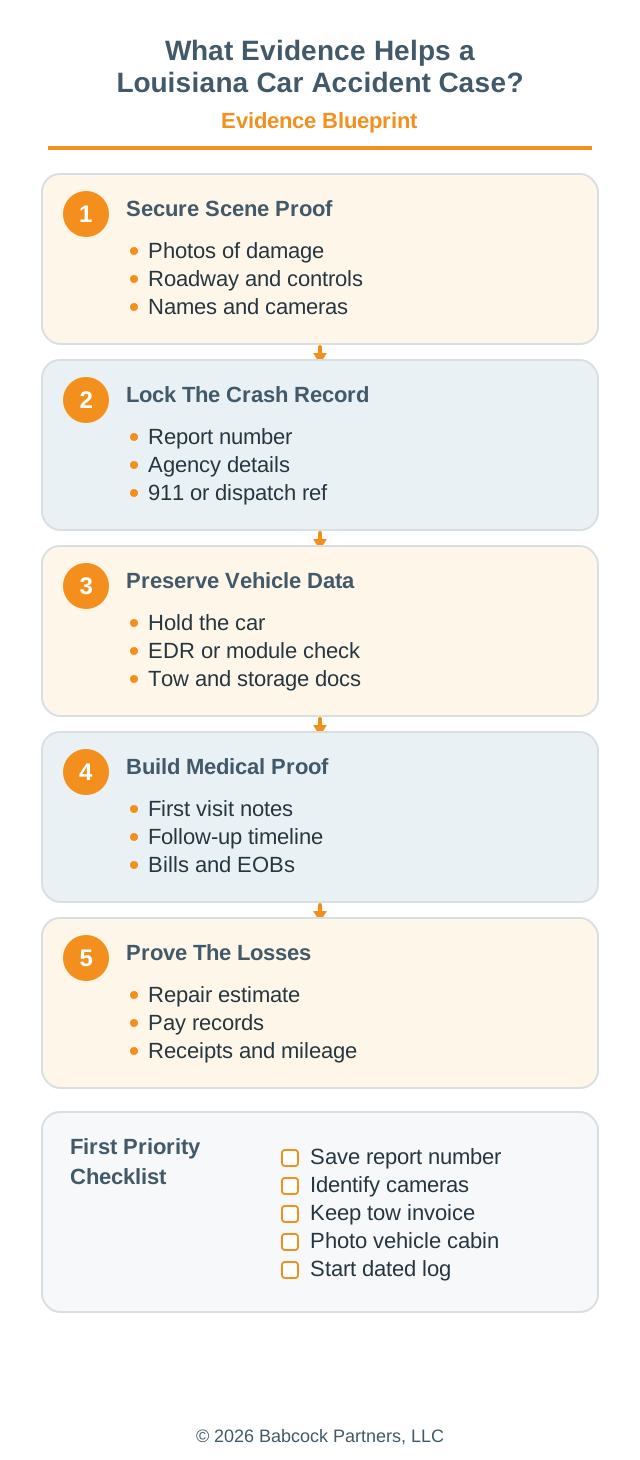
Start with the evidence most likely to disappear: scene photos, video, witness identities, vehicle condition, and digital data. Once cars are repaired, footage is overwritten, or witnesses go silent, later reconstruction gets harder and more expensive.
- Photograph both vehicles, the roadway, debris, traffic controls, skid marks, and any visible injuries.
- Save witness names, phone numbers, and any 911 or incident reference number you receive.
- Identify nearby cameras at stores, homes, apartments, or public intersections before the video loops over.
- Preserve the vehicle before repair or total loss if angle, braking, or severity is disputed.
- Keep tow tickets, storage invoices, rental paperwork, and the first repair estimate together.
Louisiana’s statewide crash-report portal is the starting point when State Police handled the investigation. The Traffic Records Unit says crash reports are processed centrally and advises the public to allow fifteen working days before requesting reports or photos. When troopers also took scene photographs, the Photo Lab instructions explain how those images can be purchased or requested.
Vehicle data can disappear too. NHTSA’s event data recorder overview says some vehicles capture a brief window of pre-crash vehicle dynamics and driver inputs, not minutes of continuous video, so a fast total-loss decision can erase a useful source. This is why we often push to document the car before repair, salvage, or teardown if the impact mechanics are disputed.
Phone records are not automatic in every case, but they can matter when the story suggests distraction. That is especially true in collisions that look like distracted driving wrecks, sudden lane drift impacts, or unexplained rear impacts with no braking story. The key is to identify that issue early enough to preserve the trail before the defense frames the event as a simple mistake.
What Records Usually Carry The Most Weight?
Independent and time-stamped records usually carry the most weight because they were created outside the lawsuit. In practice, the most useful proof is often the combination of official reports, neutral video, consistent medical follow-up, and records that fix the damages amount.
- Scene photos and video taken before the vehicles move
- Crash reports and any supplemental photos or diagrams
- Witness names, statements, and 911 or CAD references
- Medical records, billing ledgers, and health-plan summaries
- Repair estimates, total-loss files, and tow or storage charges
- Wage-loss proof, employer letters, and out-of-pocket receipts
Police reports help anchor the basics: date, place, parties, road conditions, and officer observations. If a state trooper investigated the crash, Louisiana State Police says those reports are centrally processed and available through its online system or troop offices. That does not mean the report decides everything, but it often supplies the first shared frame for later proof.
Phone use is harder. NHTSA notes that pre-crash distraction often leaves little evidence for officers to observe, which is why phone records, app timestamps, and witness descriptions can matter when the facts suggest distraction. If the collision pattern points that direction, the proof issues often look different from a simple inattention claim.
Medical timing still matters, but delayed symptoms are real. Mayo Clinic’s whiplash guidance says neck pain and related symptoms after a car accident should be checked promptly. Mayo Clinic’s concussion overview explains that some concussion symptoms may not appear right away.
That means a normal first scan or a quiet emergency-room note does not always close the issue. It does mean your later providers should document symptoms clearly, tie them to daily function, and explain why follow-up became necessary. Example: if a person develops headaches, dizziness, or concentration problems two days after a crash that looks like many rear-end accidents, a clean timeline can matter as much as the first chart.
How Should You Organize The File Before You Talk To The Insurer?
Use one timeline and keep every document attached to a date. When the file is organized by event, treatment, billing, work loss, and vehicle loss, it becomes much easier to see what is missing before an adjuster uses the gap against you.
- Start with the crash date, time, location, and every known witness or agency contact.
- Separate liability proof from medical proof, then separate both from bills and wage-loss records.
- Save original photos, original file names, and screenshots that show date and time when possible.
- Keep each insurer letter, claim number, reservation, and recorded-statement request in one place.
- Update the timeline each time a new provider, estimate, or missed-work entry appears.
Good organization is not busywork. It lets you answer basic questions fast, and it keeps the case from drifting into contradictions about when symptoms started or when damage was first documented. It also lets you catch the missing pieces before you sign a broad release, give a recorded statement, or let a vehicle disappear.
If the wreck involved turn movements, light changes, or disputed right-of-way, the timing work can overlap with the proof issues described on our intersection collision page. That is especially true when the physical layout matters more than the first verbal account. The point is to make one file tell one story.
What We Often Need To Prove
Most disputes are not about whether a crash happened. They are about whether the defendant caused it, whether this wreck caused these injuries, and whether the losses are documented with enough precision to pay.
- The other driver, vehicle, insurer, and time-and-place details are locked down
- Your version fits the physical evidence better than the competing version
- The treatment timeline matches the symptoms and the mechanism of injury
- The bills, wage loss, and property loss are real and organized
- Any missing record has an explanation before the defense exploits it
This is where weak files separate. A person may have real pain, but if the photos are sparse, treatment is broken, and the car disappears before inspection, the defense has room to argue. The problem is usually not one catastrophic gap. It is several small gaps that start reinforcing each other.
We also often need to show why missing evidence is missing. Maybe the car was towed and totaled before anyone asked about a data download. Maybe a business camera looped over after a few days. Maybe witnesses gave names at the scene, but no one saved the numbers. This is why we build a simple timeline first, then test every record against it.
That is what we mean by leverage in a car accident case. The file should make the easy defense arguments harder to say with a straight face. When the timeline, the photos, the treatment record, and the bills all reinforce each other, the claim becomes much harder to discount.
How Do Insurers Try To Punch Holes In The File?
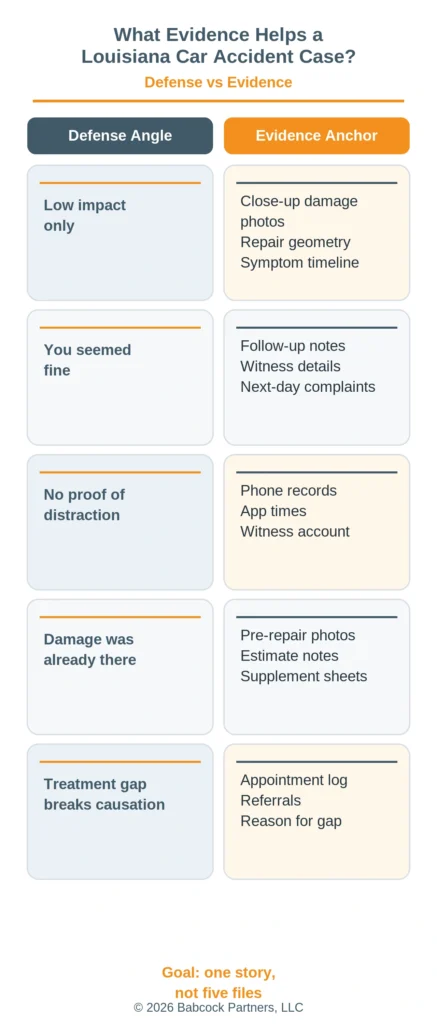
Most carriers attack the gaps, not the obvious parts. If they can separate impact from injury, injury from treatment, or treatment from billing, they have room to cut value or fight causation.
| Common Defense Theme | Evidence That Usually Answers It |
|---|---|
| Low impact means low injury | Scene photos, repair geometry, supplement sheets, event-data clues, and a consistent symptom timeline |
| You were fine at the scene | Early follow-up records, later symptom progression, and witness observations about how you looked after the crash |
| No proof of distraction | Phone records, app timestamps, witness descriptions, and camera footage that fills in what the report missed |
| Damage was old | Pre-repair photos, estimator notes, supplement comparisons, and close-up images taken before teardown |
| Treatment was too late or too inconsistent | Initial complaints, referral trail, appointment logs, and a clear explanation for any gap in care |

Common car accident defense themes and the records that usually answer them.
When the crash happened during a turn, merge, or signal change, camera angle, debris field, and lane position can matter more than the first hot take at the scene. If the fact pattern involves turn movements, signal disputes, or failure to yield, the proof issues often overlap with the timing problems discussed on our intersection collision page. The same is true when the insurer tries to treat every low-speed impact as medically simple.
The point is not to argue with physics in the abstract. It is to match the physical record, the treatment record, and the billing record so the claim reads like one file instead of five separate stories. If you need the broader liability and damages map after a wreck, our auto injury practice page lays out where these proof issues fit.
Download the printable toolkit (PDF)
Louisiana Law Snapshot (Updated 2026)
For most Louisiana car accident claims, Civil Code article 3493.1 gives delictual actions a two-year prescription that generally runs from the day injury or damage is sustained. Fault allocation matters too because Civil Code article 2323, as amended effective January 1, 2026, bars recovery if the injured person’s fault is 51% or greater and reduces damages when fault is lower.
- Evidence work should start early because the deadline and the proof problems move on separate clocks.
- Shared fault does not automatically end a claim, but it can reduce recovery and reshape settlement value.
- Records that clarify speed, lane position, distraction, and treatment timing matter more when fault is disputed.
In practical terms, those rules work together. A late-start file can make fault harder to prove, and a weak liability record leaves less room to absorb comparative-fault arguments. Early organization is not about drama. It is about keeping options open.
Get Help Before The Record Hardens
Our job is not to create drama around a car wreck. It is to find the records that survive scrutiny and build the claim around them before the defense writes the first draft of the story.
If you want help sorting the useful proof from the noise, call (225) 500-5000 or use the free case review form. The timing matters because vehicles get repaired, camera footage rolls over, and recorded statements can freeze avoidable mistakes into the claim file.
These items are helpful to have with you when you call, but do not delay calling because you do not have them. If you have them handy, keep them nearby for the call.
- The crash date, location, and the other driver’s basic insurance information
- Any report number, witness names, or photos already on your phone
- The first treatment records, discharge papers, or appointment dates
- Repair estimate, tow bill, storage invoice, or total-loss notice
- Recent pay stubs or employer information if you missed work
Call Today If…
- The vehicle may be repaired, salvaged, or released before it is documented
- An adjuster wants a recorded statement before your treatment picture is clear
- You think phone use, camera footage, or a missing witness may become a fault issue
- Your symptoms grew after the first visit and now the record feels incomplete
- The insurer is minimizing impact severity based only on selective photos or early notes
What Happens Next
- We triage the evidence first, which usually means timeline building, source identification, and gap spotting.
- We flag the deadlines and pressure points that can affect fault proof, treatment proof, and document retention.
- We map an insurer-contact strategy that protects the record instead of letting the carrier define it first.
If this article was helpful, please consider leaving Babcock Injury Lawyers a Google review.