

Sources checked: September 28, 2026
A rental car crash creates two separate files almost immediately. One concerns the collision, injuries, and fault. The other concerns the rental agreement, the vehicle, and any protection purchased at the counter. Keeping those files organized from the start makes it easier to answer the rental company, your insurer, and the other driver’s insurer without giving inconsistent information.
This guide addresses a Louisiana rental involving a private passenger vehicle. Commercial rentals, ride-share use, out-of-state policies, and unusual contract terms may require different analysis.
Start With the Crash, Not the Rental Contract
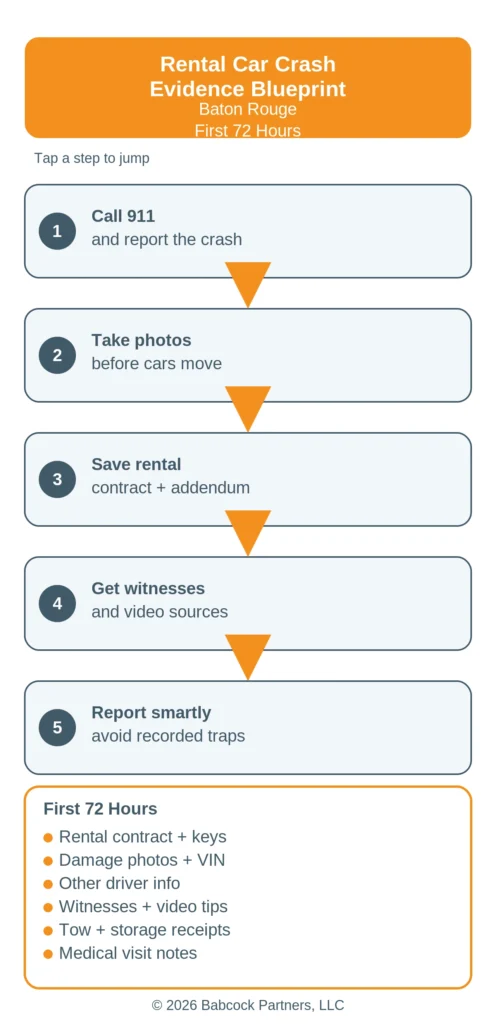
Check for injuries, move out of immediate danger if that can be done safely, and call for emergency help when needed. Louisiana R.S. 32:398 requires prompt notice to the appropriate police, sheriff, or state police agency when a crash causes injury, death, or more than $500 in property damage. The statute also requires drivers to provide identifying and vehicle information.
Photograph the resting positions of the vehicles before they are moved if it is safe to do so. Record lane markings, traffic signals, debris, skid marks, weather, and anything that blocked a driver’s view. Get the other driver’s name, contact information, plate number, insurer, and policy information. Ask witnesses for contact information rather than relying on the police report to identify everyone.
Do not argue about fault at the scene. Describe what happened without guessing about speed, distance, or what another driver saw. If symptoms require care, the guide on when to seek medical attention after a Baton Rouge crash explains why emergency warning signs and delayed symptoms should be treated as medical questions first.
Preserve the Rental File Before Making Calls
Save the full rental agreement, receipt, authorized-driver page, protection selections, and any email or app confirmation. Keep the pickup photographs or video and the condition report. If the vehicle was returned by tow truck, record where it went and who took possession of the keys.
The contract may require notice through a particular number or online form. Follow that process once the scene is stable, but keep a copy of everything submitted. Write down the representative’s name, the date and time, the incident number, and any instruction about towing or return. Do not sign a new damage acknowledgment or payment authorization without reading it carefully.
Identify Each Possible Source of Coverage
Coverage should be confirmed from the actual policies and contract. It should not be assumed from the name of a product or from what someone remembers being told at the rental counter.
Louisiana R.S. 22:1296 generally extends an insured’s liability, physical-damage, and collision coverage to a rental motor vehicle when those coverages are in force. The statute makes that insurance primary, but coverage purchased for the rental becomes primary. It also addresses the more limited security a rental company must maintain when no other valid and collectible protection satisfies Louisiana’s minimum financial-responsibility rules.
That statutory structure does not answer every coverage question. A claim may involve several of the following:
- the at-fault driver’s liability policy;
- the renter’s liability, collision, medical payments, or uninsured motorist coverage;
- protection purchased with the rental;
- a collision damage waiver in the rental agreement;
- a credit-card benefit; and
- coverage available to another authorized driver.
Ask each potential source for the policy or benefit terms, claim number, deductible, exclusions, notice requirements, and written coverage position. A credit-card benefit may require payment with that card and may exclude certain vehicles, drivers, locations, or rental periods.
A Collision Damage Waiver Is a Contract Term
A collision damage waiver is not simply another name for automobile insurance. Louisiana R.S. 22:1525 requires the waiver terms and exclusions to be displayed in the rental agreement and requires a prominent notice explaining that the waiver is optional. The statute permits exclusions for conduct such as intoxicated driving, unauthorized drivers, prohibited uses, travel outside a contractual geographic limit, and intentional damage.
Read the actual agreement before assuming that the waiver eliminates every charge. The contract may address towing, storage, administrative charges, loss of use, diminished value, or a deductible separately. If the rental company sends a demand, ask for the agreement, vehicle-condition records, repair estimate, repair invoice, photographs, dates the vehicle was unavailable, and a calculation of each amount claimed.
Keep Property Damage and Injury Proof Separate
The rental company’s damage claim concerns the vehicle and the contract. An injury claim concerns medical causation, fault, and damages. They may arise from the same collision, but one payment or release can affect more than one issue if its language is broad.
For the vehicle file, keep pickup and post-crash photographs, the rental agreement, tow and storage receipts, repair documents, correspondence, and proof of any payment. For the injury file, keep medical records, bills, pharmacy receipts, work restrictions, wage information, and a factual symptom history. The broader guide to documenting crash evidence explains how photographs, witness information, electronic records, and a simple custody log can support either file.
Do not discard a damaged child seat, dash-camera recording, phone photograph, or travel receipt that helps establish who was in the vehicle and when. Preserve original files with their metadata when possible rather than keeping only screenshots or social-media copies.
Expect Questions About Drivers, Notice, and Prior Damage
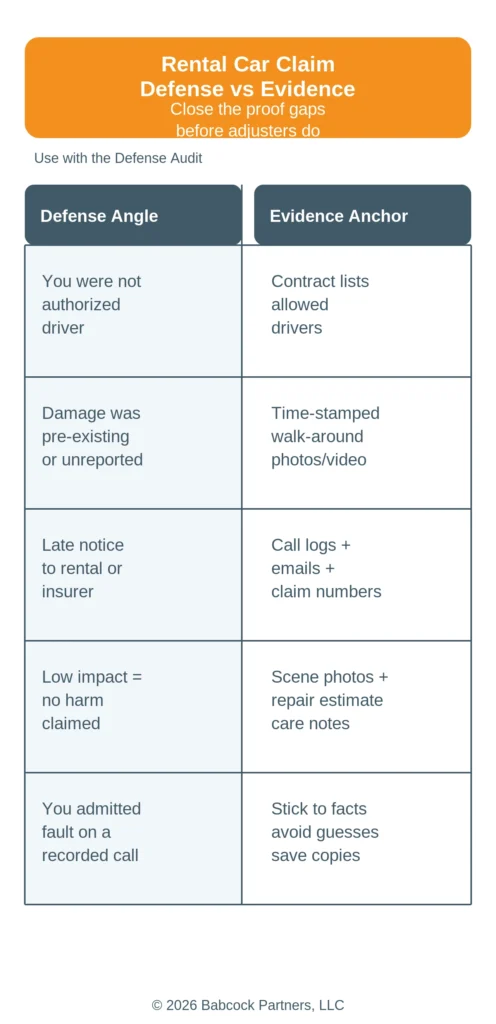
Rental claims often turn on details that matter less in an ordinary owner-operated vehicle claim. The rental company may ask whether the driver was listed on the agreement, whether a prohibited use occurred, when notice was given, and whether the damage existed at pickup. An insurer may separately question fault, the seriousness of the impact, the timing of treatment, or whether a claimed loss is supported.
Answer with records instead of slogans. The authorized-driver page answers one question. Time-stamped pickup images answer another. Call logs and claim confirmations show when notice was given. Scene photographs, repair evidence, medical records, and witness accounts help address the collision itself.
Recorded statements deserve care. A person can cooperate truthfully without guessing or accepting a question’s assumption. Ask which company is requesting the statement, which claim it concerns, whether the call is recorded, and what policy or contractual duty requires it. Do not allow the need to report the crash to become pressure to sign a final release before the losses are understood.
Louisiana Fault and Filing Rules Still Apply
The presence of a rental vehicle does not replace Louisiana’s ordinary fault analysis. Under Civil Code article 2323, fault is allocated among everyone who caused or contributed to the loss. For claims governed by the version effective January 1, 2026, a person assessed with 51 percent or more negligence cannot recover damages, while a person assessed with less than 51 percent negligence has recoverable damages reduced by that percentage. Incident date and the governing version of the law matter.
For delictual actions arising on or after July 1, 2024, Civil Code article 3493.1 generally provides a two-year prescriptive period beginning when injury or damage is sustained. Earlier incidents, claims against public entities, contractual claims, and other special circumstances may follow different rules or notice periods. Opening a claim or negotiating with an adjuster does not necessarily interrupt prescription.
Use One Timeline for Every Claim File
Create a short chronology beginning with the reservation and pickup. Include the pre-rental inspection, who was authorized to drive, the route, the crash, emergency response, towing, rental-company notice, insurer notice, medical care, vehicle return, and every later demand. Attach the supporting record to each entry.
A consistent timeline is more useful than a long narrative written months later. It lets you see missing records, conflicting instructions, and deadlines while they can still be addressed. The published Baton Rouge car accident practice page explains how fault, insurance, medical proof, and filing issues fit together when the collision caused an injury.
Read Every Payment and Release Carefully
A property-damage payment may resolve only vehicle damage, or the accompanying document may attempt to release a broader set of claims. A rental company’s demand may include charges not shown on the repair invoice. An early injury offer may arrive before the diagnosis, course of treatment, or reimbursement obligations are clear.
Before signing, identify the parties being released, the claims covered, the payment amount, and whether the agreement affects injury, property, contractual, reimbursement, or indemnity issues. When fault is disputed, injuries are significant, the driver was not listed, several insurers disagree about priority, or the rental company seeks substantial additional charges, individual legal advice may be useful before a permanent decision is made.