

Defensive driving is not timid driving. It is the habit of leaving yourself enough time and space to respond when another driver makes a mistake. On Louisiana roads, that usually means controlling following distance, scanning well beyond the vehicle ahead, and refusing to let another driver’s speed or aggression dictate your own decisions.
The useful question is not whether every crash can be prevented. It is which risks you can reduce before a problem reaches your lane.
Build space before you need it
A following distance that feels generous on a dry city street may be inadequate in rain, heavy traffic, or highway speeds. Watch the vehicle ahead pass a fixed object and count the time before your vehicle reaches the same point. Add more room when visibility is poor, the pavement is wet, you are behind a large vehicle, or the driver behind you is following too closely.
That buffer does three jobs. It gives you time to see a brake light or obstacle, lets you slow gradually instead of panic braking, and gives a tailgating driver more time to react. If another vehicle cuts into the space, rebuild it rather than trying to reclaim it immediately.
NHTSA’s speeding guidance explains that higher speed reduces the time available to react and increases stopping distance and crash force. The practical response is simple: match your speed to traffic, weather, and sight distance, even when the posted limit would allow more.
Read the whole intersection
At an intersection, look beyond the traffic signal. Check the wheels of vehicles waiting to turn, the front of opposing traffic, pedestrians near the curb, and any vehicle approaching too quickly from a side street. A green light gives permission to proceed, but it does not guarantee that the path is clear.
Left-turn conflicts deserve special attention because the turning driver may misjudge an approaching vehicle’s speed or fail to see it behind another car. Ease off the accelerator when a vehicle is waiting to turn across your lane. Covering the brake for a few seconds can create the margin needed to avoid a severe impact.
Driveways and parking-lot exits create the same problem on a smaller scale. A driver looking for a gap may focus on traffic from only one direction. Watch for wheel movement and keep an escape path when possible.
Remove the risks you control
Put the phone where it cannot compete for your attention. Program navigation and choose audio before moving. NHTSA defines distracted driving broadly because eating, talking with passengers, changing entertainment settings, and looking at a phone can all divert attention from the road. The safest habit is to stop in a safe place before handling a task that cannot wait.
Fatigue can be just as dangerous because it dulls judgment before a driver realizes how impaired attention has become. NHTSA’s drowsy-driving guidance recommends adequate sleep and warns that coffee or energy drinks alone may not prevent brief lapses in alertness. If you miss signs, drift in the lane, or cannot remember the last few miles, pull over somewhere safe.
Wear the seat belt correctly on every trip. NHTSA’s seat-belt guidance describes buckling up as the most effective step an occupant can take to reduce injury risk in a crash. Defensive driving lowers risk; a seat belt remains protection for the collision you could not avoid.
Do not turn another driver’s aggression into a contest
If a speeding or tailgating driver wants to pass, create room and let the vehicle go. Do not brake-check, block a lane change, or maintain eye contact in a way that escalates the situation. Move toward a populated area or police station if a driver follows or threatens you, and call 911 when there is an immediate danger.
Keep your own lane changes predictable. Signal early, check mirrors and blind spots, then move only when the gap will remain safe. Sudden weaving may gain a few seconds but eliminates the reaction space defensive driving is meant to preserve.
If a crash still happens, document before details disappear
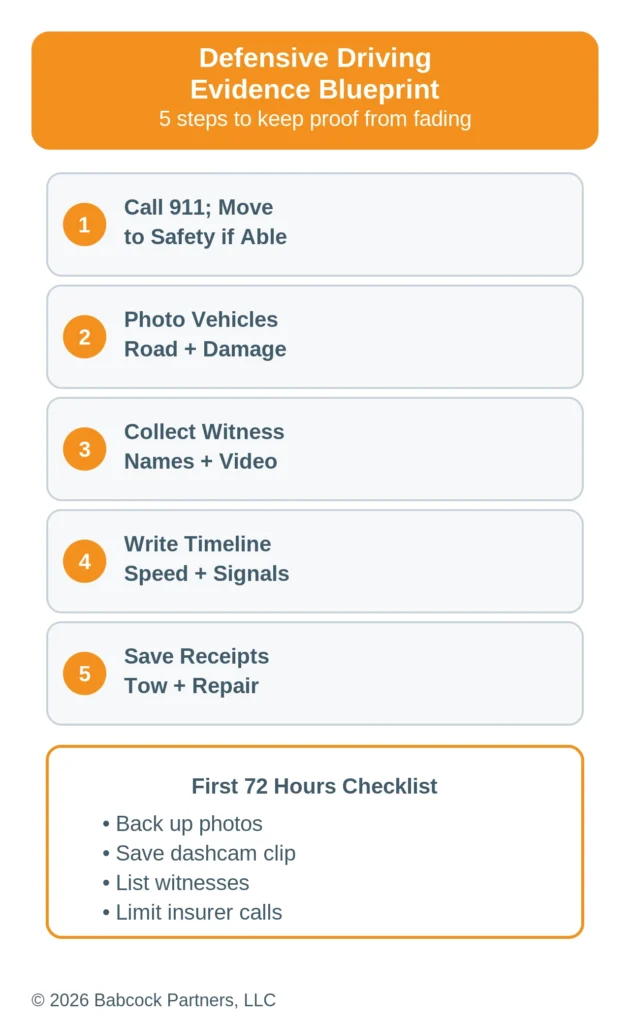
Defensive driving is not an admission that a careful driver can always avoid a collision. After a crash, get medical attention when needed and call law enforcement. Photograph vehicle positions, damage, debris, road markings, traffic controls, weather, and sight obstructions if it is safe. Obtain witness names and the report number. The Louisiana car accident checklist gives a practical sequence, and the guide to obtaining a Louisiana crash report explains how to follow up.
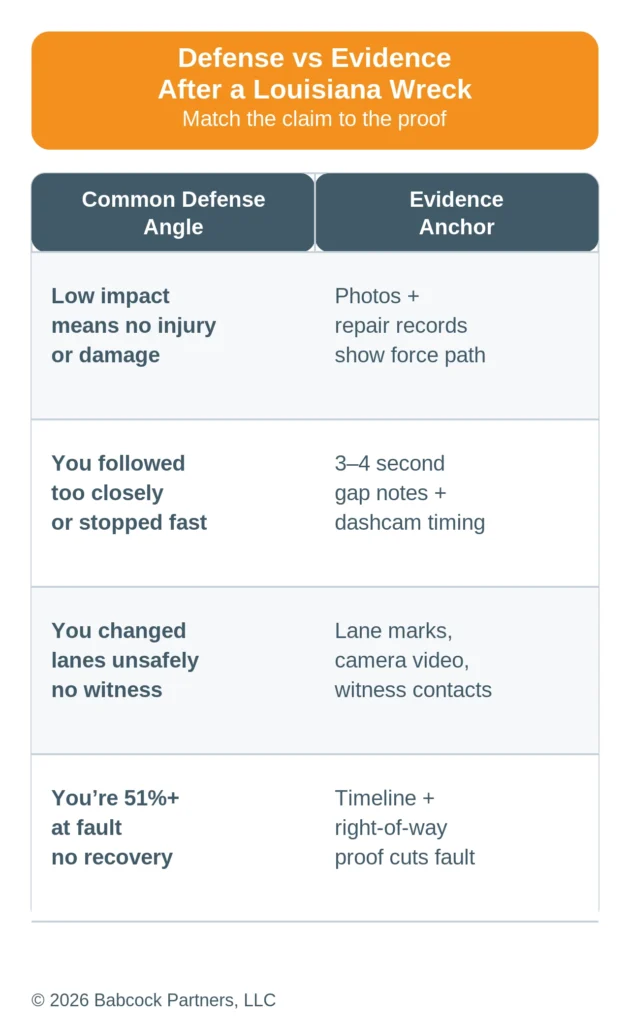
Louisiana’s comparative-fault rule can make both drivers’ conduct relevant. That does not mean an injured person should accept blame at the scene or speculate about what could have been done differently. Preserve the facts and let the complete evidence show whether there was a reasonable opportunity to avoid the collision.
A Louisiana car accident lawyer can evaluate fault, insurance coverage, medical proof, and deadlines when the crash causes a serious injury or the insurer disputes what happened.
Editorial and legal accuracy notice
Sources checked: September 26, 2026
This article provides general safety and Louisiana legal information, not legal advice. Driving conditions and claim issues depend on the facts.