

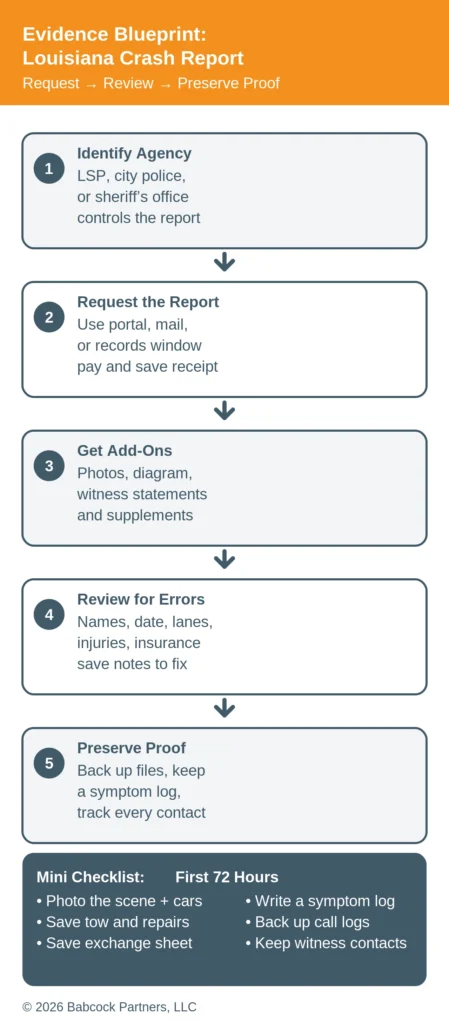
To obtain a Louisiana crash report, first identify the agency that investigated the collision. State Police, a city police department, and a parish sheriff may use different request systems. The driver exchange sheet or report number is usually the best place to start.
Choose the request path for the investigating agency
| Investigating agency | Where to start | What to confirm |
|---|---|---|
| Louisiana State Police | LSP Traffic Records Unit and its crash-report portal | Availability, purchase method, and whether the collision requires an in-person request. |
| City police | The department’s records office | Its online, mail, or in-person process and required identification. |
| Parish sheriff | The sheriff’s records division | Where its crash reports are released and whether supplements require a separate request. |
If you are unsure who responded, check the exchange sheet, citation, or other paperwork from the scene. A report missing from one portal may simply belong to another agency.
If State Police investigated
LSP’s Traffic Records Unit asks requesters to allow 15 working days after a crash before requesting reports or photographs. Its guidance specifies a 60-day wait before requesting photographs from a fatal crash. These are processing instructions, not a reason to delay preserving other evidence.
The LSP page links to online purchasing and explains purchases at a troop office. It states that fatal-crash reports must be purchased in person at a troop office. Confirm the current fee and accepted payment method before submitting a request or making a trip.
The LSP request form asks for the crash date, location, parish, troop, driver name, and report number. It also has a separate photograph-request section. For photograph questions, use the current Photo Lab instructions.
If a local department investigated
Follow that agency’s process. The City of Baton Rouge’s crash-report FAQ is a starting point for a Baton Rouge Police report; it does not set the process for every city or parish.
Ask which identifying information is needed, whether you must document your connection to the crash, and how payment is accepted. If requesting for someone else, confirm the authorization requirements. Keep the receipt or confirmation number.
Ask what the report includes
The first PDF may not include every photograph, supplement, recording, or statement associated with an investigation. Ask which additional records exist and how to request them. Some materials may be unavailable or subject to different access rules.
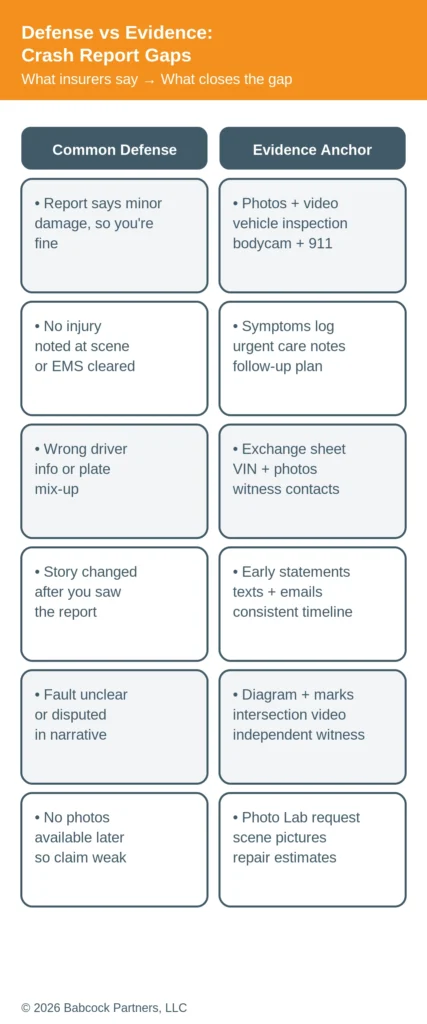
Do not assume a request for the basic report also preserves body-camera footage, 911 audio, or private surveillance. Those records may be held elsewhere. Identify their custodians and discuss any urgent preservation issue with counsel.
Read it for specific errors
Check names, driver and passenger roles, vehicle identifiers, insurance details, date, time, and location. Then compare the diagram and narrative with your photographs and what witnesses actually observed.
If something appears incorrect, keep the original report and make a separate note of the disputed entry. Contact the investigating agency about its correction or supplement process and provide the supporting information. Do not alter the report yourself. Keep any later version so the change can be explained.
An omitted symptom does not establish that an injury was absent, and an officer’s narrative does not resolve every civil-liability question. Medical records, witness accounts, photographs, and other evidence may be needed to assess the claim.
Keep the rest of the file moving
Back up original photographs and video, save witness contacts, and retain towing, repair, rental, and medical records. Note the source of each timeline entry. If records disagree, keep both rather than trying to make them match.
The car accident checklist covers these early tasks. If bills are arriving while the claim is pending, see who pays medical bills after an accident.
Waiting for a report does not itself extend a filing deadline. Civil Code article 3493.1 generally provides two years for delictual actions arising on or after July 1, 2024. Earlier collisions and special claims need separate analysis.
If an inaccurate or incomplete report is affecting an injury claim, our Baton Rouge car accident lawyers can review the report with the supporting evidence. Call (225) 500-5000 or use the contact form.