


Editorial & Legal Accuracy Notice (Louisiana)
This blog contains general legal and safety information and is not legal advice. Laws and deadlines can change, and outcomes depend on specific facts.
Last reviewed / updated: March, 2026
Reviewed, updated, and authored by: Stephen Babcock, Louisiana injury lawyer
This guide explains what to do after a car accident while pregnant in Louisiana, with a focus on medical safety basics, evidence preservation, and insurer-proof documentation.
A car accident while pregnant can leave you scared and unsure what matters first. Start with safety, then get checked, then document what happened while details are still fresh. If the crash was in Baton Rouge or nearby, our Baton Rouge car accident page can help you understand how we build a strong case file.
We treat the first days after a pregnancy crash like an evidence and documentation sprint. We are not built for volume. We are built for leverage. Speed + evidence preservation + insurer-insider knowledge + trial-ready preparation = The Babcock Benefit. In a car accident while pregnant, leverage means the records show how the crash changed your day-to-day life.
Below, we cover practical steps, what to write down, and how to avoid common insurance traps while you focus on health. You can keep the checklists handy by using the PDF toolkit links in this post. This is general information, so follow your clinician’s instructions for medical care and call 911 for emergencies.
If you are inside the first 72 hours, call (225) 500-5000 or use the free case review form before evidence changes.
Firm links: Client Reviews | Contact | Locations
Download the printable toolkit (PDF) to print the two infographics and keep a first-72-hours checklist with your claim documents. The download is for reference only and does not replace medical care.
What Should You Do After a Car Accident While Pregnant in Louisiana?
After a car accident while pregnant in Louisiana, start with safety and a medical check, then lock down the facts. Get the report number, write a timeline while you remember details, preserve photos and digital data, and keep insurance conversations short until you understand your follow-up care and documentation plan.
- Move to safety and call 911 if anyone may be hurt.
- Tell responders and medical staff that you are pregnant.
- Get the crash report number and exchange driver/insurance info.
- Take photos and save dashcam, texts, and towing/repair paperwork.
- Slow down recorded statements and releases until you have clarity.
Many car accidents while pregnant cases start with a rear-end collision at a light or in stop-and-go traffic, and the damage can look small. Still, your body can react differently during pregnancy, so treat the event seriously and document it. If you were hit from behind, our rear-end accidents page explains how timing and vehicle evidence can matter.
When Should You Get Medical Care After a Pregnancy Crash?
The AAFP’s overview of blunt trauma in pregnancy explains that care teams assess the pregnant patient and pregnancy status together, which is why a same-day check is often wise after a crash. In its pregnancy seat belt recommendations, NHTSA’s guidance for pregnant drivers and passengers also advises seeking immediate medical attention after a crash, even if you feel unhurt.
- Bring your gestational age, OB provider name, and medication list.
- Describe the crash forces: direction of impact, speed change, airbag, seat belt fit, and where you felt the hit.
- Ask what monitoring or follow-up is recommended for your stage of pregnancy.
- Request copies of visit notes and discharge instructions for your records.
- Start a simple symptom-and-function log the same day.
Seat Belt and Air Bag Basics for Pregnant Drivers
The NHTSA pregnancy seat belt document explains that the lap belt should sit low across the hips and below the belly, with the shoulder belt across the chest. The CDC’s guidance for pregnant travelers also emphasizes using the shoulder belt correctly instead of placing it behind the back.
- Place the lap belt under the belly, across the hips and upper thighs.
- Place the shoulder belt between the breasts and to the side of the belly.
- Sit upright and adjust the seat to keep a comfortable distance from the wheel.
What Symptoms and Warning Signs Matter Most After a Crash?
A Mayo Clinic overview of placental abruption lists symptoms like vaginal bleeding and abdominal pain that call for urgent evaluation. The Cleveland Clinic’s guide to bleeding during pregnancy notes that trauma can cause placental abruption, so new bleeding after a crash should never be brushed off.
- Vaginal bleeding
- New or worsening abdominal or pelvic pain
- Contractions, leaking fluid, or pressure that is not your normal
- Dizziness, fainting, or severe headache
- Decreased fetal movement compared to your usual pattern
The NIH’s MedlinePlus entry on placental abruption also summarizes warning signs and reinforces that bleeding and pain deserve prompt care. If you feel “off” but cannot name one symptom, write down what changed and share it with your clinician.
Early tests can look reassuring and you can still develop symptoms later, so keep your follow-up plan and keep notes. The AAFP trauma-in-pregnancy discussion describes monitoring and reassessment as part of care after blunt trauma.
Timeline Builder: A Pregnancy Crash Timeline That Holds Up Later
The fastest way to reduce confusion is to build one timeline that includes the crash, symptoms, and medical visits in order. A simple timeline also helps you avoid “off-by-one” errors later, like mixing up dates, places, and who told you what.
| Timestamp | Event | Symptoms / Function Changes | Who You Spoke With / Documents |
|---|---|---|---|
| Day of crash | Rear-end impact at light | Back tightness, anxiety, sleep disruption | Report number, photos, tow receipt |
| Same day | Medical visit | Notes of pain, any monitoring performed | Discharge instructions, visit notes |
| Next 7–14 days | Follow-up | Work limits, driving limits, symptom trends | OB notes, referrals, prescriptions |
This is why we build a timeline that ties symptoms to function, not just pain words. That is what we mean by leverage when an insurer tries to minimize a car accident while pregnant claim based on surface details.
What Evidence Should You Preserve in the First 72 Hours?
In a car accident while pregnant, the best evidence often comes from simple items that disappear fast: photos, texts, vehicle data, and early medical notes. This is why we push to preserve the digital trail and the vehicle condition before repairs, deletions, or normal life blur the timeline.
- Crash report number, agency, and the exact intersection or mile marker
- Photos of all vehicles, the roadway, debris, and visible marks or bruising
- Dashcam video, ride logs, call logs, and relevant texts
- Tow slips, storage yard info, repair estimates, and rental records
- Names of witnesses and any nearby businesses with cameras
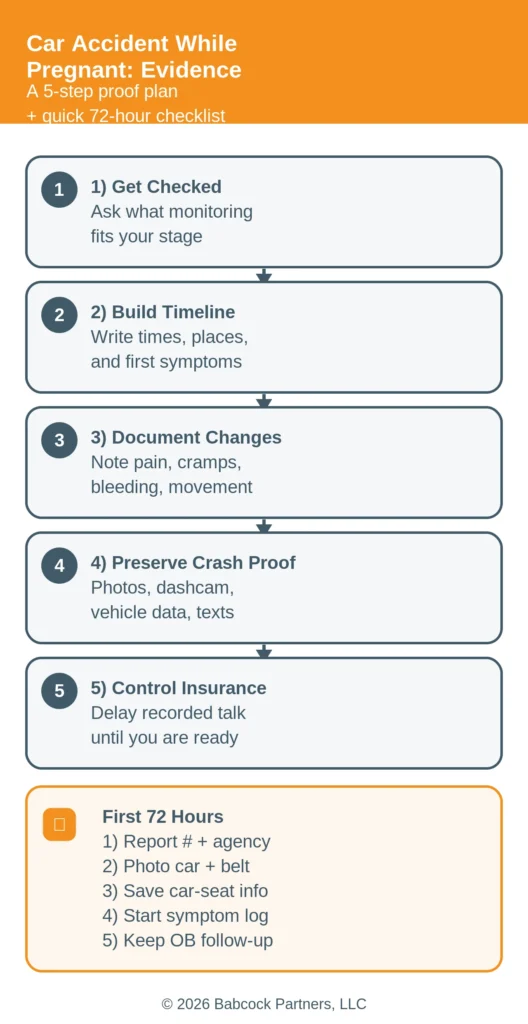
First 72 Hours: Quick Checklist
Use this checklist to preserve proof without adding stress, and keep everything in one folder. If you need a print copy, the PDF toolkit includes the same checklist and both infographics.
- Write the report number and where the report was made.
- Photograph the seat belt fit and the vehicle interior if relevant.
- Save your phone photos to a second location (email or cloud folder).
- Start a simple symptom-and-function log with dates and times.
- Keep OB follow-up appointments and save visit summaries.
Even when everyone focuses on health, you still need clean property documentation because repair timing affects what can be inspected later. Our property damage page explains what to save if an insurer argues about the car’s condition or value.
Defense Audit: How Insurers Try to Shrink a Pregnancy Crash Claim
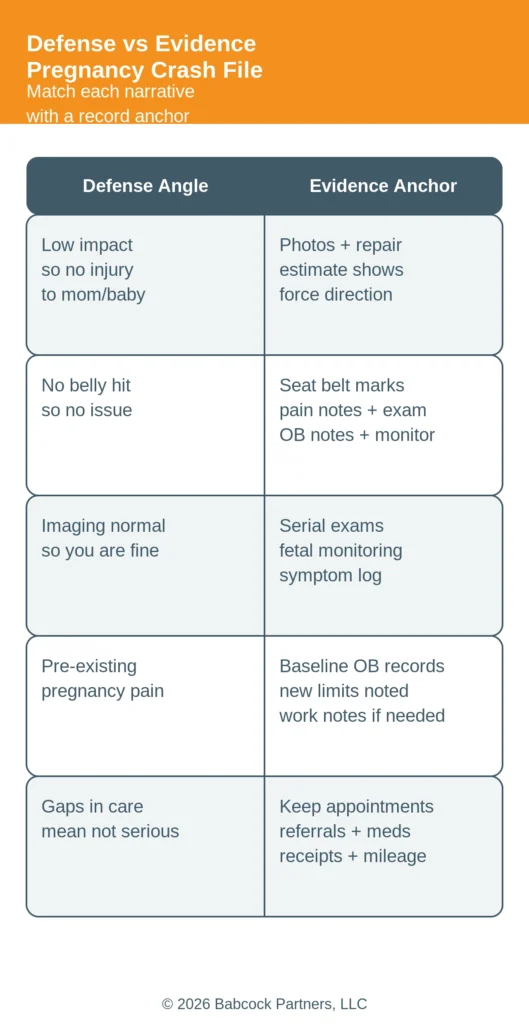
Insurance adjusters often look for a simple story that limits what they have to pay, especially when pregnancy symptoms can overlap with normal discomfort. That is what we mean by leverage: we build a file that answers predictable defenses with dates, records, and consistent follow-up.
| Common Defense Angle | Record Anchor That Helps |
|---|---|
| “Low impact, so no real harm” | Photos, repair estimate, and a timeline showing symptom onset and progression |
| “Normal tests, so you’re fine” | Follow-up visits, monitoring notes, and a symptom-and-function log |
| “You had pregnancy discomfort anyway” | Baseline OB records plus clear notes of new limits after the crash |
| “Gaps in care mean it wasn’t serious” | Appointment records, referral paperwork, pharmacy receipts, and transportation logs |
| “You’re better now, so it’s over” | Work notes, daily-activity notes, and consistent documentation of flare-ups |
If the other driver’s insurer calls quickly, keep it short and avoid guessing about medical issues or timelines you are not sure about. Before you sign anything or accept a quick settlement, learn how we approach documentation and liability on our car crash practice page.
What we see in practice
In pregnancy crash cases, we often see families focus on the baby and overlook how much the file depends on documenting the mother’s symptoms and daily limits. We also see insurers push for early recorded statements before care stabilizes, which is why a clean timeline and consistent documentation matter.
- We see property repairs happen fast, and important impact details disappear with them.
- We see symptom descriptions change over time, so early notes and follow-up notes both matter.
- We see “minor crash” labels used against people when photos do not show the full story.
- We see confusion about dates and providers, which a single timeline can fix.
- We see premature releases that close the claim before the medical picture is clear.
Frequently Asked Questions About a Car Accident While Pregnant
Most questions come down to timing, documentation, and avoiding statements you cannot safely support yet. Use these quick answers to reduce stress, then follow your clinician’s guidance for medical care.
- Should I Talk to the Insurer Before I See My Doctor?
- What If the Crash Felt Minor?
- How Should I Wear a Seat Belt While Pregnant?
Should I Talk to the Insurer Before I See My Doctor?
You can report the crash and exchange basic information, but you do not need to guess about injuries or pregnancy effects on a recorded call. Keep it factual, and tell the adjuster you will follow up after the medical evaluation and after you organize the documents.
- Provide names, vehicles, insurance, and the report number.
- Avoid giving a timeline you are not sure about.
- Do not sign releases until you understand what they cover.
What If the Crash Felt Minor?
A crash can still matter in pregnancy even when you can walk away, so do not treat “minor” as “no risk.” The AAFP trauma-in-pregnancy article explains that blunt trauma assessment often includes monitoring and reassessment, which is why a same-day call to your clinician is smart.
- Write down what happened and what you felt in the first hour, day, and week.
- Keep the follow-up plan your clinician recommends and save the paperwork.
- Preserve vehicle and digital evidence before it disappears.
How Should I Wear a Seat Belt While Pregnant?
The NHTSA pregnancy seat belt guide explains proper placement with the lap belt under the belly, across the hips, and the shoulder belt across the chest. The CDC’s guidance for pregnant travelers also emphasizes keeping the shoulder belt positioned correctly instead of behind the back.
- Keep the lap belt low, snug, and below the belly.
- Keep the shoulder belt between the breasts and to the side of the belly.
- Adjust the seat to drive comfortably and maintain control.
If you want a print-friendly version of the steps and both infographics, Download the printable toolkit (PDF). Keep it with your records so you do not have to remember details under stress.
Louisiana Law Snapshot (Updated 2026)
Louisiana’s two-year deadline for many injury claims is described in La. Civ. Code art. 3493.1, so waiting can risk losing the claim even when medical questions remain. Louisiana also uses comparative fault, and La. Civ. Code art. 2323 includes a post–Jan. 1, 2026 rule that bars recovery if you are 51% or more at fault.
| Rule | Plain-English Takeaway |
|---|---|
| Two-year delictual prescription | Most cases have a two-year deadline, so treat timing like an evidence problem and a legal problem. |
| Comparative fault (51% bar after Jan. 1, 2026) | Fault arguments can reduce or bar recovery, so clean documentation matters from day one. |
Louisiana’s general fault principle appears in La. Civ. Code art. 2315, but the practical outcome still turns on evidence. If you are unsure how the deadline applies to your facts, talk to a lawyer quickly so someone can spot issues while records are still available.
Next Steps: Free Case Review Checklist
If you were in a car accident while pregnant, the safest legal move is to preserve evidence and build clean records before the story hardens. We are not built for volume. We are built for leverage.
- Digital evidence can disappear (videos overwrite, phones auto-delete, repairs erase impact clues).
- Medical notes form early, and later corrections are harder than getting it right the first time.
- Insurers often push statements and releases before you have stable documentation.
That leverage-focused approach is the Babcock Benefit in plain English: move fast, preserve evidence, and prepare the case like it could be tried. Call (225) 500-5000 and use the free case review form if you want help triaging the next steps. If your crash was in Baton Rouge or nearby, you can also review our approach on our Baton Rouge auto accident team page.
These items are helpful to have with you when you call, but do not delay calling because you do not have them. If you have them handy, keep them nearby for the call.
- Crash report number (or the agency and date if it is not ready yet)
- Photos of vehicles, roadway, and any visible marks
- Basic timeline notes (where, when, direction of impact, airbag, seat belt fit)
- List of providers you have seen and any follow-up appointments
- Repair estimate, tow/storage information, and rental paperwork
Call Today If Any of These Are True
Do not wait for “perfect information” if key proof is about to vanish or an insurer is pushing for closure. A quick call can help you protect evidence while you keep focusing on medical care.
- Your vehicle is about to be repaired, totaled, or released from a tow/storage lot
- The insurer is asking for a recorded statement or a broad medical authorization
- You have any new or worsening symptoms and you need help organizing records
- There may be business or traffic-camera footage that could be overwritten
What Happens Next
We start by stabilizing the evidence and the timeline, then we map the proof gaps the insurer will likely target. After that, we help you avoid unforced errors in communications and paperwork.
- Evidence triage: preserve photos, video, vehicle status, and key documents.
- Deadline spotting: identify time-sensitive steps and records requests.
- Insurer contact strategy: control statements, releases, and documentation pacing.