If You Get into a Car Accident in Louisiana, Are You Automatically Entitled to Damages?


Editorial & Legal Accuracy Notice (Louisiana)

This blog contains general legal and safety information and is not legal advice. Laws and deadlines can change, and outcomes depend on specific facts.

Last reviewed / updated: March 2, 2026

Reviewed, updated, and authored by: Stephen Babcock, Louisiana injury lawyer

This guide explains common Louisiana car accident damage categories and the proof that supports them. Use it as a documentation checklist while you focus on safety and medical care.

Our approach is simple: build a clean record first, then argue value from facts. We are not built for volume. We are built for leverage. Speed + evidence preservation + insurer-insider knowledge + trial-ready preparation = The Babcock Benefit. In Louisiana car crash damage claims, leverage comes from proving every loss before the insurer can discount it.

After a wreck, insurers may accept fault but still dispute what your damages are worth. This page walks through the damage categories people often claim and the documents that make those categories hard to minimize. If you want help organizing a claim file, start with our Baton Rouge car accident practice page.

If you are inside the first 72 hours, call (225) 500-5000 or use the free case review form before evidence changes.

Firm links: Client Reviews | Contact | Locations

Want a print-friendly checklist you can save to your phone or share with a family member? Download the printable toolkit (PDF) and keep it with your crash notes.

What Damages Can You Recover in Louisiana After a Car Accident?

Most Louisiana car accident claims focus on compensating the losses the crash caused, not on punishing the driver. Because Louisiana Civil Code article 2315 requires a person who causes damage to repair it, the practical question becomes which losses you can document and connect to the collision.

  • Medical costs and related expenses: bills, prescriptions, therapy, and mileage that match your treatment timeline.
  • Lost income and work impacts: missed pay, reduced hours, and job restrictions you can support with records.
  • General damages: the daily-life harms that are not a math problem, which a Louisiana Supreme Court concurring opinion on general and special damages explains are not measured with mathematical certainty.
  • Vehicle and property damage: repair or replacement costs, and the same civil code article notes that damages can include sales taxes paid on repair or replacement of property.
  • Family relationship harms: the same civil code article explains that damages may include loss of consortium for certain family members.

If your vehicle is a total loss or repairs drag on, keeping a clean property file matters as much as medical records. A clean set of photos, estimates, and receipts makes it harder to discount what your car is worth.

If a crash is fatal, Louisiana recognizes both survival and wrongful death claims in Louisiana Civil Code article 2315.1 and Louisiana Civil Code article 2315.2. We keep that discussion brief here and point families to our Baton Rouge wrongful death page for a focused overview.

How Do Economic and Non-Economic Damages Work in Louisiana?

Economic damages are the losses you can usually prove with documents, while non-economic damages describe how the injury changed your life. When discussing proof, the Louisiana Supreme Court concurrence draws a useful line between special damages like medical expenses and lost wages and general damages that do not lend themselves to exact calculation.

Damage Type Plain-English Meaning Examples of Proof
Economic (often “special”) Out-of-pocket loss and financial harm you can add up. Itemized bills, pay stubs, employer letters, receipts, and mileage logs.
Non-Economic (often “general”) Human impact that shows up in your routine more than on a spreadsheet. Consistent medical notes, activity limits, symptom logs, and day-to-day examples.

Insurers usually start with the paperwork because it is easier to discount what is missing than to debate what is present. That is what we mean by leverage when we insist on tight records for wages, treatment, and daily limits.

Even when you feel better quickly, documentation still matters because the carrier may argue your damages were minor or unrelated. A short, consistent timeline can be more persuasive than a long story that shifts.

What Evidence Do You Need to Prove Car Accident Damages?

You do not need perfect paperwork on day one, but you do need a system so the file stays consistent as weeks pass. The fastest way to protect damages is to collect a small set of records that prove the crash happened, show what changed, and support what it cost.

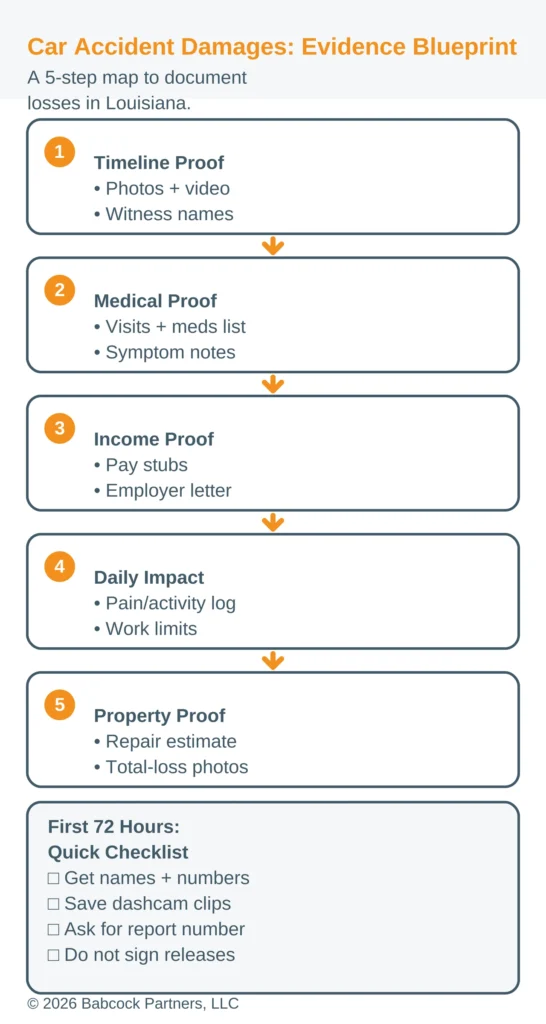
  • Crash proof: photos, video, witness names, and the report number.
  • Medical proof: visit notes, medication lists, referrals, and itemized bills.
  • Work proof: pay stubs, schedules, PTO records, and a supervisor or HR letter.
  • Daily impact proof: a simple log that tracks pain, sleep, and missed activities.
  • Property proof: repair estimates, tow invoices, rental receipts, and total-loss paperwork.
Quick reference: a 5-step damages proof blueprint + a first-72-hours checklist—Download the printable toolkit (PDF) for a clean handout.

This is why we push to preserve video and vehicle condition early, because many of the best facts disappear fast. Once the scene changes and the car is repaired or sold, the insurer gets an easier path to argue down value.

If you want a guided approach to building a claim file, we can help you set priorities and avoid proof gaps through our crash case page. The goal is not paperwork for its own sake, but documentation that holds up when the adjuster or defense lawyer tests every category.

Timeline Builder: A Simple Crash-to-Care Log

A timeline connects the crash to the first symptoms, the first visit, and the first work impact in a way that is easy to follow. It also lets you spot gaps that the defense may later claim break the chain.

Date / Time Event What To Save
Day of crash Scene photos, vehicle positions, witness info Phone media, notes app, witness numbers
Same day First symptoms you notice Short symptom list with time stamps
First 24–72 hours First medical contact and instructions Discharge papers, referral notes, prescriptions
Week 1 Work impact shows up Missed time, duty limits, employer emails
Weeks 2–4 Follow-up care and therapy patterns Visit notes, therapy plans, mileage log
Ongoing Daily impact and recovery trend Weekly summary of sleep, pain, activities

Medical Proof: Keep Care Consistent and Easy To Follow

Adjusters read your records as a story about cause and effect, so consistency matters. If you have a gap, write down the reason in plain language so the file stays honest and coherent.

  • Bring a symptom list to each visit and ask that it be noted in the chart.
  • Keep a single folder for bills, visit summaries, and referrals.
  • Save pharmacy receipts and out-of-pocket payments in the same place.

Income Proof: Show What You Missed and Why

Lost wages are easiest to defend when you can show the schedule, the pay rate, and the missed days in the same packet. If your job changes because of restrictions, document the change and ask for it in writing.

  • Pay stubs from before and after the crash.
  • A short employer letter confirming time missed and duty limits.
  • PTO records and any reduced-hour schedules.

Daily Impact: Document the Human Side Without Drama

General damages often rise or fall on whether your limitations are specific and consistent. A simple weekly log can show missed activities, sleep problems, and household limits without exaggeration.

  • Write down what you could not do, not just how you felt.
  • Use the same categories each week to show patterns.
  • Avoid “all or nothing” language and stick to examples.

Property Damage Evidence: Protect the Repair Story

Property damage disputes often start with missing photos, missing estimates, or unclear totals. If you are fighting valuations, our property damage claim guidance can help you understand what paperwork insurers usually request and how to keep it organized.

  • Take photos before the vehicle is moved or repaired, if safe.
  • Save tow and storage invoices, because those costs can grow quickly.
  • Keep every estimate version so changes are easy to explain.

How Do Insurers Try to Reduce Car Accident Damages?

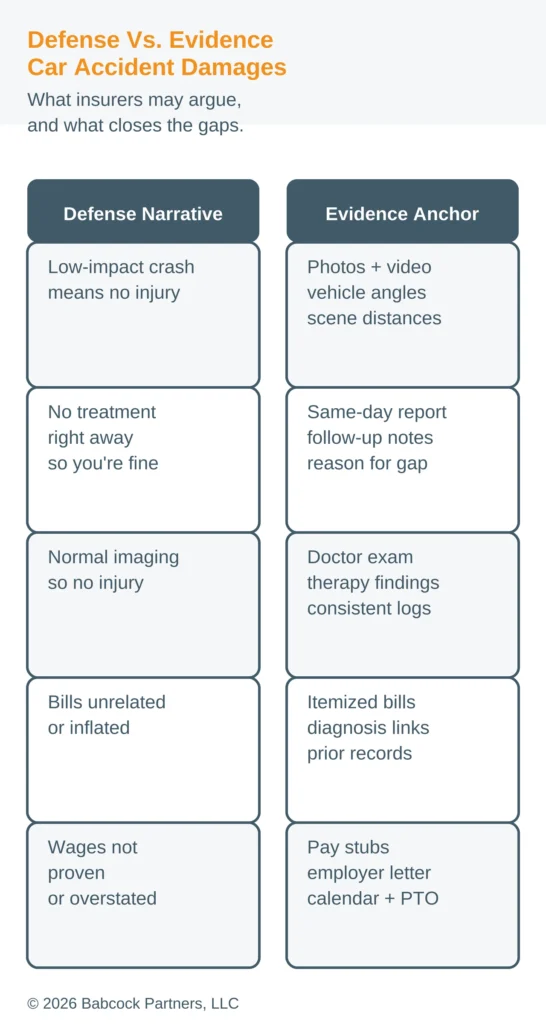
Insurance companies rarely deny every claim outright, but they often narrow the story to shrink the value. The easiest way to reduce damages is to argue fault, question treatment, or label expenses as unrelated, so your documentation needs to answer those angles early.

Common Defense Angle Evidence That Helps
“You were partly at fault.” Scene photos, video, witness statements, and a clear timeline.
“You waited too long to treat.” Same-day symptom notes, first-visit records, and an honest reason for any gap.
“Imaging was normal, so you are fine.” Physical exam findings, therapy notes, and consistent functional limits.
“These bills are not related.” Itemized records that match the injury story and referral path.
“Lost wages are not proven.” Pay stubs, employer confirmation, and work restriction paperwork.
Common defenses—and the documents that help answer them.

Defense Audit: Quick Self-Check Before You Talk to an Adjuster

Before you give a recorded statement, check whether your file supports each damage category you plan to claim. If something is missing, you can usually fix the gap by gathering records, not by arguing.

  1. Crash facts: Can you describe what happened using photos or the report number, not guesses?
  2. Medical story: Do your first symptoms line up with your first medical contact?
  3. Work story: Do you have a simple way to show missed time and restrictions?
  4. Daily impact: Can you give three specific examples of what changed?
  5. Property: Do your photos and estimates match the repair total you are claiming?

That is what we mean by leverage when we prepare for defense narratives before they show up in a denial letter. When your file answers the likely angles, the adjuster has fewer “soft spots” to press.

Fault arguments also reduce damages under Louisiana Civil Code article 2323, which is why insurers often search for a rule violation to pin on you. For rear-end crashes, the traffic rule about following distance in Louisiana Revised Statute 32:81 is one of the first places they look.

If you were hit from behind and you want a focused overview of proof and defenses, see our rear-end accident page. We keep this article centered on damages, not on recreating every crash type.

What we see in practice

Most damage disputes are not about whether the crash happened; they are about whether the records tell a tight, believable story. When the file is scattered, we see insurers use that confusion to discount treatment, wages, and daily impact.

  • Treatment gaps become “you must be fine” arguments unless you document the reason.
  • Missing wage proof turns a real work loss into a “soft” claim the carrier can ignore.
  • Property disputes grow when photos are taken late or estimates keep changing without explanation.
  • General damages shrink when limitations are vague instead of specific and consistent.

We also see people get pressured into broad medical authorizations that pull in years of unrelated records, which can distract from what actually changed after the crash. A narrower, organized set of records usually tells a cleaner story than a data dump.

We see claim files improve fast when someone builds a one-page timeline and keeps all documents in one place. This is why we focus on evidence preservation first, because the best time to document is before the insurer builds its theme.

When Should You Talk to a Lawyer About Car Accident Damages in Louisiana?

You should consider talking to a lawyer when the stakes are high or the proof is likely to disappear, even if the insurer sounds friendly. If you are not sure whether your damages are being undervalued, a quick review can help you spot missing records and risky statements before they are used against you.

  • There are serious injuries, surgery, or long-term work limits.
  • A commercial vehicle is involved, and the carrier is moving quickly to control the narrative.
  • You are being pushed to give a recorded statement or sign a broad authorization.
  • Your vehicle is a total loss, and the valuation paperwork does not make sense.
  • A family member died, and you need guidance beyond a standard injury claim.

If your crash happened in or near Baton Rouge, our local resources start at the Baton Rouge hub. If you are dealing with property-only disputes, start with our property damage page and then escalate if the insurer will not move.

If you want the print-friendly checklist, download the printable toolkit (PDF) and keep it with your bills and notes. It is designed to be easy to share and easy to update as your treatment and work situation changes.

Louisiana Law Snapshot (Updated 2026)

Most Louisiana car accident injury cases are subject to a two-year deadline, and Louisiana Civil Code article 3493.1 describes that delictual prescription period. Comparative fault can also reduce your recovery, and Louisiana Civil Code article 2323 explains how fault is allocated and includes a post–Jan. 1, 2026 bar when a claimant is found 51% or more at fault.

Rule Why It Matters for Damages
Two-year prescription Waiting too long can forfeit the claim no matter how strong the evidence is.
Comparative fault Your damages can be reduced by your percentage of fault, and 51% or more fault can bar recovery after Jan. 1, 2026.

Free Case Review: Next Steps

We are not built for volume. We are built for leverage. If you want help turning scattered records into a trial-ready damages file, call (225) 500-5000 and use the free case review form so we can start evidence triage and claim strategy early.

Even strong claims can lose value when photos disappear, treatment gaps grow, or an early statement locks in a weak story. The Babcock Benefit is about moving quickly, preserving evidence, and preparing the file as if it will be tested in litigation. You can also review our team’s car accident page if you want to see how we approach these cases.

These items are helpful to have with you when you call, but do not delay calling because you do not have them. If you have them handy, keep them nearby for the call.

  • Crash report number and photos/video
  • Medical visit summaries and bills so far
  • Work schedule, pay stubs, and missed time
  • Repair estimates and tow/rental receipts
  • A short symptom and activity log

Call Today If…

  • The insurer is pushing a quick settlement or a “final” release.
  • You have ongoing symptoms, missed work, or new restrictions.
  • Your vehicle is a total loss or the valuation seems off.
  • There is video evidence or a witness you cannot re-contact later.
  • You are unsure how to document general damages without overdoing it.

What Happens Next

  1. Evidence triage: We identify what can disappear first and prioritize preserving it.
  2. Deadline spotting: We flag time limits and documentation gaps that can reduce value.
  3. Insurer strategy: We plan communications so your file stays consistent and complete.
×